


Loading profile. Please wait . . .
Agalinis divaricata (Chapman) Pennell
Pineland Agalinis




Federal Protection: No US federal protection
State Protection: No Georgia state protection
Global Rank: G3?
State Rank: S1?
Element Locations Tracked in Biotics: Yes
SWAP 2015 Species of Greatest Conservation Need (SGCN): No
SWAP 2025 Species of Greatest Conservation Need (SGCN): Yes
2025 SGCN Priority Tier: High Conservation Concern
Element Occurrences (EOs) in Georgia: 5
Habitat Summary for element in Georgia: Dry, grassy, pine-scrub oak ridges
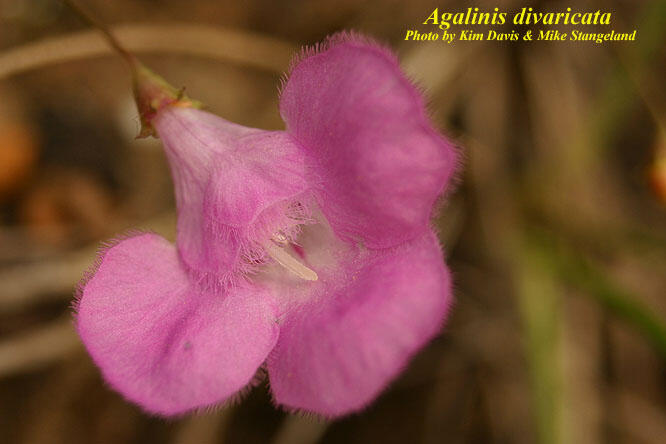
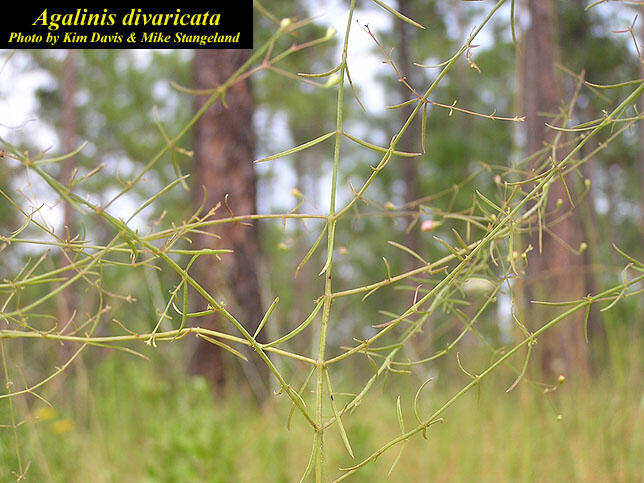
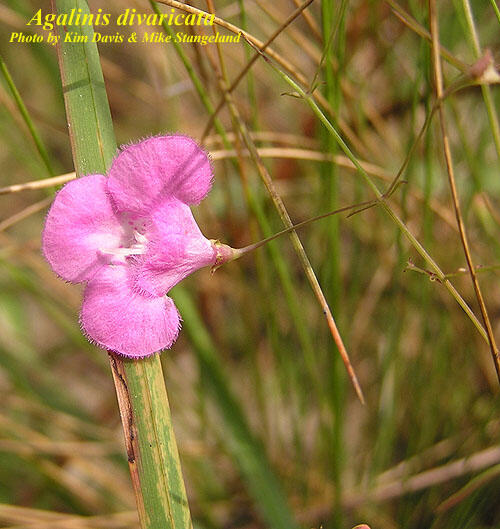
Annual herb 8 - 24 inches (20 - 60 cm) tall with many slender, spreading and upwardly curving branches; stem and branches are usually hairless, occasionally with very short, rough hairs. Leaves are 0.4 - 0.8 inch long, very narrow and needle-like (1 - 3 cm long and 0.2 - 0.6 mm wide), opposite, minutely rough-hairy on the upper surface, not held in clusters (fascicles), mostly spreading at 90 degrees from the stem. Flowers are 0.6 - 0.8 inch (1.4 - 2 cm) long, pale to dark pink, hairless on the outside, very hairy in the throat, with long hairs on the margins; the upper lip has two short lobes folded forward over the throat, and the lower lip has 3 much longer, spreading lobes; there are faint red-purple spots within the pale throat but no yellow lines. Flower stalks are thread-like, 0.8 - 1.3 inch (2 - 3.2 cm) long, 3 - 12 times the length of the bracts that subtend the flower. The fruit is a round to oval, dark brown capsule about 0.1 inch (3-5 mm) long with yellowish-brown seeds. Plants are dull green when living and turn black when dried.
Common Agalinis species with leaves less than 0.5 mm wide and not clustered in fascicles and that occur in Georgia’s Coastal Plain sandhills and dry longleaf pine woodlands include:
Agalinis linifolia (Coastal False Foxglove) – Flowers are more than 1 inch (3 - 4 cm) long.
Agalinis plukenetii (Plukenet’s False Foxglove) – The upper lip of the flower has two large lobes about the same size as those of the lower lip.
Agalinis setacea (Thread-leaf False Foxglove) – The throat of the flower has red spots and 2 yellow lines.
Agalinis tenuifolia (Slender-leaf False Foxglove) – The upper lobes of the flower fold over the flower opening, closing the throat.
There are a total of 11 rare Agalinis species in Georgia. For more information on these species, see https://www.georgiabiodiversity.org/portal/element_lists?group=plant and the links below.
Agalinis aphylla (Scale-leaf Purple Foxglove) occurs in pitcherplant bogs and pine flatwoods in the Coastal Plain. http://beta.floranorthamerica.org/Agalinis_aphylla
Agalinis decemloba (Ten-lobe Purple Foxglove) occurs in dry, sandy or loamy soils in sunny, disturbed areas in northwest Georgia. https://www.georgiabiodiversity.org/portal/profile?group=plants&es_id=15912
Agalinis divaricata (Sprawling Purple Foxglove) occurs in dry, grassy, pine-scrub oak ridges in the Coastal Plain. https://georgiabiodiversity.org/portal/editprofile?group=plants&es_id=15287http://beta.floranorthamerica.org/Agalinis_divaricata
Agalinis filicaulis (Spindly Purple Foxglove) occurs in seasonally wet, longleaf pine-wiregrass savannas in the Coastal Plain. http://beta.floranorthamerica.org/Agalinis_filicaulis
Agalinis filifolia (Seminole Purple Foxglove) occurs in dry, sandy, longleaf pinelands in the Coastal Plain. http://beta.floranorthamerica.org/Agalinis_filifolia
Agalinis gattingeri (Gattinger's Purple Foxglove) occurs in cherty soils in oak-pine woods and rocky glades in Catoosa County in northwest Georgia. http://beta.floranorthamerica.org/Agalinis_gattingeri
Agalinis georgiana (Georgia Purple Foxglove) occurs in moist wiregrass pinelands in the Coastal Plain. For more information, see: https://www.georgiabiodiversity.org/portal/profile?group=plants&es_id=19802
Agalinis harperi (St. Marks Purple Foxglove) occurs in pine savannas, bogs, interdune swales species in the Coastal Plain. http://beta.floranorthamerica.org/Agalinis_harperi
Agalinis laxa (Lax Purple Foxglove) occurs in dry longleaf pine sandhills in the Coastal Plain. For more information, see: https://georgiabiodiversity.org/portal/editprofile?group=plants&es_id=17175
Agalinis maritima var. grandiflora (Saltmarsh Purple Foxglove) occurs in saltmarshes in the Coastal Plain. http://beta.floranorthamerica.org/Agalinis_maritima_var._grandiflora
Agalinis tenella (Few-flowered Purple Foxglove) occurs in dry, sandy to loamy openings in the Coastal Plain. http://beta.floranorthamerica.org/Agalinis_tenella
Dry, grassy sandhills and Longleaf Pine/scrub oak woodlands in southwest Georgia and roadsides and rights-of-way through these habitats.
Sprawling Purple Foxglove is an annual herbaceous species, reproducing only by seed. No studies have been published on the reproduction or ecology of this species, but information from closely related species may apply. Its flowers are visited by a variety of nectar-seeking butterflies and bees that search for both nectar and pollen and that likely pollinate some of the flowers. The fruits contain many tiny seeds that are wind-dispersed. As with all species of Agalinis, Sprawling Purple Foxglove is hemi-parasitic, meaning that it is capable of synthesizing carbohydrates through photosynthesis and that it derives other nutrients and water by attaching to other plants. The attachment is by haustoria, small root-like structures on Agalinis roots that penetrate the roots of host plants and extract nutrients and water.
Surveys must be conducted during flowering, early September – mid-October.
Southwest Georgia, Alabama, Florida. It is also rare in Alabama.
Sandhills and Longleaf Pine woodlands are threatened by conversion to pine plantations, pastures, and commercial and residential developments, as well as fire suppression.
| Threat 1 | Threat 2 | Threat 3 | |
|---|---|---|---|
| General Threat | Agriculture & aquaculture | Energy production & mining | Transportation & service corridors |
| Specific Threat | None | None | None |
Agalinis divaricata is ranked S1? by the Georgia Department of Natural Resources, indicating that it is probably critically imperiled in the state but that additional survey is needed to make a definitive ranking. Five populations have been documented in Georgia but only two have confirmed since the 1980s; only one of these occurs on conservation land.
Protect sandhills and Longleaf Pine woodlands from habitat conversion. Apply prescribed fire every 2 - 3 years during the growing season.
Canne-Hilliker, J.M. and J.F. Hays. 2019. Agalinis divaricata species account. Flora of North America, vol. 17. Oxford University Press, New York. http://beta.floranorthamerica.org/Agalinis_divaricata
GADNR. 2019. Element occurrence records for Agalinis divaricata. Georgia Department of Natural Resources, Wildlife Resources Division. Social Circle, Georgia.
Godfrey, R.K. and J.W. Wooten. 1981. Aquatic and wetland plants of southeastern United States–Dicotyledons. University of Georgia Press, Athens.
Hilty, J. 2019. Species account for Slender False Foxglove, Agalinis tenuifolia. Illinois Wildflowers. https://www.illinoiswildflowers.info/prairie/plantx/slfs_foxglove.htm
NatureServe. 2020. Species account for Agalinis divaricata. NatureServe Explorer: an online encyclopedia of life. NatureServe, Arlington, Virginia. http://explorer.natureserve.org/servlet/NatureServe?searchName=Agalinis+divaricata
Pennell, F.W. 1929. Agalinis and allies in North America: II. Proceedings of the Academy of Natural Sciences of Philadelphia 81:111-249.
Pennell, F.W. 1919. Scrophulariaceæ of the southeastern United States. Proceedings of the Academy of Natural Sciences of Philadelphia 71(3): 224-291.
Weakley, A.S. 2015. Flora of the southern and mid-Atlantic States. University of North Carolina Herbarium, University of North Carolina, Chapel Hill. http://www.herbarium.unc.edu/flora.htm
Linda G. Chafin
Linda G. Chafin, 20 April 2020: original account