

Loading profile. Please wait . . .
Glandularia bipinnatifida (Nutt.) Nutt.
Dakota Vervain




Federal Protection: No US federal protection
State Protection: No Georgia state protection
Global Rank: G5
State Rank: S1
Element Locations Tracked in Biotics: Yes
SWAP 2015 Species of Greatest Conservation Need (SGCN): Yes
SWAP 2025 Species of Greatest Conservation Need (SGCN): No
2025 SGCN Priority Tier:
Element Occurrences (EOs) in Georgia: 4
Habitat Summary for element in Georgia: Blackland prairies
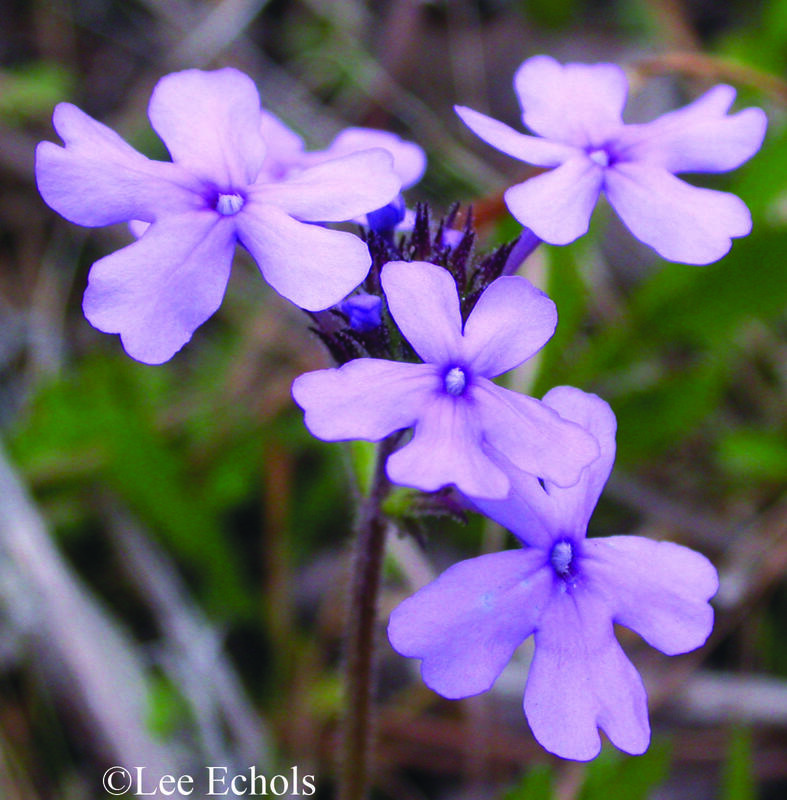
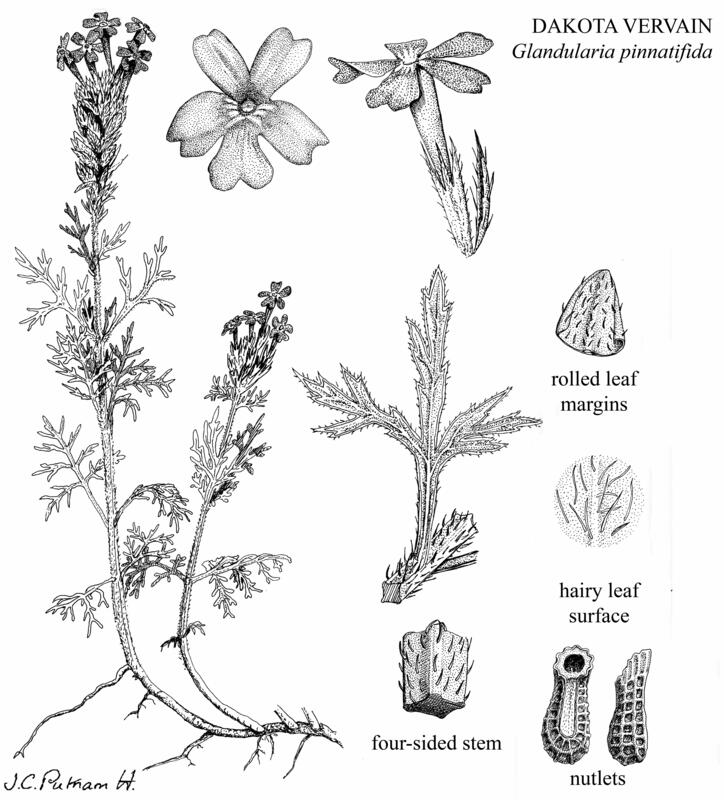
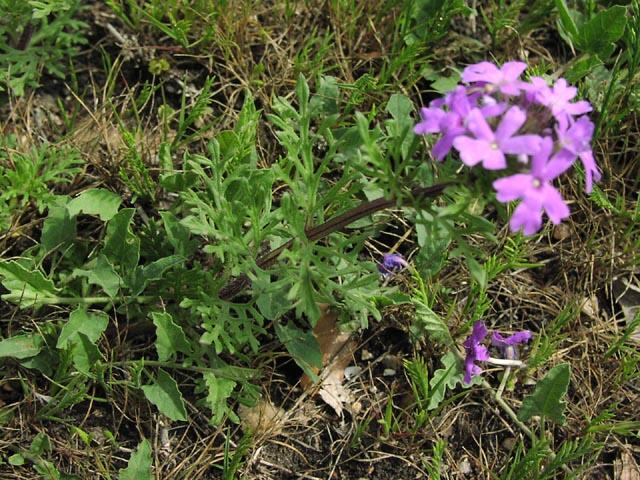
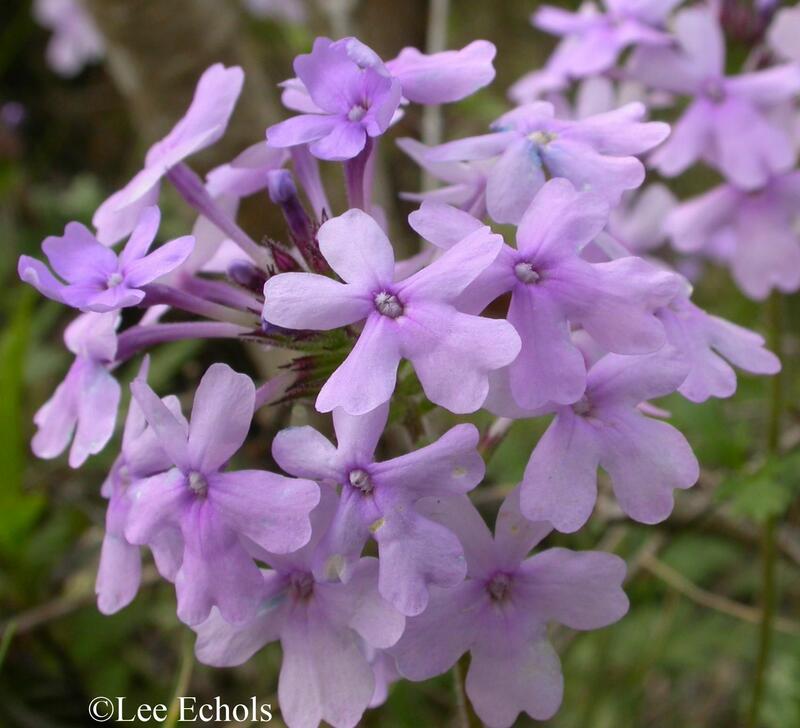
Perennial (sometimes annual) herb, all parts covered with stiff, white hairs. Stems are four-sided, with many sprawling, upwardly arching, or erect branches up to 20 inches (50 cm) long. Leaves are 0.8 - 2.4 inches (1 - 6 cm) long, opposite, divided into many narrow (1 - 4 mm wide) segments with rolled-under margins. The flower clusters are round- or flat-topped, lengthening into a spike up to 2.4 - 8 inches (6 - 20 cm) long as the fruits develop. The flowers are up to 1.6 inch (4 cm) wide, pink or purple, with 5 spreading petals and a tube about 0.5 inch (1 - 1.5 cm) long; a 5-lobed calyx surrounds the base of the flower tube; below each flower are leafy bracts that are as long as or longer than the calyx. Fruits consist of 4 very small nutlets about 0.3 cm long.
Moss-verbena (Glandularia pulchella, synonym: Verbena tenuisecta) is a common roadside and pasture weed native to South America. It has very finely divided leaves with leaf segments that are 0.5 - 1.5 mm wide. The bracts below the flower are much shorter than the calyx.
Rose Vervain (Glandularia canadensis) also occurs along roadsides as well as in dry woodlands and opening. It has coarsely toothed and lobed – but not dissected – leaves.
None in Georgia.
Patches of open, grassy blackland prairies with clay soils high in calcium; woodland edges near the prairies and open areas in adjacent woodlands.
Dakota Vervain has the widest range of any species in the genus Glandularia in North America. It is also the most variable in terms of growth form and appearance of any of the Vervain species. Dakota Vervain is usually a perennial, although sometimes an annual, and it reproduces by seed. Its nectar-producing flowers are typical butterfly-pollinated flowers, with pink petals spreading to form a flat “landing platform.” Other long-tongued insects, such as hover flies, may also visit the flowers, as well as long-tongued bees. Some bee visitors to Dakota Vervain have bristles on their forelegs which gather nectar when the bee inserts its legs into the flower tube. Its seeds are dispersed by gravity and by small animals.
Surveys are best conducted during flowering (late March–early June) although the leaves are distinctive throughout the growing season.
Middle Georgia, blackland prairies in south-central Alabama, and 19 other states in the midwest and southwestern U.S.
Destruction of habitat by clearing, logging, and development.
Glandularia bipinnatifida is ranked S1 by the Georgia Department of Natural Resources, indicating that it is critically imperiled in the state. Four populations are documented in Georgia, all on a single wildlife management area in middle Georgia.
Avoid logging and mechanical clearing in blackland prairies. Apply prescribed fire every 2 - 3 years during the growing season.
Chafin, L.G. 2007. Field guide to the rare plants of Georgia. State Botanical Garden of Georgia and University of Georgia Press, Athens.
Echols, L. 2007. Rare plants of Georgia’s blackland prairies. Tipularia, Journal of the State Botanical Garden of Georgia, 2007: 23-29.
Echols, S.L. and W.B. Zomlefer. 2010. Vascular plant flora of the remnant blackland prairies in Oaky Woods Wildlife Management Area, Houston County, Georgia. Castanea 75(1): 78-100.
GADNR. 2020. Element occurrence records for Glandularia bipinnatifida. Georgia Department of Natural Resources, Wildlife Resources Division, Social Circle, Georgia.
NatureServe. 2019. Glandularia bipinnatifida comprehensive report. NatureServe Explorer. Arlington, Virginia. http://explorer.natureserve.org/servlet/NatureServe?searchName=Glandularia+bipinnatifida
Radford, A.E., H.E. Ahles, and C.R. Bell. 1968. Manual of the vascular flora of the Carolinas. University of North Carolina Press, Chapel Hill.
Umber, R.E. 1979. The genus Glandularia (Verbenaceae) in North America. Systematic Botany 4(1): 71-102. https://www.jstor.org/stable/2418666
Weakley, A.S. 2015. Flora of the southern and mid-Atlantic States. University of North Carolina Herbarium, University of North Carolina, Chapel Hill. http://www.herbarium.unc.edu/flora.htm
Linda G. Chafin
L. Chafin, Feb. 2008: original account.
K. Owers, Jan. 2010: added photos.
L. Chafin, Feb 2020: updated original account.