


Loading profile. Please wait . . .
Lepidochelys kempii (Garman, 1880)
Kemp's Ridley Sea Turtle




Federal Protection: Listed Endangered
State Protection: Endangered
Global Rank: G2
State Rank: S2
Element Locations Tracked in Biotics: Yes
SWAP 2015 Species of Greatest Conservation Need (SGCN): Yes
SWAP 2025 Species of Greatest Conservation Need (SGCN): Yes
2025 SGCN Priority Tier: High Conservation Concern
Element Occurrences (EOs) in Georgia: 11
Habitat Summary for element in Georgia: Open ocean; sounds; coastal rivers; beaches
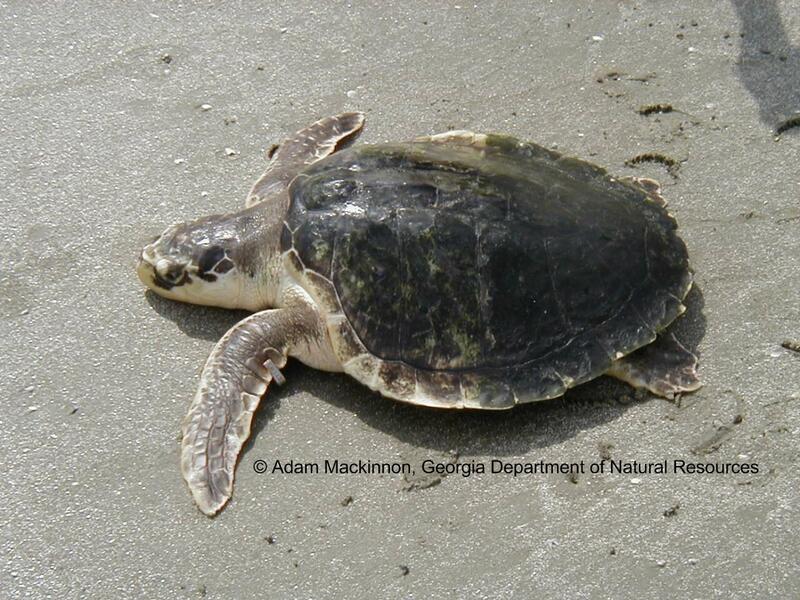
The Kemp's ridley turtle is the smallest of the sea turtle species found worldwide. Adult carapace length is 58-70 cm (23-28 in), and average weight is 41 kg (90 lbs). The carapace is relatively flat and round. The shell, head, and flippers have a gray to grayish-green hue. The color of the ventral surface of the turtle, including the plastron, is cream to white.
Although belonging to different genera, green, loggerhead, and hawksbill sea turtles are superficially similar in appearance to Kemp’s ridley sea turtles. The foremost costal scute on each side of the Kemp’s ridley sea turtle carapace touches the nuchal scute, distinguishing it from hawsbill and green sea turtles. Overall color, carapace shape (round in Kemp’s, elongated in loggerheads), and the absence of barnacles and other carapace-encrusting organisms are usually sufficient for separating Kemp’s ridleys from loggerhead sea turtles. Each bridge scute on a Kemp’s ridley contains a conspicuous pore that is unique to this genus. Kemp’s ridley turtles can be distinguished from the olive ridley, a similar species primarily found in the Pacific Ocean, by examining the lateral scutes: Kemp’s ridley turtles have 5 lateral scutes, whereas Olive ridleys have 6 or more lateral scales.
Kemp’s ridley turtles prefer shallow coastal waters where food is abundant. In Georgia, juvenile Kemp's ridley sea turtles are common in estuaries during the months of April through October. They are the second most abundant species after loggerheads. Post-hatchlings and small juveniles are found in pelagic habitats until they reach approximately 20 cm carapace length (8 in.), when they move into coastal habitat
Kemp’s ridley sea turtles consume blue, stone, and spider crabs, moon snails, and a number of other invertebrates and plants.
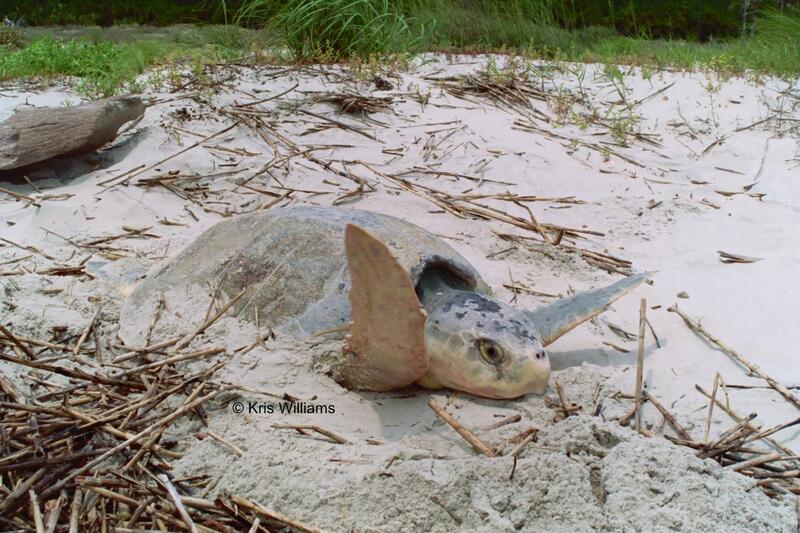
Kemp's ridleys nest almost exclusively on the beaches of Rancho Nuevo on the Mexican gulf coast. The nesting season runs from April through mid-July, with individual females nesting every 1-3 years. Kemp’s ridleys nest in aggregations known as “arribadas”. Large groups of females congregate off the nesting beach and come ashore in waves, often during the day. Clutch size averages approximately 100 eggs. Eggs hatch after 50-60 days of incubation. Kemp’s ridleys have been documented nesting along the southeastern U.S. coast, although nesting outside the Gulf of Mexico is rare. A single Kemp’s ridley nest was documented in Georgia on Wassaw Island in 2005. Post hatchlings and juveniles can be found associated with sargassum weed mats in convergence zones in the Gulf of Mexico. The oceanic phase is hypothesized to last approximately 2 years.
None
Adult ridleys are found primarily in the Gulf of Mexico, but juveniles have been observed foraging along the U.S. Atlantic coast. A few records exist of Kemp’s ridleys found in the mid-Atlantic and Mediterranean Sea.
Nesting records suggest the Kemp’s ridley population sustained a dramatic decline beginning in the late 1940s. An amateur film shot in 1947 shows an estimated 42,000 female Kemp’s ridleys on the beach in one day during an arribada. By 1990, approximately 200 females were recorded nesting annually in Mexico. Population declines were attributed to egg collection for human consumption and incidental capture and drowning in commercial fisheries. Nesting beaches were protected from poaching in 1966 and egg loss is no longer a major concern. Shrimp trawling is thought to be the major source of mortality, although longlines, gillnets and trap/pot gear are also responsible for some mortality. As a result of conservation efforts, nesting has increased steadily over the last 20 years. In 2009, over 20,000 Kemp’s ridley nests were documented on beaches in Mexico. In Georgia, strandings typically begin in April and continue through the summer, peaking in June and July and tapering off into early November. Kemp’s ridley turtles in Georgia waters are most likely susceptible to the same hazards as other species including incidental capture and drowning in the shrimp trawl fishery, collision with recreational and commercial boats, fishing line entanglements, and habitat loss.
| Threat 1 | Threat 2 | Threat 3 | |
|---|---|---|---|
| General Threat | Biological resource use | Human intrusions & disturbance | Energy production & mining |
| Specific Threat | Fishing & harvesting aquatic resources | Recreational activities | Oil & gas drilling |
The Kemp’s ridley turtle is listed as endangered as a result of human consumption and mortality from commercial fisheries. A significant proportion of Georgia’s Kemp’s ridley nesting habitat is in conservation ownership including Little Tybee Island Natural Area, Wassaw Island National Wildlife Refuge, Ossabaw Island Heritage Preserve, Blackbeard Island National Wildlife Refuge, Sapelo Island Wildlife Management Area, Wolf Island National Wildlife Refuge, Jekyll Island State Park, Little Cumberland Island, and Cumberland Island National Seashore; however nesting on Atlantic beaches is considered an extremely rare event.
The protection of Kemp’s ridley eggs at major nesting beaches at Rancho Nuevo, Mexico, combined with the development and implementation of Turtle Excluder Device (TED) regulations and shrimp fishery closures have likely contributed to a modest but steady increase in the number of nesting females in Mexico. In Georgia, the proper use of TEDs in the shrimp trawl fishery will help reduce juvenile and adult female mortality. Because sea turtles are long-lived with delayed sexual maturity, a significant conservation effort over a long period of time will be necessary to recover Kemp’s ridley populations.
Lutz, P.L., J.A. Musick, and J. Wyneken (editors). 2003. The Biology of Sea Turtles, Volume II. CRC Press. Boca Raton, Florida. 455 pages.
Lutz, P.L. and J.A. Musick (editors). 1997. The Biology of Sea Turtles. CRC Press. Boca Raton, Florida. 432 pages.
Ernst, C. H., J. E. Lovich, and R. W. Barbour. 1994. Turtles of the United States and Canada. Smithsonian Institution Press, Washington D.C. 578 pp.
Magnuson, J. J., K. A. Bjorndal, W. D. DuPaul, G. L. Graham, F. W. Owens, C. H. Peterson, P.C. H. Pritchard, J. I. Richardson, G. E. Saul, and C. W. West. 1990. Decline of the sea turtles: causes and prevention. National Acad. Press, Washington, D.C. 259 pp.
Mason, P. A. and K. M. Andrews. 2008. Kemp’s Ridley Sea Turtle Lepidochelys kempii. Pp. 453-455 in Jensen, J. B., C. D. Camp, J. W. Gibbons, and M. J. Elliott (eds.). Amphibians and Reptiles of Georgia. University of Georgia Press, Athens, GA. 575 pp.
U.S. Fish and Wildlife Service and National Marine Fisheries Service. 1992. Recovery Plan for the Kemp’s Ridley Sea Turtle (Lepidochelys kempii). National Marine Fisheries Service, St. Petersburg, FL.
Website of interest: http://www.seaturtle.org/nestdb/index.shtml?view=3
John B. Jensen, Mark Dodd, and Bradford Winn
28-Feb-11