Loading profile. Please wait . . .
Pinguicula primuliflora Wood & Godfrey
Clearwater Butterwort




Federal Protection: No US federal protection
State Protection: Threatened
Global Rank: G3G4
State Rank: S1
Element Locations Tracked in Biotics: Yes
SWAP 2015 Species of Greatest Conservation Need (SGCN): Yes
SWAP 2025 Species of Greatest Conservation Need (SGCN): Yes
2025 SGCN Priority Tier: High Conservation Concern
Element Occurrences (EOs) in Georgia: 12
Habitat Summary for element in Georgia: In shallow, sandy, clearwater streams and seeps; Atlantic whitecedar swamps
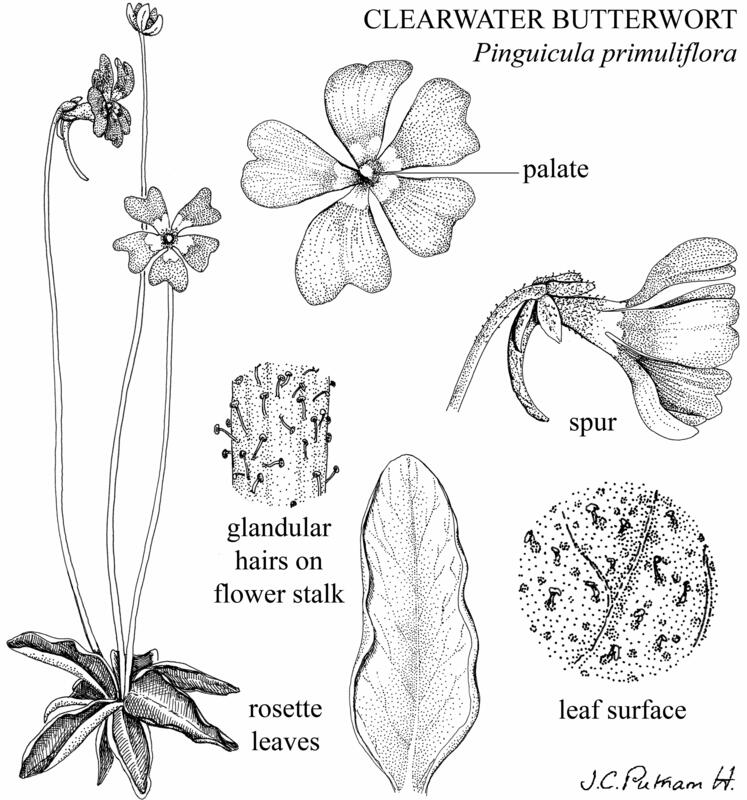
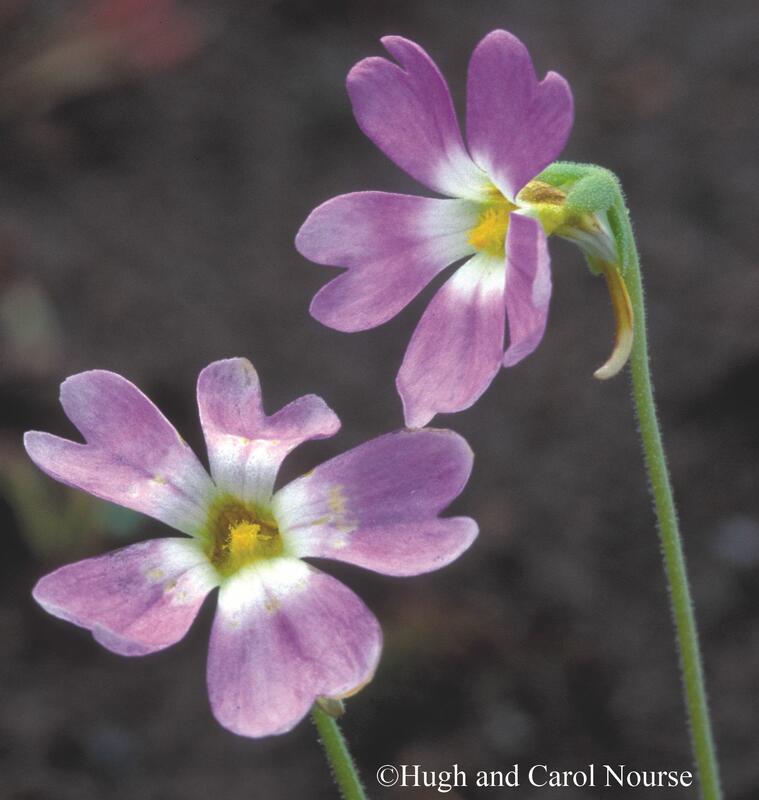
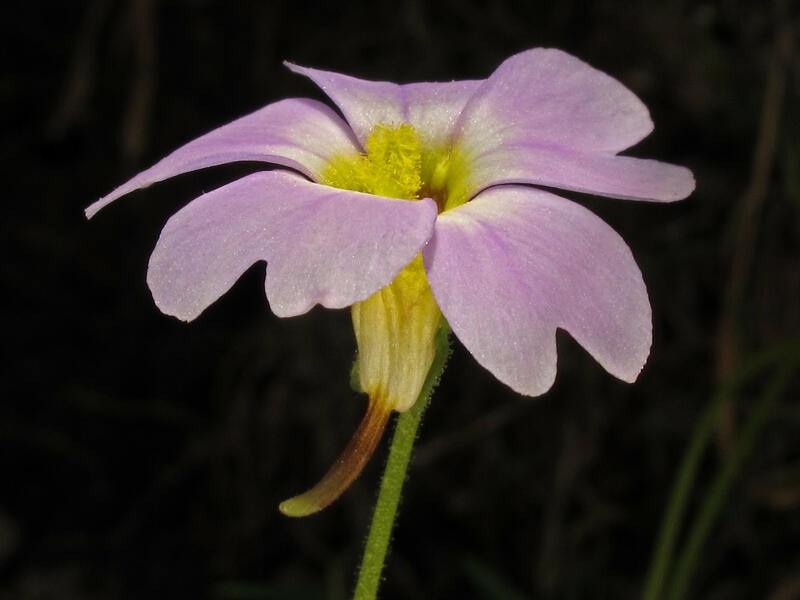
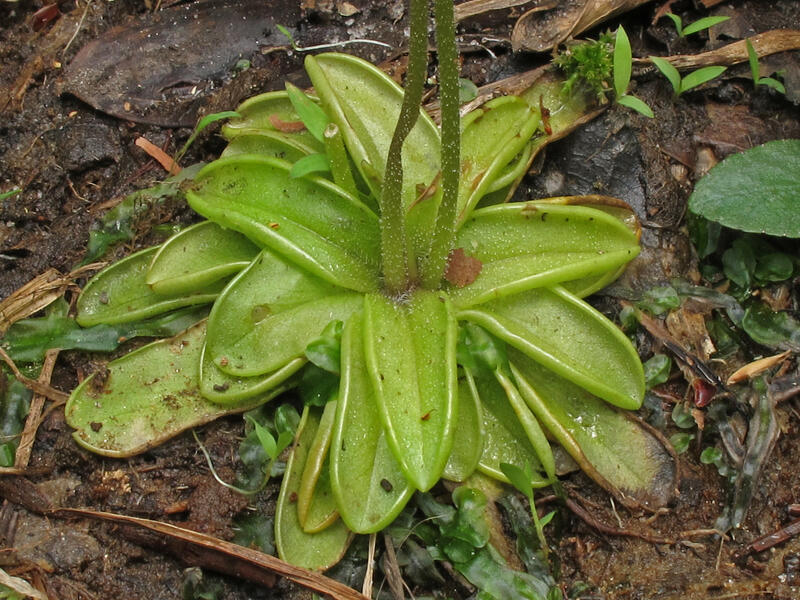
Perennial herb with a basal rosette of leaves up to 7 inches (18 cm) wide. Leaves are 2.4 - 3.5 inches (6 - 9 cm) long and 0.8 - 1 inch (2 - 2.5 cm) wide, fleshy, bright green, with inrolled edges and blunt tips; the upper leaf surfaces have a wet look and an oily feel. Leafless flower stalks 3 - 6 inches (8 - 15 cm) tall rise from the center of the rosette and have scattered, gland-tipped hairs (10x magnification recommended) and a solitary flower at the top. The flower has a short spur that extends behind the flower and a short tube that opens out to about 1 inch (2.5 cm) wide; there are five pale blue-purple to dark pink, notched lobes with a ring of white at the base of the lobes; the tube and spur are yellow with reddish-brown veins; the palate, a small structure protruding from the lower lobe and covering the entrance to the flower tube, is covered with yellow hairs. The fruit is a nearly round capsule about 0.2 inch (5 mm) wide.
There are two other blue-flowered species of butterwort in Georgia's Coastal Plain. Blue Butterwort (Pinguicula caerulea) flowers have dark blue veins on the flower lobes; the hairs on the flowering stalk are a mix of straight hairs (on the lower part of the stalk) and gland-tipped hairs (on the upper part of the stalk).
Dwarf Butterwort (Pinguicula pumila) basal leaf rosettes are usually less than 1 - 1.6 inches (3 - 4 cm) across, and the flowers are usually less than 0.6 inch (1.5 cm) wide.
None in Georgia.
In Georgia's Fall Line ecoregion, in shallow water of sand-bottomed streams and spring-runs and in sphagnum mats along stream banks, Atlantic white cedar swamps, and bogs.
Clearwater Butterwort is a perennial herb that reproduces sexually by seed and also vegetatively by producing tiny plantlets on the tips of the leaves; as the older plant’s leaves decay, the new plants take root and become established. Butterwort flowers are adapted for pollination by long-tongued insects such as butterflies, which probe the nectar-containing spur with their tongues. As they probe, they pick up pollen on their heads from the stamens which are near the top of the throat and transfer it to the stigma (also near the top of the throat) of another butterwort flower. Butterwort seeds are dispersed by the wind; if conditions are moist, the capsule will close and not re-open until the humidity drops, favoring wind dispersal.
Butterworts are carnivorous species which use a “flypaper” strategy to trap and digest insects on their leaves. Tiny, stalked glands on the upper surface of the leaf exude a sticky substance that looks wet and attracts insects in search of water. Ultraviolet patterns on the leaf surfaces also attract insects. Small insects such as mosquitoes and gnats are trapped in this sticky substance. Once an insect has been trapped, the edges of the leaf roll up and inward, not to trap the insect, but to bring more sticky glands into contact with the insect’s body. The insect is then dissolved by enzymes secreted by low glands on the leaf surfaces; the nutrients contained in the insect’s body are then absorbed into the leaves through microscopic holes. The boggy soils where butterworts grow tend to be nitrogen-deficient, a shortage that is compensated for by the nitrogen absorbed from insect bodies.
Surveys are best conducted during flowering (March–May) when the gland-tipped hairs are present on the flower stalk. Late-summer plants may have tiny plantlets growing on the tips of the leaves; no other butterworts in Georgia produce plantlets on their leaves.
Fall Line Sandhills region of Georgia and the Coastal Plain of Florida, Alabama, and Mississippi.
Draining and filling of wetlands. Runoff and sedimentation into springs and spring-runs. Digging by feral hogs. Logging and clearing in floodplains and stream bottoms. Poaching by carnivorous plant hobbyists.
| Threat 1 | Threat 2 | Threat 3 | |
|---|---|---|---|
| General Threat | Biological resource use | Human intrusions & disturbance | Natural system modifications |
| Specific Threat | None | None | None |
Pinguicula primuliflora is ranked S1 by the Georgia Department of Natural Resources, indicating that it is critically imperiled in Georgia. Twelve populations have been documented in Georgia, one known to have been destroyed. Only two populations occur on conservation lands.
Avoid polluting springs and spring-runs. Prevent sedimentation into streams during bridge and road construction. Protect wetlands from ditching, draining, and filling. Eradicate feral hogs. Avoid logging along streams and in floodplains. Prosecute plant poachers.
Chafin, L.G. 2007. Field guide to the rare plants of Georgia. State Botanical Garden of Georgia and University of Georgia Press, Athens.
GADNR. 2020. Element occurrence records for Pinguicula primuliflora. Georgia Department of Natural Resources, Wildlife Resources Division, Social Circle, Georgia.
Gibson, T.C. 1991. Differential escape of insects from carnivorous plant traps. American Midland Naturalist 125(1): 55-62. https://www.jstor.org/stable/2426369
Godfrey, R.K. and H.L. Stripling. 1961. Synopsis of Pinguicula (Lentibulariaceae) in the southeastern United States. American Midland Naturalist 66(2): 395-409. https://www.jstor.org/stable/2423039?seq=1#metadata_info_tab_contents
Godfrey, R.K. and J.W. Wooten. 1981. Aquatic and wetland plants of southeastern United States, vol. 2, dicotyledons. University of Georgia Press, Athens.
Heslop-Harrison, Y. and J. Heslop-Harrison. 1981. The digestive glands of Pinguicula: structure and cytochemistry. Annals of Botany 47: 293-319. https://academic.oup.com/aob/article-abstract/47/3/293/150736
Joel, D.M., B.E. Juniper, and A. Dafni. 1985. Ultraviolet patterns in the traps of carnivorous plants. New Phytologist 101(4): 585-593. https://nph.onlinelibrary.wiley.com/doi/epdf/10.1111/j.1469-8137.1985.tb02864.x
Molano-Flores, B., S. Primer, J. Annis, M.A. Feist, J. Coons, R. Digges. 2018. Reproductive ecology of three rare North American Pinguicula species. Plant Species Biology 33: 129-139. https://esj-journals.onlinelibrary.wiley.com/doi/abs/10.1111/1442-1984.12204
NatureServe. 2020. Pinguicula primuliflora comprehensive report. NatureServe Explorer. Arlington, Virginia. http://explorer.natureserve.org/servlet/NatureServe?searchName=Pinguicula+primuliflora
Patrick, T.S., J.R. Allison, and G.A. Krakow. 1995. Protected plants of Georgia. Georgia Department of Natural Resources, Natural Heritage Program, Social Circle.
Schnell, D.E. 2002. Carnivorous plants of the United States and Canada, 2nd edition. Timber Press, Inc. Portland, Oregon.
Sheridan, P.M. and T.S. Patrick. 2003. A rare plant survey of Atlantic White-Cedar habitats of the Georgia west-central Fall Line sandhills. Meadowview Biological Research Station. http://www.pitcherplant.org/Papers/Ararep~1.PDF
Weakley, A.S. 2015. Flora of the southern and mid-Atlantic States. University of North Carolina Herbarium, University of North Carolina, Chapel Hill. http://www.herbarium.unc.edu/flora.htm
Linda G. Chafin
L. Chafin, Jul. 2008: original account
K. Owers, Feb. 2010: added pictures
L. Chafin, Mar. 2020: updated original account