


Loading profile. Please wait . . .
Stokesia laevis (Hill) Greene
Stokes Aster




Federal Protection: No US federal protection
State Protection: No Georgia state protection
Global Rank: G4
State Rank: S1
Element Locations Tracked in Biotics: Yes
SWAP 2015 Species of Greatest Conservation Need (SGCN): Yes
SWAP 2025 Species of Greatest Conservation Need (SGCN): Yes
2025 SGCN Priority Tier: High Conservation Concern
Element Occurrences (EOs) in Georgia: 12
Habitat Summary for element in Georgia: Pitcherplant bogs
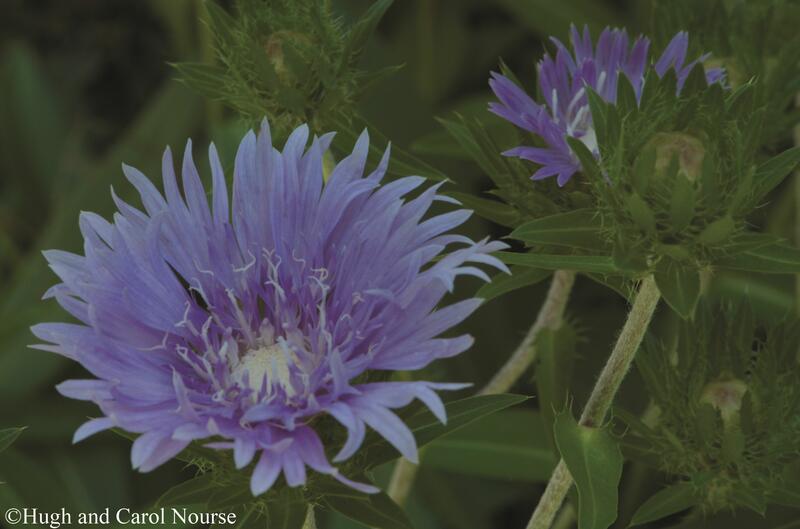
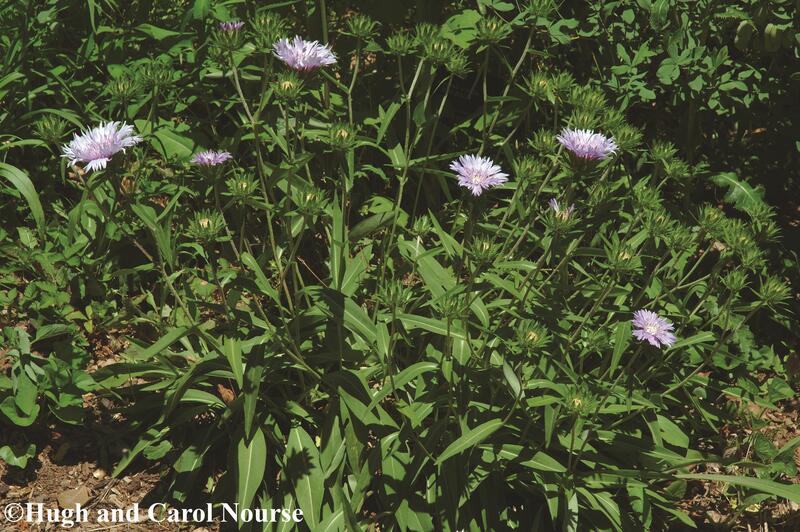
Perennial herb with a stem up to 2 feet (20 - 60 cm) long, sprawling or erect, covered in woolly hairs. Basal leaves are 4 - 12 inches (10 - 30 cm) long and 0.4 - 2 inches (1 - 5 cm) wide, evergreen, smooth and somewhat fleshy, dotted with tiny glands, with bluntly pointed tips and winged leaf stalks. Mid-stem leaves are 2.8 - 4.7 inches (7 - 12 cm) long, alternate, widely spaced, clasping the stem, lance-shaped, margins slightly inrolled and smooth except for a few pointed teeth near the base. The flower heads are 2.8 - 4 inches (7 - 10 cm) wide, held at the tips of long, leafy stalks; 5 - 7 whorls of leafy, spiny involucral bracts surround the base of the head. Technically, there are no ray flowers in Stokes Aster heads – the outer whorls of disk flowers are elongated up to 1.2 inch (3 cm) and appear to be rays; they are blue, lavender, or white, with 5 deeply cut lobes at the tip. The inner disk flowers are up to 0.8 inch (2 cm) long, tubular, blue or white. Fruits are about 0.25 inch (5 - 8 mm) long, dry and seed-like, greenish-white, shiny, hairless, 3- or 4-sided.
No other Coastal Plain species has such large, showy, blue flower heads. The fleshy, gland-dotted basal leaves are similar to those of a pink-flowered species which occurs in flatwoods, Vanilla Plant (Carphephorus odoratissimus).
Stokes Aster is the only species in its genus.
Wet pine savannas and flatwoods, pitcherplant bogs. roadside ditches through these habitats.
Stokes Aster reproduces sexually by seed and possibly vegetatively – some sources describe it as rhizomatous. Unlike most members of the composite family, Stokes Aster flower heads do not include both disk and ray flowers, but have only disk flowers all of which are fertile and bisexual. The flowers must be cross-pollinated in order to produce seed. They are visited by a wide variety of insects and are probably pollinated by butterflies and bees. Stokes Aster is a potential oilseed crop; its seeds contain high levels of a fatty acid that can be converted to epoxy oil and used in the manufacture of plastics, varnish, and glues.
Surveys are best conducted during flowering (June–August).
Georgia, Florida, Alabama, Mississippi, Louisiana, and South Carolina. Stokes Aster is widely sold in the horticulture trade and is established as a garden plant well outside its natural range.
Clearing and logging; ditching, draining, and filling wet savannas and bogs; conversion of habitat to pine plantations, pastures, and development; fire suppression and encroachment by woody plants.
| Threat 1 | Threat 2 | Threat 3 | |
|---|---|---|---|
| General Threat | Agriculture & aquaculture | Natural system modifications | None |
| Specific Threat | Wood & pulp plantations | Fire & fire suppression | None |
Stokes Aster is ranked S1 by the Georgia Department of Natural Resources, indicating that the species is critically imperiled in Georgia. Eleven populations have been documented in Georgia, but only four have been confirmed since 2000. No populations are protected on conservation lands.
Avoid ditching, draining, and filling wetlands. Avoid logging, bedding, and other soil-compacting activities. Apply prescribed fire every 2 - 3 years. Avoid placing firebreaks around bogs, and allow fire to burn into wetlands. Protect sites from conversion to pine plantations and developments. Avoid grading, poorly timed mowing, and herbicide use on roadsides through this species' habitat.
Chafin, L.G. 2007. Field guide to the rare plants of Georgia. State Botanical Garden of Georgia and University of Georgia Press, Athens.
Cronquist, A. 1980. Vascular flora of the southeastern United States, Vol. 1, Asteraceae. University of North Carolina Press, Chapel Hill.
GADNR. 2020. Element occurrence records for Stokesia laevis. Georgia Department of Natural Resources, Wildlife Resources Division, Social Circle, Georgia.
Godfrey, R.K. and J.W. Wooten. 1981. Aquatic and wetland plants of southeastern United States, Vol. 2, dicotyledons. University of Georgia Press, Athens.
Gunn, C.R. and G.A. White. 1974. Stokesia laevis: taxonomy and economic value. Economic Botany, 28(2): 130-135.
NatureServe. 2020. Stokesia laevis species account. NatureServe Explorer. NatureServe, Arlington, Virginia. https://explorer.natureserve.org/Taxon/ELEMENT_GLOBAL.2.136776/Stokesia_laevis
Radford, A.E., H.E. Ahles, and C.R. Bell. 1968. Manual of the vascular flora of the Carolinas. University of North Carolina Press, Chapel Hill.
Strother, J.L. 2006. Stokesia laevis species account. Flora of North America, Vol. 19. Oxford University Press, New York. http://beta.floranorthamerica.org/Stokesia_laevis
Weakley, A.S. 2015. Flora of the southern and mid-Atlantic States. University of North Carolina Herbarium, University of North Carolina, Chapel Hill. http://www.herbarium.unc.edu/flora.htm
Linda G. Chafin
L. Chafin, Sept. 2008: original account
K. Owers, Feb. 2010: added pictures
L. Chafin, May 2020: updated original account.