

Loading profile. Please wait . . .
Lilium michiganense Farw.
Michigan Lily




Federal Protection: No US federal protection
State Protection: Rare
Global Rank: G5
State Rank: S1
Element Locations Tracked in Biotics: Yes
SWAP 2015 Species of Greatest Conservation Need (SGCN): Yes
SWAP 2025 Species of Greatest Conservation Need (SGCN): Yes
2025 SGCN Priority Tier: High Conservation Concern
Element Occurrences (EOs) in Georgia: 6
Habitat Summary for element in Georgia: Remnant wet prairies and calcareous flatwoods
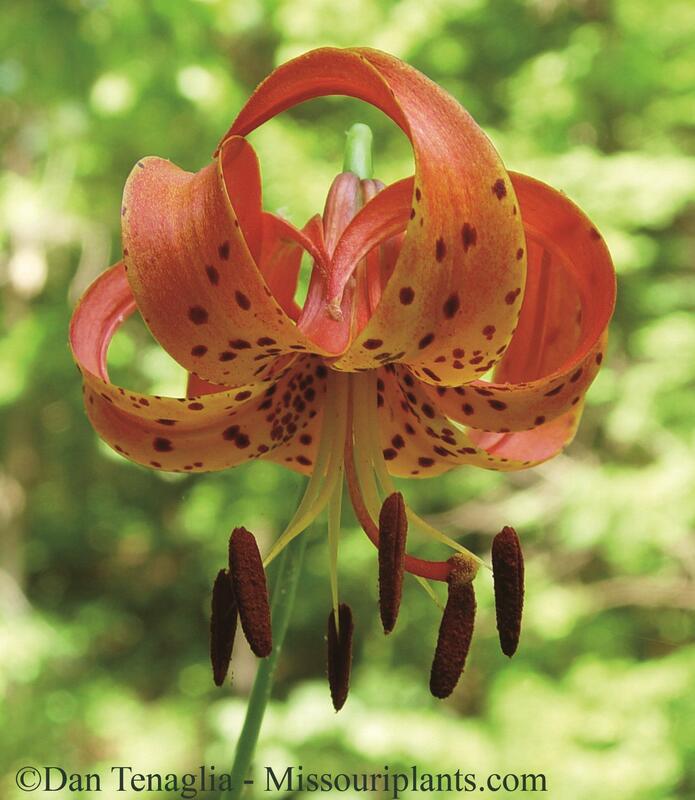
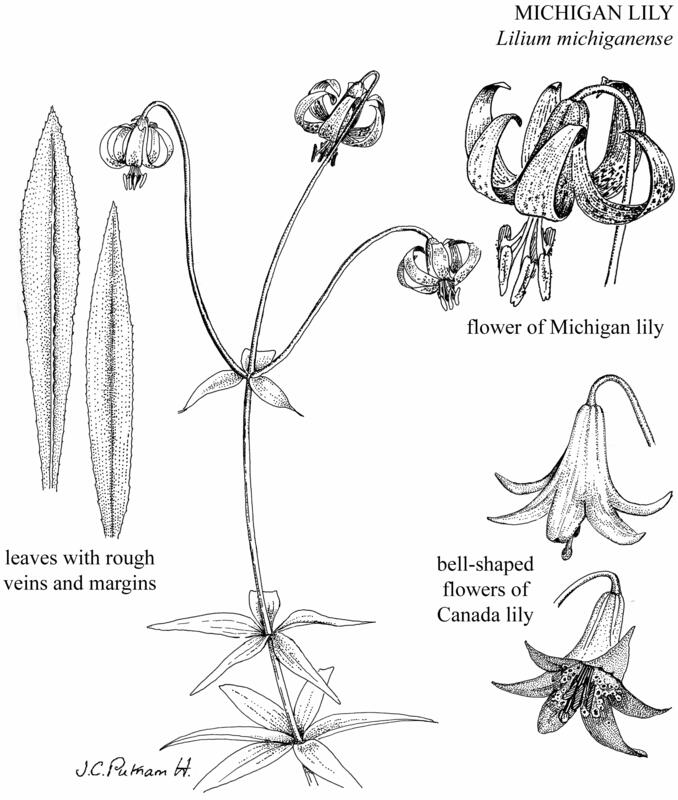
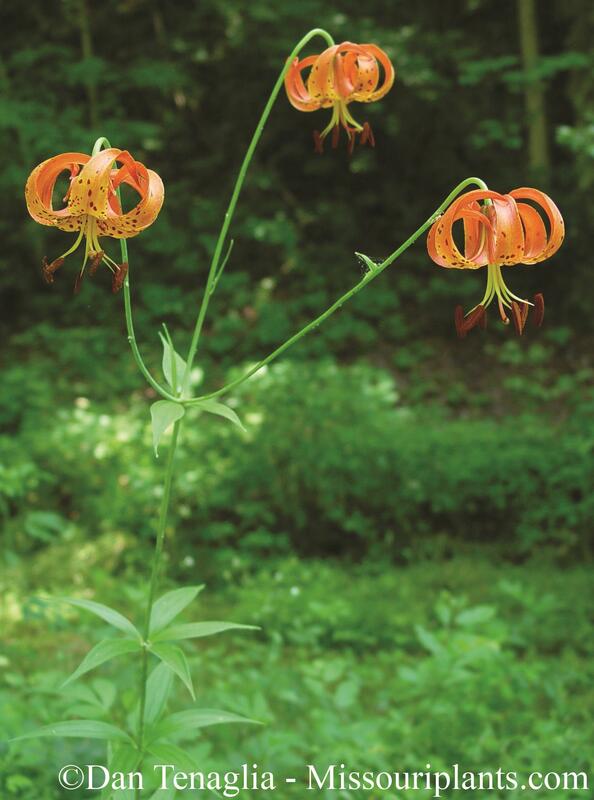
Perennial herb with a waxy, green stem up to 6 feet (2 meters) tall. The leaves are up to 6 inches (4.6 - 15.3 cm) long and 1 inch (0.6 - 2.3 cm) wide, lance-shaped with roughened veins and margins, in 4 - 12 whorls with 3 - 13 leaves per whorl. Flowers are 1 - 11 per plant, nodding at the tips of long stalks at the top of the stem. Six tepals (3 petals + 3 nearly identical sepals), each up to 3.5 inches (9 cm) long, curve strongly backwards; they are orange and yellow with maroon spots near the base. Six stamens extend well below the tepals, with dark brown, dangling anthers up to 0.5 inch (0.6 - 1.3 cm) long. The fruit is an erect capsule, 1 - 2 inches (2.8 - 5 cm) long.
Turk’s-cap Lily (Lilium superbum) flowers are very similar to Michigan Lily’s except the anthers are more than 0.5 inch (1.4–2.6 cm) long. Turk’s Cap's leaves are smooth or only slightly rough on the edges and veins.
Four species of Lilium are rare in Georgia:
Canada Lily (Lilium canadense, Special Concern) occurs in sunny gaps in rich, limestone woods in Dade and Floyd Counties. For more information, see: https://www.georgiabiodiversity.org/portal/profile?group=plants&es_id=18601
Michigan Lily (Lilium michiganense) occurs in Coosa Valley prairies and flatwoods with wet, calcium-rich soils in northwest Georgia. For more information, see: https://www.georgiabiodiversity.org/portal/profile?group=plants&es_id=15586
Wood Lily (Lilium philadelphicum) occurs in remnant wet meadows, forest openings, damp roadsides, and rights-of-way through these habitats, usually over sandstone. For more information, see: https://www.georgiabiodiversity.org/portal/profile?group=plants&es_id=16274
Pineland Lily (Lilium pyrophilum) occurs in seeps on or near Altamaha Grit outcrops in Georgia; elsewhere in its range it occurs in Fall Line sandhills in the wetland transition areas at the base of sandhills and streams. For more information, see: https://www.georgiabiodiversity.org/portal/profile?group=plants&es_id=34948
Coosa Valley prairies and flatwoods with wet, calcium-rich soils.
Michigan Lily is a perennial herb that reproduces sexually by seed and vegetatively by offsets from its bulbs. The flowers are pollinated by large butterflies such as monarchs, fritillaries, and swallowtails, as well as sphinx moths and hummingbird moths, all of which are attracted to the copious nectar produced at the base of the tepals. The flowers must be cross-pollinated in order to produce fruit and viable seeds. In order to prevent self-pollination, the stamens release their pollen before the stigma matures within a given flower. Deer and rabbits eat the aboveground parts while voles eat the bulbs. Its seeds are probably dispersed by wind.
Plants are most conspicuous during flowering (mid-June–July) but the height of the stems, the capsules, and the roughened surface of the leaves are distinctive during late summer and fall.
Georgia, north to New York and Ontario, and west to Mississippi and South Dakota.
Logging and other mechanized clearing of habitat. Badly timed mowing and herbicide applications in roadside rights-of-way. Browsing by deer.
| Threat 1 | Threat 2 | Threat 3 | |
|---|---|---|---|
| General Threat | Transportation & service corridors | Natural system modifications | Invasive & other problematic species, genes & diseases |
| Specific Threat | None | None | None |
Lilium michiganense is ranked S1 by the Georgia Department of Natural Resources, indicating that it is critically imperiled in Georgia. Four populations are known, three on public lands in roadside rights-of-way, the fourth on private land.
Avoid logging and mechanical clearing near populations. Use hand-clearing or carefully timed mowing, not herbicides, to maintain rights-of-way. Reduce the size of Georgia’s deer population.
Chafin, L.G. 2007. Field guide to the rare plants of Georgia. State Botanical Garden of Georgia and University of Georgia Press, Athens.
Drake, J. 2014. Lilies in the wild and in the garden. Breath O' Spring Publications, Inc., Suwannee, Georgia. https://tinyurl.com/wdupfbx
GADNR. 2020. Element occurrence records for Lilium michiganense. Georgia Department of Natural Resources, Wildlife Resources Division, Social Circle, Georgia.
Gleason, H.A. and A. Cronquist. 1991. Manual of vascular plants of northeastern United States and adjacent Canada, 2nd edition. New York Botanical Garden, New York.
Hilty, J. 2018. Michigan Lily, Lilium michiganense. Illinois Wildflowers. https://www.illinoiswildflowers.info/prairie/plantx/mich_lilyx.htm
Horn, D., T. Cathcart, T.E. Hemmerly, and D. Duhl. 2005. Wildflowers of Tennessee, the Ohio Valley, and the southern Appalachians. Lone Pine Publishing, Auburn, Washington.
NatureServe. 2019. Lilium michiganense comprehensive report. NatureServe Explorer. Arlington, Virginia. http://explorer.natureserve.org/servlet/NatureServe?searchName=Lilium+michiganense
Radford, A.E., H.E. Ahles, and C.R. Bell. 1968. Manual of the vascular flora of the Carolinas. University of North Carolina Press, Chapel Hill.
Skinner, M.W. 2003. Lilium michiganense species account. Flora of North America, Vol. 26. Oxford University Press, New York. http://beta.floranorthamerica.org/Lilium_michiganense
Smith, R.M. 1998. Wildflowers of the southern mountains. University of Tennessee Press, Knoxville.
Weakley, A.S. 2015. Flora of the southern and mid-Atlantic States. University of North Carolina Herbarium, University of North Carolina, Chapel Hill. http://www.herbarium.unc.edu/flora.htm
Linda G. Chafin
L. Chafin, Sep. 2007: original account
K. Owers, Feb. 2010: added pictures
L. Chafin, Mar. 2020: updated original account.