


Loading profile. Please wait . . .
Polygonia faunus (Edwards, 1862)
Green Comma




Federal Protection: No US federal protection
State Protection: No Georgia state protection
Global Rank: G5
State Rank: S3
Element Locations Tracked in Biotics: Yes
SWAP 2015 Species of Greatest Conservation Need (SGCN): Yes
SWAP 2025 Species of Greatest Conservation Need (SGCN): Yes
2025 SGCN Priority Tier: Moderate Conservation Concern
Element Occurrences (EOs) in Georgia: 3
Habitat Summary for element in Georgia: Hardwoods, higher elevations
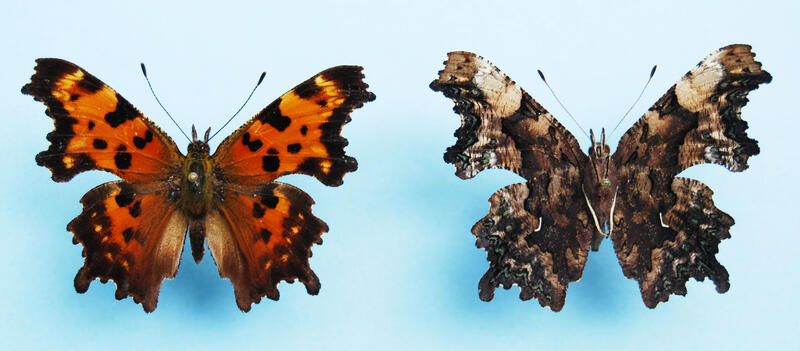
This is a member of the anglewing genus Polygonia. It has the typical black spots on an orange background for the genus. What distinguishes the Green Comma from other members of the genus is the deeply sinuate edges on the wings, and the green lunules (hence the name) in the subterminal area on the underside of both wings (especially the hindwings; see photo above). These are subtle, but if you enlarge the image above of the underside they are clearly visible. Also clearly visible is the whitish comma-shaped mark on the underside of the hindwing, which explains the "Comma" part of the name of this species.
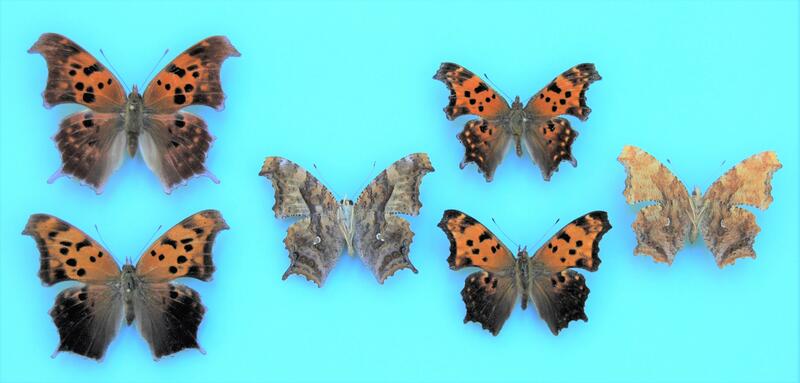
Two other Polygonia species (see photo, below) can be found together with P. faunus -- the Question Mark (Polygonia interrogationis) and the Comma (Polygonia comma). The Question Mark is usually a bit bigger, with much more even edges to the wings. Additionally the Question Mark has an extra dot under the comma-shaped mark on the underside of the hindwings, hence the name "Question Mark". The Comma is similar in size to the Green Comma, with similar edges to the wings and the comma-shaped mark, but the Comma does not have the green lunules on the underside of the hindwings.
Forested habitats in the mountains in north central and northeast Georgia. They often visit damp spots along roads and in clearings to imbibe water and salts from the soil.
Gooseberry (Ribes sp.) is the one known larval foodplant of this subspecies of the Green Comma, and was originally recorded in Virginia by Smyth, and reported by Clark (1937), who named the subspecies after Smyth. Larvae of other subspecies feed on Birches (Betula sp.), as well as alders, blueberry and willows. In West Virginia, the range of subspecies smythi seems to mirror the range of yellow birch (Betula alleghaniensis) quite well, so it may be using this species of birch there, and three larvae of the nominate subspecies P. f. faunus have been found on yellow birch in New Hampshire (Schweitzer, et al. 2011).
There may be either one or two broods in Georgia for P. faunus smythi. Adults have been seen in March and April, then again in June into July at least (personal observation and Harris, 1972). Adults may then continue to appear into the fall (though they apparently become inactive in the fall at some points in its range; Schweitzer, et al., 2011) and then overwinter. As such, without more records and without rearing data, it is not clear whether there is a summer brood and then a fall brood, or just one prolonged brood during the summer that makes it all the way to the following winter as adults. Certainly, the specimens from June of 2001 (see below) are fresh, so these individuals are clearly newly emerged at this point in the year.
Although adults occasionally visit flowers, they frequently visit moist spots on roads/paths and along streams, as indicated elsewhere. They also frequent dung, sap and rotting fruit, if these are available.
As indicated, adults overwinter, and then mate and lay eggs when spring arrives. Since this subspecies has apparently been reared by E. A. Smyth in the late 1880's and possibly by no one else since, we do not have a good description of the larva, although we can assume that is looks similar to the larvae of the other subspecies of the green comma. The larva of P. faunus faunus, is a rather typical Polygonia larva, with transverse rows of branching spines on each segment that are yellowish on the thorax and anterior abdomen and whitish on the abdominal segments. The ground color of the body is blackish but has irregular lateral orange stripes, and numerous thin transverse yellowish stripes on the segments with yellow spines, and white stripes on the segments with white spines (personal communication, Jason Dombroskie).
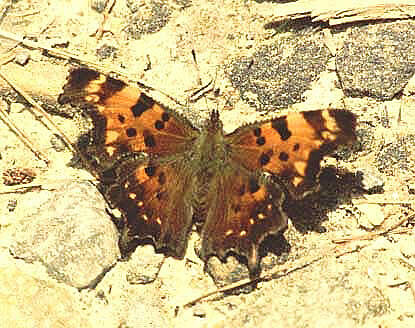
In this case, the Green Comma, as stated elsewhere, seems to be using a rather common foodplant in a habitat that is widespread in the north central and northeast Georgia mountains. The most common place that the author has encountered the butterfly is along roads at moist spots. The image of the live individual (see below) was taken on a dirt road at Cooper's Creek WMA in Union/Fannin Counties -- the primary method I have used to survey this species is to drive slowly along the roads and simply watch for them to fly and land. Since they frequent moisture along roads, paths and creeks, walking or driving along these is a reasonable way to locate this species. Since the species comes to dung and rotten fruit, however, baiting with dung or mashed fruit for this species could be the BEST way to find individuals. Theoretically the species could be found in much of north central and northeastern Georgia.
This is a widespread butterfly in the U.S., with populations in the northeastern U.S. and southeastern Canada, and also across the mountainous habitats in the west. It is absent from the plain states and provinces. The subspecies smythi, however, is restricted to the southern Appalachians. It is found from northeastern West Virginia/southwestern Virginia southwestward along the Appalachians into northern Georgia (Schweitzer, et al. 2011). In this state, it has been found in a few of the counties in very northern and very northeastern Georgia (Harris, 1972; see map).
Ribes foodplants are common and widespread in Georgia, and the butterfly seems to inhabit rather typical hardwood forests with some openings/streams/roads and paths. It is difficult to understand what might be at issue for this butterfly, and why this butterfly may be declining. The Gypsy Moth has yet to be found established in Georgia, though if that happens, it will be in the northern mountains first. And yet, spraying for the Gypsy moth with Btk takes place in the Spring, and some P. faunus smythi larvae could be out and susceptible, but spraying typically takes place near higher human traffic areas. It would be hard to imagine that spraying Btk would be an issue for this butterfly, and spraying is not even happening at this point. It is possible that microhabitat and microclimate alterations due to climate change may be leading to a reduction of population numbers, but we don't really know what the butterfly actually requires.
| Threat 1 | Threat 2 | Threat 3 | |
|---|---|---|---|
| General Threat | Natural system modifications | Pollution | None |
| Specific Threat | Fire & fire suppression | Air-borne pollutants | None |
Currently listed as S3, but this species may be in decline (no records in the last five years, and the author HAS been looking religiously at one of the classic locations, Cooper's Creek in Union and Fannin Counties). This species may warrant an S1 or S2 ranking.
As we don't know exactly what the butterfly requires other than a common foodplant in a rather widespread and unremarkable habitat, it is difficult to near impossible to know exactly what its management needs are. If climate change is actually impacting this butterfly, then it may be nearly impossible to prevent loss of the butterfly from the state in the long run.
Clark, A. H. 1937. A new subspecies of the nymphalid butterfly Polygonia faunus. Proceedings of the U.S. National Museum 84(3013): 219-222.
Harris, L., Jr. 1972. Butterflies of Georgia, pages 258-260. University of Oklahoma Press, Norman.
Schweitzer, D. F., M. C. Minno, and D. L. Wagner. 2011. Rare, declining and poorly known butterfly and moths (Lepidoptera) of forests and woodlands in the eastern United States, pages 205-209. Forest Health Technology Enterprise Team.
James K. Adams, Professor of Biology, Dalton State College, Dalton, GA
July 23, 2020