


Loading profile. Please wait . . .
Ammodramus savannarum (Gmelin, 1789)
Grasshopper Sparrow




Federal Protection: No US federal protection
State Protection: No Georgia state protection
Global Rank: G5
State Rank: S3S4
Element Locations Tracked in Biotics: Yes
SWAP 2015 Species of Greatest Conservation Need (SGCN): Yes
SWAP 2025 Species of Greatest Conservation Need (SGCN): Yes
2025 SGCN Priority Tier: Moderate Conservation Concern
Element Occurrences (EOs) in Georgia: 0
Habitat Summary for element in Georgia: Breeds in grasslands, pasture lands. PD RV, rare in CP. Wintering range poorly known
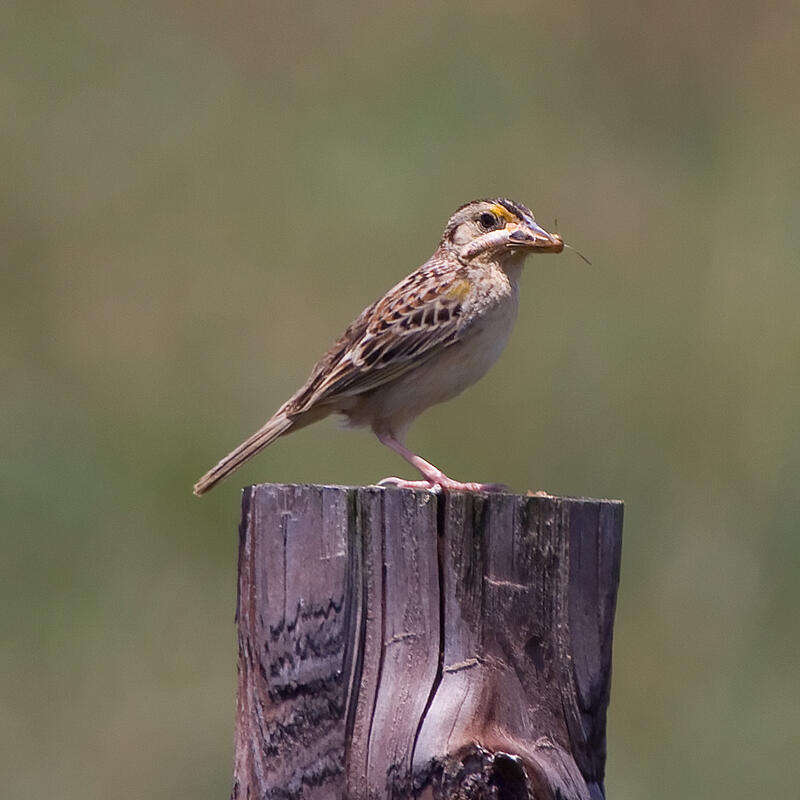
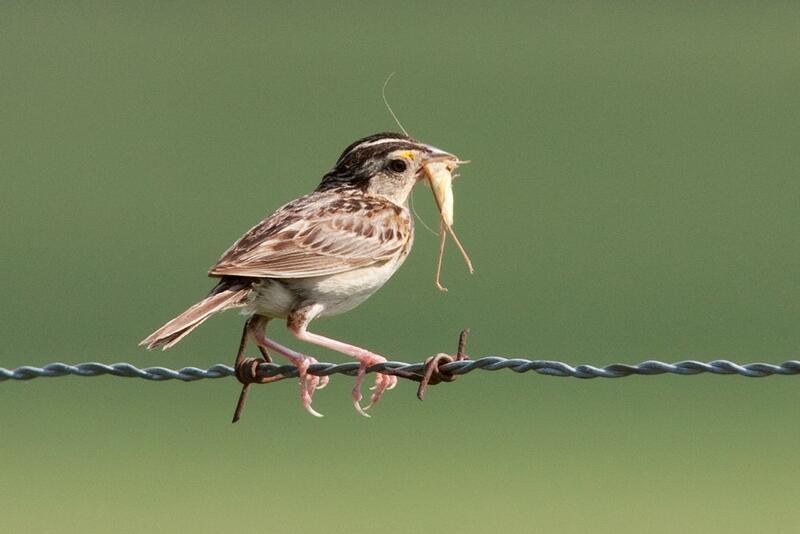
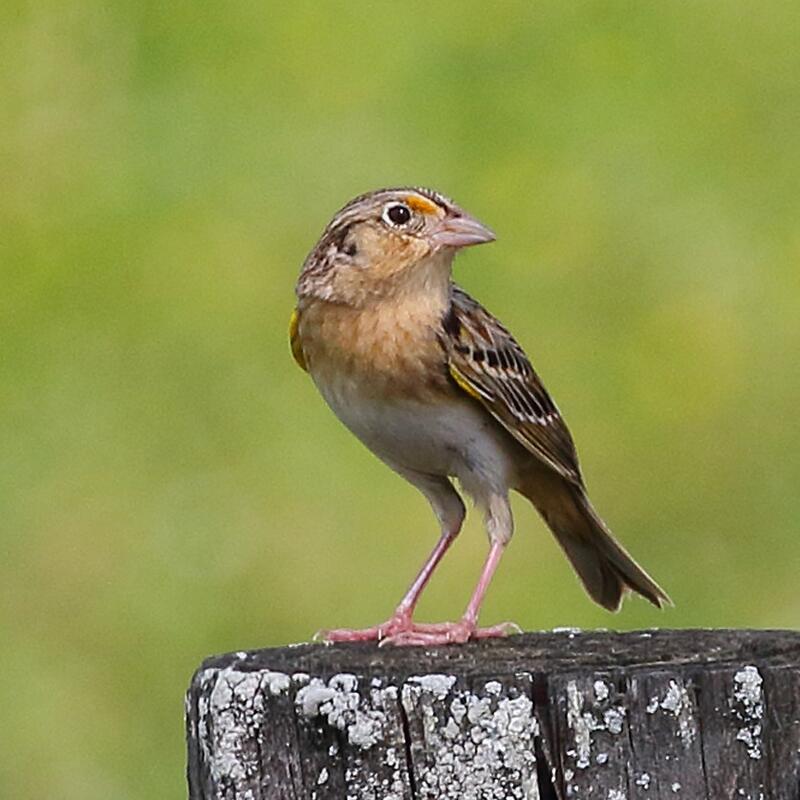
A small flat-headed sparrow 11-11.5 cm (4.25-4.5 inches) long and weighing 14-20 g (0.5-0.7 ounce) this bird has a relatively large pinkish to gray bill. Its dark eye is surrounded by a white eye-ring. The auricular (cheek) area and face is buff in color. A narrow white median crown stripe runs along the top of the head and is flanked on either side by a broad brownish crown stripe. A broad buffy to light grayish stripe runs over the top of the eye from the base of the bill to the nape. The throat and upper chest is buff fading to white on the stomach and abdomen. The nape has relatively fine reddish-brown and light gray streaking while the back has wider streaks that are reddish-brown, black, and gray. Upper wings have an intricate pattern of brown, black, and gray. A bright yellow spot can often be seen on the alula (the thumb like projection at the wrist joint) when the bird is in-hand, particularly when it is excited or agitated. Legs are pinkish gray.
LeConte’s sparrow (Ammospiza leconteii) can look similar to the grasshopper sparrow but has a yellowish hue to the buff color which covers much of its face, nape, throat, upper chest, and flanks. The LeConte’s also has well-defined dark streaking on the back, flanks, and upper chest and a smaller gray bill. Henslow’s sparrow (Centronyx henslowii) has chestnut brown back and wing feathers, many with black centers and white edges, giving the back a streaked appearance with alternating broad chestnut and black streaks interspersed with thin white streaks. Flanks and upper breast are buff but have well-defined dark streaking. Its head is olive to olive-gold in color with two broad, black crown stripes, black markings on the side of the face, and two black malar stripes that run parallel to each other. Bachman’s sparrow (Peucaea aestivalis) occasionally occurs in the same areas as the grasshopper sparrow, particularly in winter. In-hand they are easily distinguishable from grasshopper sparrows by their grayish face, reddish-brown crown stripes, and reddish-brown eye stripe which runs from the back of the eye to the nape. The nape and back have vertical reddish-brown and gray streaks. The throat, breast and vent are buff color while the belly and abdomen are white. Bachman’s sparrow has a relatively long tail proportional to its body
In Georgia, the grasshopper sparrow nests in grasslands that have few trees and shrubs. These include native grasslands as well as pastures. Researchers found that this species was absent from fields with greater than 35% shrub cover in the Georgia Piedmont. It favors larger tracts of habitat and is often absent from smaller patches. Preferred vegetation height is about 0.3 m, and some bare ground is critical for this ground-foraging species. In winter grasshopper sparrows are found in pastures and grasslands as well as open pine savanna habitats with a dense ground cover of grasses and forbs. They regularly use powerline corridors with these characteristics.
During the summer this bird eats mostly insects, particularly grasshoppers, but also caterpillars, ants, and bugs. Other animal foods eaten include spiders, snails, and various other invertebrates. In winter it consumes mostly seeds of grasses, sedges, and other herbaceous plants.
In Georgia, the breeding season starts in late April or early May and lasts through early August. The nest is built on the ground by the female and is usually covered by a grass dome and has a side entrance. Construction normally takes 2-3 days. It is well concealed and difficult to find. Early clutches typically contain three to five eggs, while later clutches most often are smaller. Incubation takes 11-13 days, with fledging occurring 7-9 days after hatching. Two or more broods are common, an important adaptation for a ground nesting bird susceptible to high predation rates. In a few cases adults that have lost a nest have been observed assisting with feeding and brooding of unrelated young from nearby nests. While the Brown-headed Cowbird will parasitize nests of this species, parasitism rates are generally low.
During the breeding season passive aural and call playback surveys are the most effective survey methods. Winter surveys are best conducted using methods such as flush-netting, since this species does not vocalize much or respond well to call playback during this time. Flush-netting is a technique that involves two people walking parallel to each other dragging a long, weighted rope through the grass to flush birds. The location where the bird lands after being flushed is noted and a mist net is set up near this spot. The bird is then flushed into the net and captured. The bird can then be examined, banded, or feather, tissue, or other samples collected.
Breeding occurs primarily in the eastern two-thirds of the U. S. and extreme southern Canada with outlying nesting populations in the western third of the U. S., and in Mexico, the Caribbean, Central America, and in Columbia and possibly Ecuador in South America. Populations are often very local in occurrence.
There are a number of historical nesting records for the Georgia Piedmont, particularly from the area surrounding Athens. Additionally, there are historical nest records for Gordon and Murray counties, both sites in the Ridge and Valley ecoregion, and Laurens County in the Coastal Plain. During the Breeding Bird Atlas project surveys (1994-2001) this species was found throughout areas of the Cumberland Plateau, Ridge and Valley, and Piedmont with a significant amount of pastureland or grassland. It was also found at a few sites in the Blue Ridge Mountains and several locations in the Upper Coastal Plain ecoregion. Isolated populations occurred in the Coastal Plain in Decatur, Laurens, and possibly Burke counties. The Decatur County population was discovered at the Bainbridge airport in May 1995. Initially it was thought that these birds might possibly be Florida grasshopper sparrows (Ammodramus savannarum floridanus), a federally endangered subspecies, but subsequent genetic analysis confirmed that birds from this population were the more common pratensis subspecies. This is the southernmost breeding population of this subspecies east of the Mississippi River. It is still present today and some individuals have been used for captive rearing and reintroduction experiments as a surrogate for the rapidly declining Florida grasshopper sparrow, that only occurs in central Florida.
Winter range includes the southern tier of states from southeast Virginia to Texas, southern Arizona and California, Cuba, Mexico, and parts of Central America.
Habitat loss, modification, and degradation are the greatest threats to this species across its range. Most of the prairie and native grasslands this species used historically have been lost since European colonization. Remaining prairie fragments are often degraded or too small to sustain populations. Many of the pastures this bird uses today are over or under grazed, making them less suitable for this sparrow during the nesting season.
| Threat 1 | Threat 2 | Threat 3 | |
|---|---|---|---|
| General Threat | Agriculture & aquaculture | Energy production & mining | Agriculture & aquaculture |
| Specific Threat | Livestock farming & ranching | Renewable energy | Wood & pulp plantations |
Breeding Bird Survey (BBS) data show that grasshopper sparrow populations in Georgia declined by 4.4% annually from 1966-2015. Annual declines of nearly 5.5 were seen in the eastern BBS regions during the same period.
Grasshopper sparrow populations respond favorably to management practices geared toward improvement of habitat quality. Four techniques that have been used effectively and are recommended include; appropriately timed prescribed burning, light grazing in lusher grasslands, delayed mowing of hayfields, and establishment of native warm season grasses.
Beaton, G., P. W. Sykes, Jr. and J. W. Parrish, Jr. 2003. Annotated Checklist of Georgia Birds. 5th edition. Georgia Ornithological Society Occasional Publication No. 14.
Burleigh, T. D. 1927. Three interesting breeding records for 1925 from the Piedmont region of northeastern Georgia. Wilson Bulletin 39:15-19.
Burleigh, T. D. 1958. Georgia Birds. University of Oklahoma Press, Norman.
Dobbs, M. M. 2010. Grasshopper Sparrow (Ammodramus savannarum) Pp.380-381 in T. M. Schneider, G. Beaton, T. S. Keyes, and N. A. Klaus, eds. The Breeding Bird Atlas of Georgia. University of Georgia Press, Athens.
Johnston, D. W., and E. P. Odum. 1956. Breeding bird populations in relation to plant succession on the Piedmont of Georgia. Ecology 37:50-62.
Lloyd, S. H., and A. P. Hamilton. 1963. Kingbird and grasshopper sparrow nests in Gordon County. Oriole 28:15-16.
Patterson, T. K. 1984. Nesting of grasshopper sparrow in the Upper Coastal Plain. Oriole 49:76-78.
Sauer, J. R., D. K. Niven, J. E. Hines, D. J. Ziolkowski, Jr, K. L. Pardieck, J. E. Fallon, and W. A. Link. 2017. The North American Breeding Bird Survey, Results and Analysis 1966 - 2015. Version 2.07.2017 USGS Patuxent Wildlife Research Center, Laurel, MD.
Vickery, P. D. 1996. Grasshopper Sparrow (Ammodramus savannarum). In A. Poole and F. Gill, eds., The Birds of North America, No. 239. The Academy of Natural Sciences, Philadelphia, PA and The American Ornithologists’ Union, Washington, DC.
Vickery, P. D., J. R. Herkert, F. L. Knopf, J. Ruth, and C. E. Keller. 2000. Grassland birds: An overview of threats and recommended management strategies. Pp. 74-77 in R. Bonney, Jr., D. N. Pashley, R. J. Cooper, and L. Niles, eds., Strategies for Bird Conservation: The Partners in Flight Planning Process. Proceedings of the 3rd Partners in Flight Workshop (Oct. 1-5, 1995), Cape May, NJ. RMRS-P-16, U. S. D. A. Forest Service, Rocky Mountain Research Station, Ogden, UT.
Young, D. P., Jr. 1987. Observations of grasshopper sparrows nesting in Clarke County. Oriole 52:49-50.
Marion M. Dobbs and Todd M. Schneider
7 November 2019