


Loading profile. Please wait . . .
Protonotaria citrea (Boddaert, 1783)
Prothonotary Warbler




Federal Protection: No US federal protection
State Protection: No Georgia state protection
Global Rank: G5
State Rank: S3S4
Element Locations Tracked in Biotics: Yes
SWAP 2015 Species of Greatest Conservation Need (SGCN): Yes
SWAP 2025 Species of Greatest Conservation Need (SGCN): Yes
2025 SGCN Priority Tier: High Conservation Concern
Element Occurrences (EOs) in Georgia: 0
Habitat Summary for element in Georgia: Bottomland forest, swamps, and similar forested wetlands. Nests in tree cavities
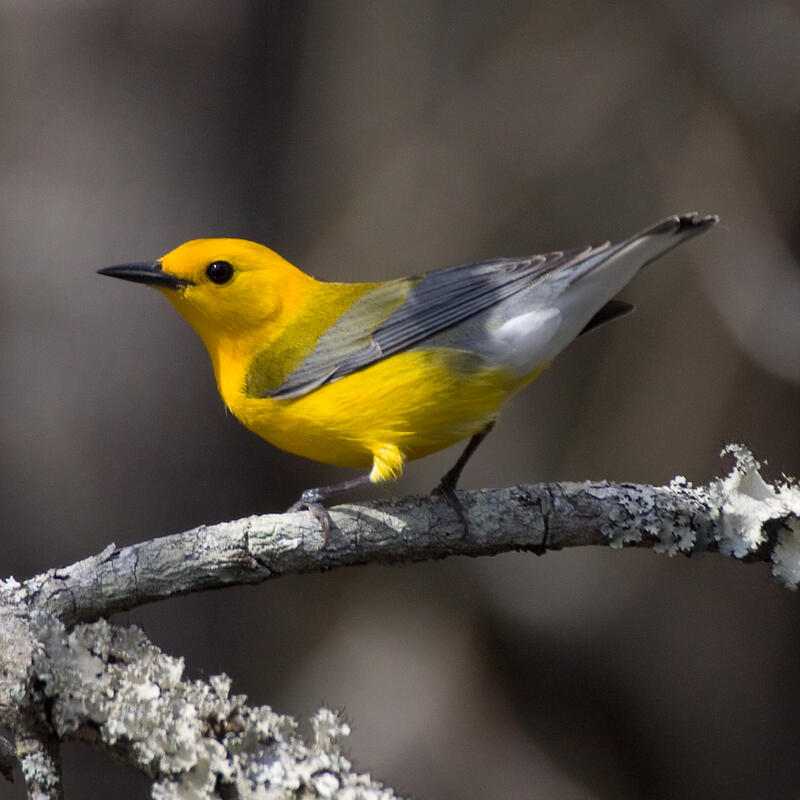
A bright golden-yellow warbler with gray wings, dark eyes, gray to black bill, white vent, and gray legs. Males and females are similar in color and pattern, although the yellow of the male tends to be significantly brighter than the female during the breeding season and males a have a darker (often black) bill. Total length is about 14cm and average weight is 14-16 g. The Prothonotary warbler is unique in being the only habitual cavity-nesting warbler in the eastern United States and one of only two in North America.
The yellow warbler (Setophaga petechia) and blue-winged warbler (Vermivora cyanoptera) are two species that can be mistaken for the Prothonotary. Yellow warblers can typically be found in similar riparian habitats on both the breeding and wintering grounds. They are a slightly smaller bird with bright yellow-green upper-parts, including the wings (not gray like the Prothonotary), and yellow to gray legs. Females have yellow to yellow-green underparts while males have yellow underparts with red to chestnut streaking on the breast and flanks. Blue-winged warblers will generally occupy different habitats, but they are very close in appearance to Prothonotaries. The primary physical differences in blue-winged warblers is smaller size, a black eyeline, blueish wings (rather than gray), and white wing bars.
Rarely straying far from water during the breeding season, the Prothonotary warbler prefers low elevation flooded bottomlands, shaded blackwater swamps, and the forested margins of large lakes and rivers. Forested wetlands less than 100ha (250 acres) in size are avoided, as are wooded streamside riparian zones less than 30m (100 ft.) wide. Wintering habitat is primarily mangrove swamps, where this bird is usually one of the most abundant migratory species, along with northern waterthrush (Seiurus novaboracensis). It also winters regularly in lower abundance in dry tropical forest, residential areas, and wooded stream corridors in pasture lands near coastal areas.
Primarily insects, spiders, and other small invertebrates. Outside of the breeding season seeds, fruits, and nectar may also be eaten.
Males arrive at breeding sites in late March or April and promptly begin defending territories centered around one or more suitable cavities. When females arrive several days later, pairs are quickly formed and nest construction begins soon after. The nest is made largely of damp moss and cypress needles (when available), which may improve hatching success by stabilizing nest temperature and humidity. The nest cup is made from rootlets, bark, grasses, sedges, vine tendrils, and even fishing line. Usually four or five eggs (range 3-7) are laid and incubated by the female for 12-14 days, with fledging 9-10 days after hatching. Normally only one brood per year is raised in Georgia; however, it is likely that at least occasionally two broods are raised per year, given this occurs in other Southeastern states.
The Prothonotary warbler departs its Georgia breeding grounds in late summer and migrates to mangrove swamps and tropical forests of Central and South America for winter.
Wildlife Conservation Section staff are currently monitoring nestboxes and conducting point count surveys during the breeding season. These efforts will hopefully provide a better understanding of natal site fidelity, natural cavity preference versus abundance, migration dates, and general population trends in Georgia. As with most passerine species, more information is needed about the species from fledging to adulthood including; dispersal from the natal site, survivorship, migration movements and pathways, and breeding ecology in the first year. How the combination of nest-site limitation, habitat specificity, and long-distance migration influences lifetime reproductive success in this species is not known. More information based on natural cavity nests in habitats of varying quality is needed to provide a more complete understanding of the impacts of habitat degradation on breeding populations
This warbler’s breeding range extends from New Jersey and Pennsylvania south through the Atlantic and Gulf coastal plains and much of the Piedmont, and west to central Oklahoma and Texas. It also occurs in the Mississippi and Ohio River valleys, with scattered breeding populations found in the upper Midwest and along the north shore of Lake Erie in southern Ontario.
During the early 1900s this warbler was found breeding primarily in Georgia’s Coastal Plain and along the Chattahoochee River drainage in the Piedmont. Apparently, it began expanding its range up river courses in the 1960s and a nest was found in Rome in the Ridge and Valley ecoregion in 1962. The Prothonotary now breeds commonly south of the Fall Line and locally in the Piedmont and Ridge and Valley where it is usually concentrated along major river corridors. It is still absent from the Blue Ridge Mountains.
Disturbance to breeding habitats, primarily through logging and conversion of bottomland hardwood forests, is responsible for local declines of this species and is the most significant threat on the breeding grounds. It has been estimated that less than 10% of the original bottomland forests in the lower 48 states remain today. A primary negative impact of silviculture is removal of cavity trees and alteration of hydrological regimes. Invasive exotic tree species such as Chinese tallow (Triadica sebifera) and Chinese privet (Ligustrum sinense) can pose a threat by crowding out native tree species that are more suitable for future nest trees.
The impact of habitat destruction in wintering areas on overall population stability cannot be ignored. Mangrove swamps are rapidly being degraded and destroyed on this bird’s tropical wintering grounds. For these reasons, Partners in Flight considers the Prothonotary warbler a species of high conservation concern throughout its breeding range.
| Threat 1 | Threat 2 | Threat 3 | |
|---|---|---|---|
| General Threat | Biological resource use | Natural system modifications | Invasive & other problematic species, genes & diseases |
| Specific Threat | Logging & wood harvesting | Dams & water management/use | Invasive non-native/alien species/diseases |
The Prothonotary warbler has shown significant declines across its range and is a species of conservation concern in Georgia. Breeding Bird Survey data for 1966-2015 show annual declines of 1.1% and 3.27% across its breeding range and in Georgia, respectively.
Local, volunteer-based nestbox programs for this species are becoming more common in regional and county parks to repopulate areas where populations have dwindled or disappeared. Use of nestboxes in forested wetlands where natural nest sites have been lost over time can be a valuable tool for enhancing declining local populations and increasing public recognition of conservation issues. General efforts to conserve coastal wetlands, including mangroves, will benefit the species on wintering grounds. Currently there are no known direct management efforts for the species in wintering areas.
Bassett, A. S. 1927. Prothonotary Warbler breeding in Chatham County, Georgia. Auk 44:425.
Beaton, G., P. W. Sykes, Jr. and J. W. Parrish, Jr. 2003. Annotated Checklist of Georgia Birds. 5th edition. Georgia Ornithological Society Occasional Publication No. 14.
Burleigh, T. D. 1958. Georgia Birds. University of Oklahoma Press, Norman.
Griffin, W. W., and J. C. Major. 1947. General notes: Prothonotary Warbler Protonotaria citrea citrea. Oriole 12:36.
Lux, R. H. 1962. Prothonotary Warbler nest in Floyd County. Oriole 27:37.
Murphey, E. E. 1937. Observations on the Bird Life of the Middle Savannah Valley, 1890-1937. Contributions of the Charleston Museum No. 9, Charleston, SC.
Norris, R. A. 1940. Some recent winter records from the Fitzgerald region. Oriole 5:8-9.
Norris, R. 1940. Spring notes from the Fitzgerald region. Oriole 5:15-17.
Norris, R. 1940. Summer notes from the Fitzgerald region. Oriole 5:32-34.
Peake, R. H., Jr. 1968. Range extensions of warblers in the Georgia Piedmont. Oriole 33:23-26.
Petit, L. J. 1999. Prothonotary Warbler (Protonotaria citrea). In A. Poole and F. Gill, eds., The Birds of North America, No. 408. The Birds of North America, Inc., Philadelphia, PA.
Petit, L. J., W. J. Fleming, K. E. Petit, and D. R. Petit. 1987. Nest-box use by Prothonotary Warblers (Protonotaria citrea) in riverine habitat. Wilson Bulletin 99:485-488.
Sauer, J. R., D. K. Niven, J. E. Hines, D. J. Ziolkowski, Jr., K. L. Pardieck, J. E. Fallon, and W. A. Link. 2017. The North American Breeding Bird Survey, Results and Analysis 1966-2015. Version 2.07.2017 U.S.G.S. Patuxent Wildlife Research Center, Laurel, MD.
John B. Jensen and Zach Henshaw