

Loading profile. Please wait . . .
Agastache nepetoides (L.) Kuntze
Yellow Giant-hyssop




Federal Protection: No US federal protection
State Protection: No Georgia state protection
Global Rank: G5
State Rank: S1
Element Locations Tracked in Biotics: Yes
SWAP 2015 Species of Greatest Conservation Need (SGCN): Yes
SWAP 2025 Species of Greatest Conservation Need (SGCN): Yes
2025 SGCN Priority Tier: Moderate Conservation Concern
Element Occurrences (EOs) in Georgia: 8
Habitat Summary for element in Georgia: Openings in rich hardwoods
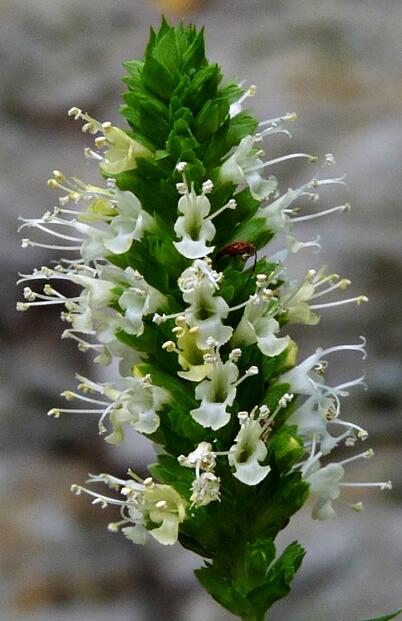
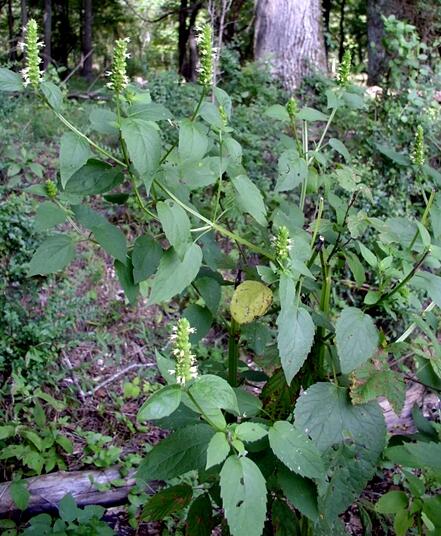
Yellow Giant Hyssop is a perennial herb in the Mint Family (Lamiaceae). At maturity, its stems are 3 - 7 feet (1-2 meters) tall, stiffly erect, hairless (except near the top), and four-sided with narrow wings on each corner; they are usually branched near the top. Mid-stem leaves are opposite, up to 6 inches long (15 cm) and 3 inches wide (7.6 cm), with long petioles (2 inches or 5 cm); they are lance-ovate with coarsely toothed margins, and hairless or nearly so (young leaves at the top of the plant may be slightly hairy); unlike most mints, its leaves lack any odor. The main stem and branches are tipped with cylindrical flower spikes up to 16 inches long and 1.5 inches wide (41 x 3.8 cm), densely packed with many pale yellow or yellowish-green flowers and buds; individual flowers are short-lived and only a few will be open at any given time. The flowers are about 0.3 inch long (8 mm) with a short tube, two spreading lips, and four exserted stamens. After the flowers are pollinated and shed, four small, round nutlets develop at the base of the calyx.
When in flower, Yellow Giant Hyssop is unmistakable. Vegetatively, it resembles several other species in the Mint Family. However, its tall, winged, hairless stems; smooth, odorless leaves; and long petioles should distinguish it from other mints growing in this part of the state and in this habitat. False Nettle (Boehmeria cylindrica) also has smooth, long-stalked, opposite leaves but the leaf blade has three strong veins and its stems are round; it is a wetland species in the nettle family.
Purple Giant Hyssop, Agastache scrophulariifolia, occurs in rich woodland borders, cracks in limestone outcrops, and sunny gaps in forested floodplains over limestone. Its flowers are purplish-pink and its stems are usually unbranched and lack wings. For more information, see: https://www.georgiabiodiversity.org/portal/profile?group=plants&es_id=17622
Moist, limestone- or mafic-based soils in wooded floodplains of small streams. Plants are the most vigorous when growing in partial shade of woodland edges and canopy gaps. In other states, it grows in roadside and railroad rights-of-way.
Yellow Giant Hyssop is a perennial herb that spreads by seed or short rhizomes. Its flowers are pollinated by bees, bee flies, and butterflies that visit the flowers for nectar; other flies may feed on pollen. Its seeds are very small and are probably dispersed by gravity and small animals. Flowering occurs mid-summer to early fall and lasts 1-2 weeks.
Yellow Giant Hyssop will be most recognizable when it flowers in late summer, mid-July through September. It should be fairly recognizable earlier in the growing season by its tall, four-sided, winged, hairless stems; smooth, odorless leaves; and long petioles. The tall flower spikes persist late into the fall and should help with recognition. Although known in Georgia mostly from natural areas, it should be looked for in open, moist, disturbed areas with partial to full sun, such as pastures, rights-of-way, and roadsides, over mafic or limestone bedrock in northwest Georgia.
Yellow Giant Hyssop occurs throughout eastern and midwestern North America and is considered secure in most states and provinces. It is rare in 10 states and provinces from Georgia north to Quebec and west to Alabama and Minnesota.
Habitat loss from stream impoundment that floods bottomlands, clearing and logging in bottomlands, invasion by Chinese Privet, Japanese Stilt Grass, Garlic Mustard, and other exotic species that thrive in bottomlands.
| Threat 1 | Threat 2 | Threat 3 | |
|---|---|---|---|
| General Threat | Residential & commercial development | Agriculture & aquaculture | None |
| Specific Threat | None | None | None |
Agastache nepetoides is ranked S1 by the Georgia Department of Natural Resources, indicating that it is critically imperiled in the state. There are six populations of Yellow Giant Hyssop documented from Georgia, all but one since 2004. Four occur on privately owned lands; one occurs on land owned by the U.S. Army Corps of Engineers; the other occurs on a roadside through the Chattahoochee National Forest where it is subject to roadside mowing and herbicide use.
Monitor known populations for exotic plant invasion and remove invasives immediately. Careful canopy thinning, after seeds are dispersed and without compacting the soil with heavy equipment, will admit more sunlight and promote flowering. Avoid impounding streams and flooding bottomlands.
Georgia’s Agastache nepetoides plants are among the southernmost populations of this species. Plants occurring at the periphery of a species’ range are thought to be of special conservation importance. Peripheral populations are usually smaller and less genetically diverse within the population, but genetically divergent from centrally located populations. These genetic differences may confer special survival traits that plants in other portions of the species’ range lack, such as the ability to survive changes in the climate or the arrival of a new pathogen. Peripheral populations may be in the process of evolving into a new species. They are especially deserving of conservation action.
GADNR. 2019. Element occurrence records for Agastache nepetoides. Georgia Department of Natural Resources, Wildlife Resources Division, Social Circle.
Hilty, J. 2018. Agastache nepetoides species account. Illinois Wildflowers. http://www.illinoiswildflowers.info/savanna/plants/yg_hyssop.htm Accessed 19 April 2019.
NatureServe. 2019. Agastache nepetoides comprehensive report. NatureServe Explorer. Arlington, Virginia. http://explorer.natureserve.org/servlet/NatureServe?searchName=Agastache+nepetoides
Toomey, B. and B.H. Toomey. 2002. Agastache nepetoides (L.) Kuntze, Yellow Giant Hyssop–Conservation and Research Plan. New England Wild Flower Society, Framingham, MA. http://www.nativeplanttrust.org/documents/24/Agastachenepetoides.pdf
Weakley, A.S. 2015. Flora of the Southern and Mid-Atlantic States. University of North Carolina Herbarium and North Carolina Botanical Garden. University of North Carolina, Chapel Hill. http://www.herbarium.unc.edu/flora.htm
Linda G. Chafin
Linda G. Chafin, April 2019: original account.