


Loading profile. Please wait . . .
Anemone caroliniana Walt.
Carolina Windflower




Federal Protection: No US federal protection
State Protection: No Georgia state protection
Global Rank: G5
State Rank: S1?
Element Locations Tracked in Biotics: Yes
SWAP 2015 Species of Greatest Conservation Need (SGCN): Yes
SWAP 2025 Species of Greatest Conservation Need (SGCN): No
2025 SGCN Priority Tier:
Element Occurrences (EOs) in Georgia: 6
Habitat Summary for element in Georgia: Upland seepage swamp openings over Iredell soils; wet meadows
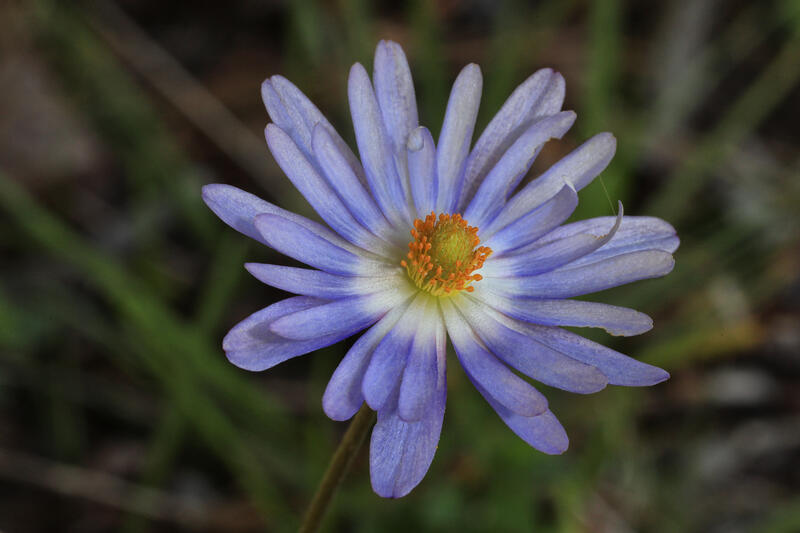
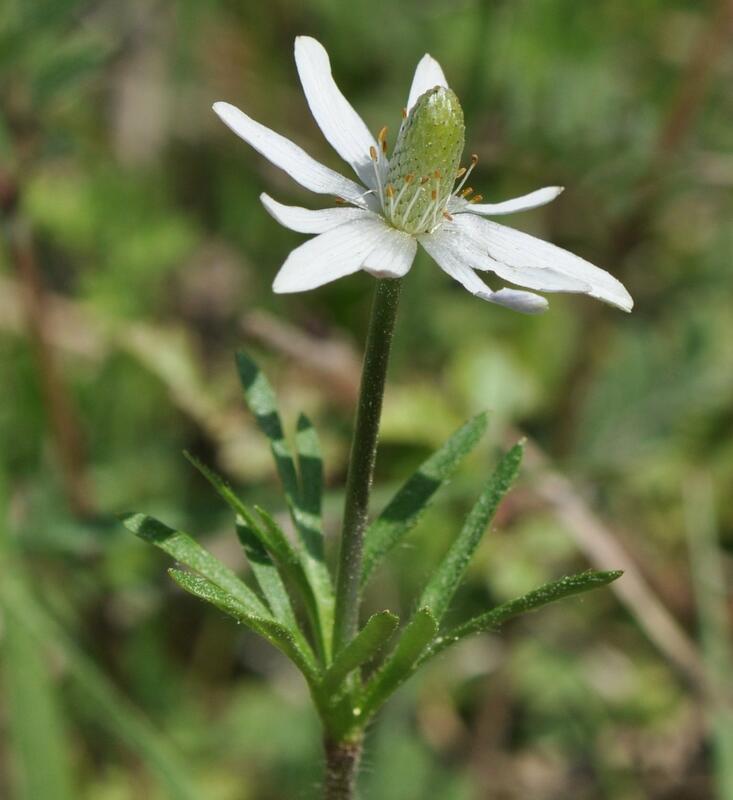
Perennial herb rising from a small tuber and spreading vegetatively by horizontal rhizomes. The stem is solitary, 2 - 16 inches (5 - 40 cm) tall, unbranched, with 3 deeply dissected, leaf-like bracts in a whorl below the middle of the stem, often close to the base; the stem is densely hairy above the bracts, smooth or slightly hairy below the bracts; each stem is topped with a single flower or fruiting head. Basal leaves are few in number, 0.4 - 1.2 inch (1 - 3 cm) long and 0.3 - 1 inch (0.8 - 2.5 cm) wide with stalks 1.2 - 4 inches (3 - 10 cm) long; the leaf blade is usually divided into three or more, toothed, somewhat fleshy segments; basal leaves may be buried in the leaf litter and may appear several inches from the base of the stem. The flowers are 1 - 1.5 inch (2.5 - 4 cm) wide, solitary at the top of the stem, with 10 - 30 narrow, petal-like sepals (there are no petals) encircling a whorl of orange-tipped stamens and a green, central cone (or cylinder) of immature fruits; sepal color ranges from white to lavender, rose, blue, or purple, and are sometimes bi-colored; the undersurface of the outer sepals is silky-hairy. The flowers vary widely in appearance due to the range in number, color, size, and shape of the sepals. Fruiting heads are oval or cylindrical, up to 1.2 inch (3 cm) long and 0.5 inch (1.2 cm) wide, and tightly packed with many woolly, wind-dispersed seeds.
Tall Anemone (or Thimbleweed, Anemone virginiana) usually has a branched stem and several flowers on each plant. Its leaves are conspicuously veined with sharply pointed teeth, and its flowers are greenish to white. It occurs throughout north Georgia in forests over rich, basic soils.
Glade Windflower (Anemone berlandieri) is also very similar, see below.
Glade Windflower (Anemone berlandieri) stems are hairy both above and below the leaf-like bracts; its sepals are usually cream-colored, tinged pink or tan on the lower surface; in Georgia, it is known only from the margins of Piedmont granite outcrops. For more information, see: https://georgiabiodiversity.org/portal/profile?group=plants&es_id=21022
Openings in upland seepage swamps over Iredell soils in the Piedmont, and moist pastures, grassy fields, and roadsides in the Coastal Plain.
Carolina Windflower is a perennial herb that reproduces sexually by seed and asexually by the spread of rhizomes. It produces basal leaves in late winter from a tuber. By early spring, the single stem has emerged, flowered, and gone to fruit. The flowers are short-lived and the fruiting head quickly disintegrates and disperses its seeds. The flowers are cross-pollinated by insects that are rewarded only with pollen since the flowers do not produce nectar.
Carolina Windflower is most conspicuous when in flower in early April. The flowers are short-lived and quickly go to fruit. The plants are easily overlooked during the rest of the growing season.
Georgia north to North Carolina and Tennessee, west to Texas and north to South Dakota, Minnesota, and Illinois.
Conversion of habitat to pine plantations, pastures, and residential and commercial development. Canopy closure in upland seepage swamps. Spring mowing of rights-of-way. Invasion by exotic pest plants, such as Japanese Honeysuckle, Autumn Olive, and Chinese Privet.
Anemone caroliniana is ranked S1? by the Georgia Department of Natural Resources, indicating that it is likely to be critically imperiled but that current information on its status is lacking. It has been documented in Georgia six times since 1938, but only once in the last few decades. The known extant population is threatened by right-of-way maintenance.
Confirm status of historical populations. Avoid herbiciding and spring-mowing of right-of-ways. Bring plants into conservation cultivation and consider re-introduction to federally owned areas of Monticello Glades or other Iredell soil sites in the Piedmont. Selective removal of trees in uplands seepage swamps would benefit this sun-loving species.
Dutton, B.E., C.S. Keener and B.A. Ford. 1997. Species account for Anemone caroliniana. Flora of North America North of Mexico, vol. 3. Accessed 6 July 2019. http://www.efloras.org/florataxon.aspx?flora_id=1&taxon_id=233500052
GADNR. 2019. Element occurrence records for Anemone caroliniana. Georgia Department of Natural Resources, Wildlife Resources Division. Social Circle, Georgia.
Helzer, C. 2017. Spring Obsession: Anemone caroliniana. The Prairie Ecologist: Essays, photos, and discussion about prairie ecology, restoration, and management. https://prairieecologist.com/tag/anemone-caroliniana/
NatureServe. 2019. Species account for Anemone caroliniana. NatureServe Explorer: an online encyclopedia of life, Version 7.1. NatureServe, Arlington, Virginia. Accessed 6 July 2019. http://explorer.natureserve.org/servlet/NatureServe?searchName=Anemone+caroliniana
Weakley, A.S. 2015. Flora of the southern and mid-Atlantic States. University of North Carolina Herbarium, University of North Carolina, Chapel Hill. http://www.herbarium.unc.edu/flora.htm
Linda G. Chafin
Linda G. Chafin, 7 July 2019: original account.