


Loading profile. Please wait . . .
Jeffersonia diphylla (L.) Pers.
Twinleaf




Federal Protection: No US federal protection
State Protection: Rare
Global Rank: G5
State Rank: S1
Element Locations Tracked in Biotics: Yes
SWAP 2015 Species of Greatest Conservation Need (SGCN): No
SWAP 2025 Species of Greatest Conservation Need (SGCN): Yes
2025 SGCN Priority Tier: High Conservation Concern
Element Occurrences (EOs) in Georgia: 9
Habitat Summary for element in Georgia: Mesic deciduous forests over limestone
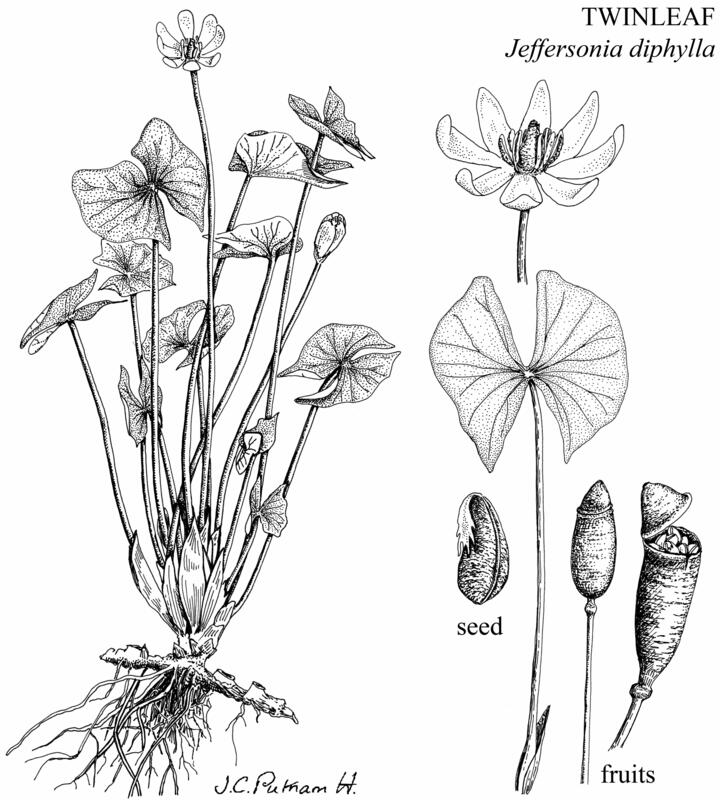
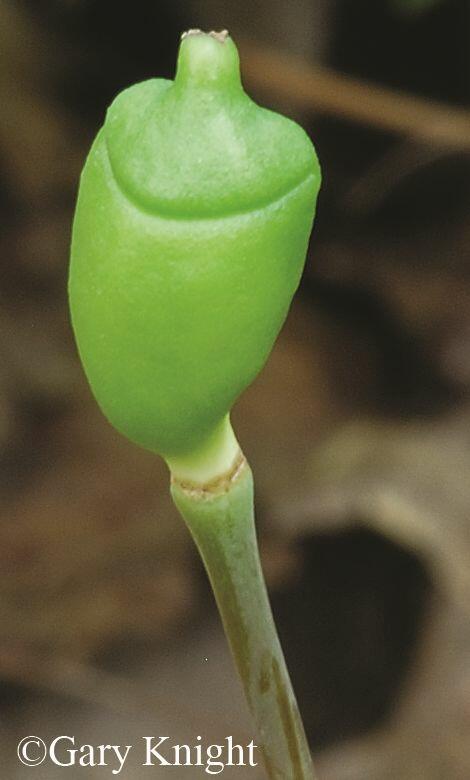
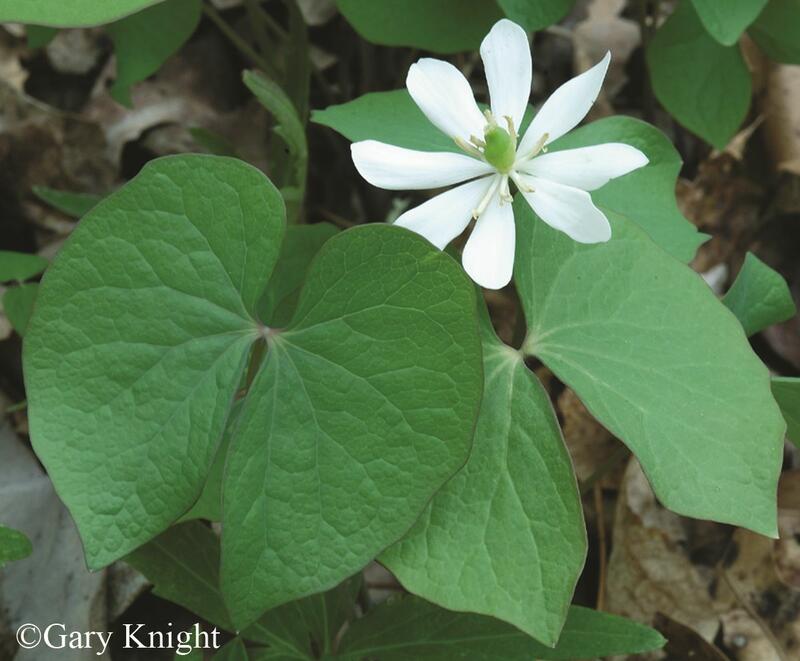
Perennial herb 4 - 16 inches (10 - 40 cm) tall, with an underground stem (rhizome) that sends up a new plant with 4 - 8 (or more) leaves each year; there is no aboveground stem. Leaves consist of two spreading, wing-like leaflets each up to 1.5 inches (1.2 - 4 cm) long and 1 inch wide (0.6-2.5 cm) wide at flowering time, and expanding to 2.4 - 5 inches long and 1.2 - 2.8 inches wide (6 - 13 cm long and 3 - 7 cm wide) by mid-summer. The leaf stalk is erect, 3.5 - 10 inches (9 - 25 cm) tall at flowering, maturing to 7 - 17 inches (18-43 cm) tall by mid-summer. At flowering, leaves are red to maroon then mature to a waxy, bluish-green. The flowers are 0.6 - 1.6 inch (1.5 - 4 cm) across, held at the top of leafless flower stalks; each flower has 7 - 9 white petals and 8 white stamens with yellow anthers. The fruit is an erect, pear-shaped pod, about 0.8 inch (2 cm) tall, the top quarter of which opens back like a lid, exposing the seeds, which fall out as the pod tips over. Each seed has a fleshy, white, fringed "handle" (elaiosome).
Bloodroot (Sanguinaria canadensis) leaves are waxy, blue-green, and often deeply lobed but never divided into two equal halves. Its leaf stalks exude red juice if broken, its flower has 8 - 16 petals, the stamens are bright gold, and the fruit pod splits along 2 vertical seams.
None
Moist, deciduous hardwood forests over limestone.
Twinleaf reproduces sexually by seed as well as vegetatively by branching of its rhizome. Buds on the rhizome branches produce new, separate (though genetically identical) plants, with the connecting portions of the rhizome decaying away. Flower stalks emerge from the rhizome in early spring just before or at the same time as the new, reddish-maroon leaves emerge. The flowers open only on sunny days and will continue to open for several days, the whole population remaining in flower for up to 2 weeks. Flowers are visited by halictid bees and honeybees on warm, sunny days. Twinleaf flowers produce abundant pollen but no nectar. As the flower begins to wither, the stamens bend inward toward the stigma, depositing pollen and effecting self-pollination. Twinleaf can produce fruit and viable seeds from both self-pollinated and insect-pollinated flowers.
Fruits develop at the top of the flower stalks. When the fruits are mature, the flower stalk bends over and the upper part of the fruit – the lid – pops open, tipping the seeds out. The seeds are dispersed by ants, which are attracted by fringed "handles" (fat- and protein-rich elaiosomes) on the seeds; ants carry the seeds to their nests, feed the elaiosomes to their larvae, and discard the seeds in their nutrient-rich waste dumps which are ideal seed beds. However, most of the seeds are eaten by other animals; as a result, Twinleaf relies heavily on vegetative reproduction for population growth.
Plants are most conspicuous during flowering (late March–early April) and fruiting (April) but their leaves persist through the summer and are easy to identify.
Georgia and Alabama, north to New York and Ontario, west to Minnesota and Iowa. Twinleaf is abundant in northern and midwestern states.
Conversion of habitat to pine plantations, pasture, and development. Logging and other mechanical clearing. Invasion by exotic pest plants such as Japanese honeysuckle. Plant poaching.
| Threat 1 | Threat 2 | Threat 3 | |
|---|---|---|---|
| General Threat | Agriculture & aquaculture | Natural system modifications | Invasive & other problematic species, genes & diseases |
| Specific Threat | Wood & pulp plantations | Other ecosystem modifications | Invasive non-native/alien species/diseases |
Jeffersonia diphylla is ranked S1 by the Georgia Department of Natural Resources, indicating that it is critically imperiled in Georgia. It is listed as Rare by the State of Georgia. Six populations are known, four on state conservation lands.
Georgia’s plants are the southernmost populations of this species. Plants occurring at the periphery of a species’ range are thought to be of special conservation importance. Peripheral populations are usually smaller and less genetically diverse within the population, but genetically divergent from centrally located populations. These genetic differences may confer special survival traits that plants in other portions of the species’ range lack, such as the ability to survive changes in the climate or the arrival of a new pathogen. Peripheral populations may be in the process of evolving into a new species. They are especially deserving of conservation action.
Avoid logging, clearing, and other mechanical disturbances in mature hardwood forests. Eradicate exotic pest plants. Prosecute plant poachers.
Chafin, L.G. 2007. Field guide to the rare plants of Georgia. State Botanical Garden of Georgia and University of Georgia Press, Athens.
Clark, J. 2004. Wildflowers of Pigeon Mountain, Lookout Mountain, Cloudland Canyon State Park, and Chickamauga National Military Park in northwest Georgia. Waldenhouse Publishers, Walden, Tennessee.
GADNR. 2020. Element occurrence records for Jeffersonia diphylla. Georgia Department of Natural Resources, Wildlife Resources Division, Social Circle, Georgia.
George, Lisa O'Rourke. 1997. Jeffersonia diphylla species account. Flora of North America, Vol. 3. Oxford University Press, New York. http://www.efloras.org/florataxon.aspx?flora_id=1&taxon_id=233500714
Grieg, E. 2012. Twinleaf–a president’s wildflower. Eye on Nature: Views of nature from the New Jersey Highlands. https://eyeonnature.wordpress.com/2012/04/02/twinleaf-a-presidents-wildflower/
Horn, D., T. Cathcart, T.E. Hemmerly, and D. Duhl. 2005. Wildflowers of Tennessee, the Ohio Valley, and the southern Appalachians. Lone Pine Publishing, Auburn, Washington.
NatureServe. 2019. Jeffersonia diphylla comprehensive report. NatureServe Explorer. Arlington, Virginia. http://explorer.natureserve.org/servlet/NatureServe?searchName=Jeffersonia+diphylla
Patrick, T.S., J.R. Allison, and G.A. Krakow. 1995. Protected plants of Georgia. Georgia Department of Natural Resources, Natural Heritage Program, Social Circle.
Radford, A.E., H.E. Ahles, and C.R. Bell. 1968. Manual of the vascular flora of the Carolinas. University of North Carolina Press, Chapel Hill.
Smith, B.H., M.L. Ronsheim, and K.R. Swartz. 1986. Reproductive ecology of Jeffersonia diphylla (Berberidaceae). American Journal of Botany 73(10): 1416-1426. https://www.jstor.org/stable/2443846?seq=1#metadata_info_tab_contents
Weakley, A.S. 2015. Flora of the southern and mid-Atlantic States. University of North Carolina Herbarium, University of North Carolina, Chapel Hill. http://www.herbarium.unc.edu/flora.htm
Linda G. Chafin
L. Chafin, Apr. 2007: original account
K. Owers, Feb. 2010: added pictures
L. Chafin, March 2020: updated original account.