

Loading profile. Please wait . . .
Illicium floridanum Ellis
Florida Anise




Federal Protection: No US federal protection
State Protection: Endangered
Global Rank: G5
State Rank: SH
Element Locations Tracked in Biotics: Yes
SWAP 2015 Species of Greatest Conservation Need (SGCN): Yes
SWAP 2025 Species of Greatest Conservation Need (SGCN): No
2025 SGCN Priority Tier:
Element Occurrences (EOs) in Georgia: 2
Habitat Summary for element in Georgia: Steepheads, floodplain forests
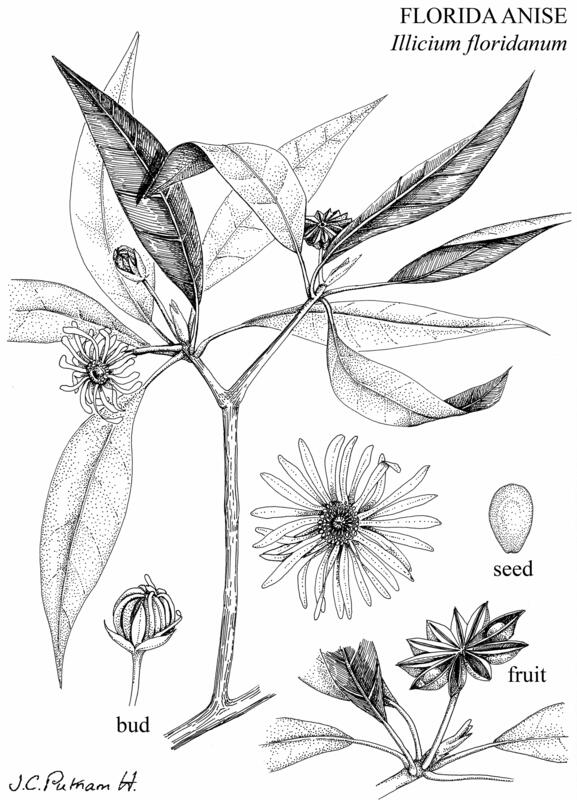
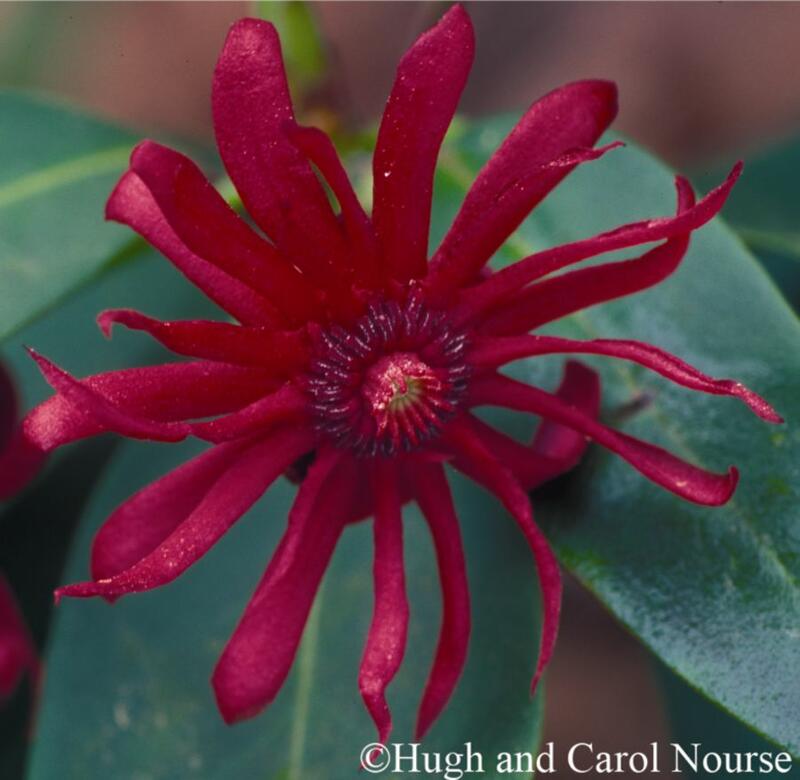
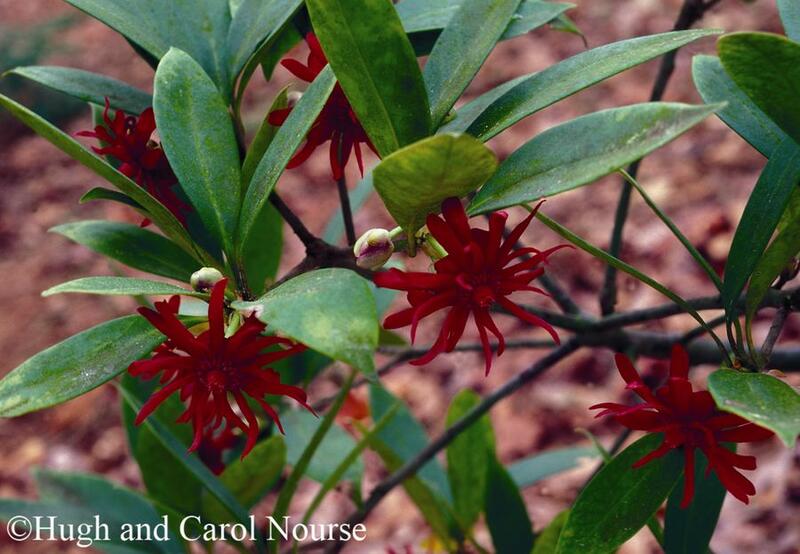
Evergreen shrub or small tree, 5 - 26 feet (1.5 - 8 meters) tall. Leaves 2 - 8 inches (5 - 21 cm) long and 0.6 - 2.4 inches (1.5 - 6 cm) wide, evergreen, smooth, leathery, with entire margins, tapering bases, and pointed tips; alternate or appearing whorled at the ends of branches; with a strong, spicy or fishy smell when crushed. Leaf stalks are reddish, up to 1 inch (2.6 cm) long. Flowers are 1 - 2 inches (2.5 - 5 cm) wide, dark red to maroon (rarely white), often hidden among the leaves, foul-smelling, with 20 - 33 narrow petals. Fruits are 1 - 1.6 inches (2.5 - 4 cm) wide, star-shaped, composed of 11 - 17 woody pods arranged in a circle. Although very rare in the wild in Georgia, Florida Anise is widely used in landscaping.
No other native shrub has flowers that are similar to Florida Anise but several other evergreen shrubs in the Coastal Plain have similar-looking leaves though none have the strong, pungent smell of Florida Anise leaves. Horse Sugar or Sweet Leaf (Symplocos tinctoria) occurs in drier habitats and has rough-hairy leaves that smell like green apples when crushed. Wild Olive (Osmanthus americanus) has similar leathery, evergreen leaves but they are opposite. Coastal Dog-hobble (Leucothoe axillaris) grows in the same habitats as Florida Anise but is a low shrub with arching, zigzag stems; its leaves have small teeth on the margins.
None in Georgia. Yellow Star-anise (Illicium parviflorum), which is endemic to and rare in Florida, has never been found in the wild in Georgia. It naturally occurs only in central Florida although it is widely used in landscaping throughout Georgia. Its spicy-smelling leaves are oval with bluntly rounded tips; its leaf stalks are green; and the flowers are small with 6 - 12 rounded, yellow petals. Both Florida Anise and Yellow Star-anise are closely related to Chinese Star Anise (Illicium verum) whose fruits are used for spice and medicine.
Lower slopes and stream banks in moist wooded ravines and steepheads, often forming dense thickets in stream bottoms.
Florida Anise produces an abundance of flowers, each of which remains open and receptive to pollination for 12 - 14 days. The flowers are pollinated primarily by flies, which are attracted to nectar secreted at the base of the stamens and by the pungent smell of the flowers. Because Florida Anise forms large clonal patches, much of the insect activity leads to self-pollination, and, since Florida Anise is self-incompatible, self-pollination does not lead to fruit production. Only flowers that are cross-pollinated with pollen from another plant will produce fruit. Florida Anise plants reproduce primarily by root sprouting, forming large thickets of genetically identical plants (clones). As the size of a clonal thicket increases, the farther an insect pollinator must fly to reach a separate plant, thus further decreasing the chances that an insect will carry out cross-pollination and that fruit will be produced. The star-shaped fruits have an average of 13 segments, each with a single seed that is ejected explosively from the fruit for a short distance. The leaves and fruits of Florida Anise are poisonous to cattle.
Surveys are best conducted during flowering (late March–April), although the plants may be recognized by their colony-forming habit and distinctive leaves all year.
Coastal Plain of Georgia, Florida, Alabama, Mississippi, and Louisiana; one isolated population occurs in northeastern Mexico.
Logging and other clearing in ravines and wetlands; ditching and draining in streamside wetlands; impoundment of small streams.
Illicium floridanum is ranked SH ("historic") by the Georgia Department of Natural Resources, indicating that the species has not been seen in Georgia in several decades. Only two populations have been documented in Georgia, in 1966 and 1980. Both occurred on private land and their current status is unknown.
Avoid clearcutting on slopes and in ravines. Avoid damming streams and draining wetlands. Preserve natural hydrology in uplands that supply water to steephead streams.
Chafin, L.G. 2007. Field guide to the rare plants of Georgia. State Botanical Garden of Georgia and University of Georgia Press, Athens.
GADNR. 2020. Element occurrence records for Illicium floridanum. Georgia Department of Natural Resources, Wildlife Resources Division, Social Circle, Georgia.
Godfrey, R.K. 1988. Trees, shrubs, and woody vines of northern Florida and adjacent Georgia and Alabama. University of Georgia Press, Athens.
Kirkman, L.K., C.L. Brown, and D.J. Leopold. 2007. Native trees of the southeast. Timber Press, Portland, Oregon.
Koehl, V., L.B. Thien, E.G. Heij, and T.L. Sage. 2004. Causes of self-sterility in natural populations of the relictual angiosperm, Illicium floridanum (Illiciaceae). Annals of Botany 94(1): 43-50. https://www.ncbi.nlm.nih.gov/pubmed/15155377
NatureServe. 2019. Illicium floridanum comprehensive report. NatureServe Explorer. Arlington, Virginia. http://explorer.natureserve.org/servlet/NatureServe?searchName=Illicium+floridanum
Roberts, M. L. and R. R. Haynes. 1983. Ballistic seed dispersal in Illicium (Illiciaceae). Plant Systematics and Evolution 143: 227-232. https://www.jstor.org/stable/23669876?seq=1
Thien, L.B., D.A. White, and L.Y. Yatsu. 1983. Reproductive biology of a relict – Illicium floridanum. American Journal of Botany 70: 719-727. https://www.jstor.org/stable/2443126?seq=1#metadata_info_tab_contents
Vincent, M.A. 1997. Illicium floridanum species account. Flora of North America, Vol. 3. Oxford University Press, New York. http://www.efloras.org/florataxon.aspx?flora_id=1&taxon_id=233500688
Weakley, A.S. 2015. Flora of the southern and mid-Atlantic States. University of North Carolina Herbarium, University of North Carolina, Chapel Hill. http://www.herbarium.unc.edu/flora.htm
Linda G. Chafin
L. Chafin, Oct. 2007: original account
K. Owers Feb. 2010: added pictures
L. Chafin, Feb 2020: updated original account.