


Loading profile. Please wait . . .
Carex dasycarpa Muhl.
Velvet Sedge




Federal Protection: No US federal protection
State Protection: Rare
Global Rank: G4?
State Rank: S3
Element Locations Tracked in Biotics: Yes
SWAP 2015 Species of Greatest Conservation Need (SGCN): No
SWAP 2025 Species of Greatest Conservation Need (SGCN): Yes
2025 SGCN Priority Tier: Moderate Conservation Concern
Element Occurrences (EOs) in Georgia: 25
Habitat Summary for element in Georgia: Evergreen hammocks; mesic hardwood forests
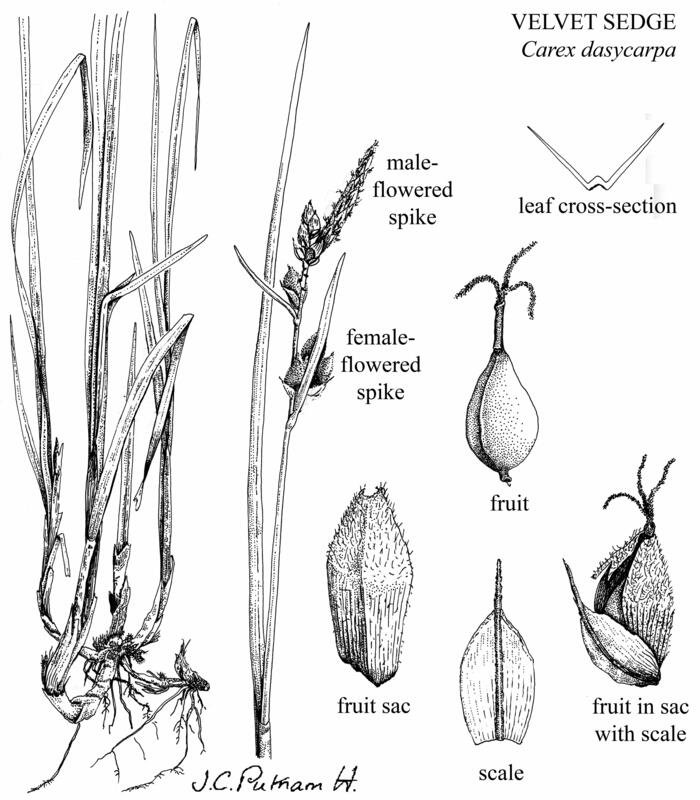
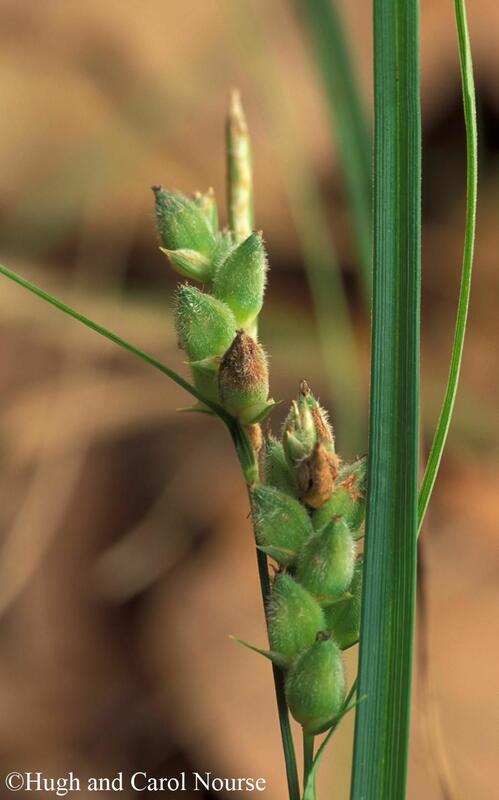
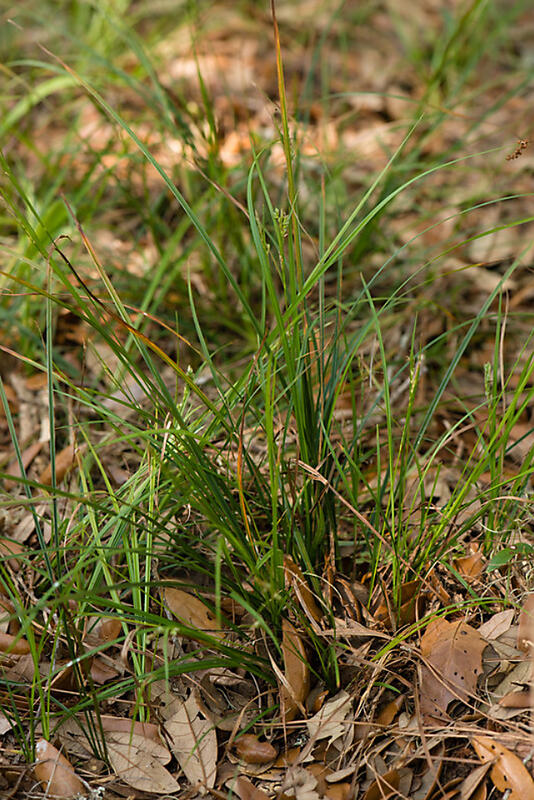
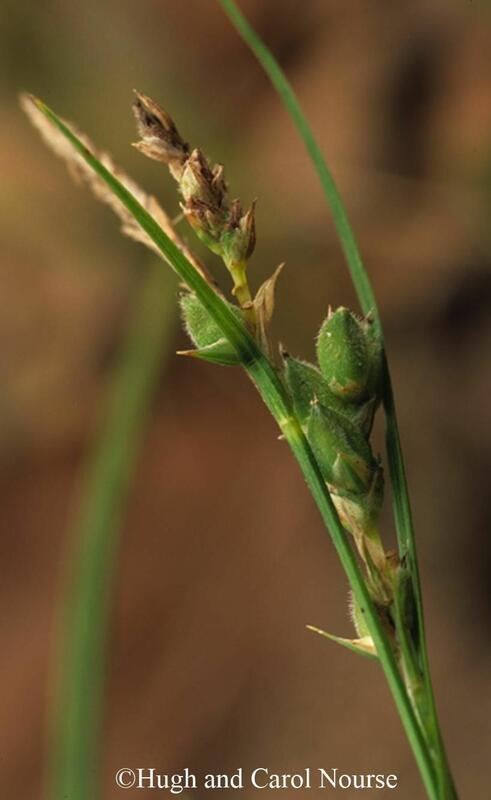
Perennial, grass-like herb forming loose clumps connected by slender underground stems (rhizomes). Flowering stems are 5 - 16 inches (13 - 40 cm) tall, with 3 - 8 basal leaves. Leaves are 2 - 14 inches (5 - 35 cm) long, with a hairy, reddish, basal sheath encircling the stem. Leaf blades are less than 0.2 inch (2 - 4.5 mm) wide, and are softly hairy near the base, W-shaped in cross-section when young, and with 3 prominent veins on the upper surface. Male-flowered spikes are up to 0.8 inch (8 - 20 mm) long, solitary at the top of the flowering stem, and covered with pale, papery scales with a green midvein. Female-flowered spikes are 0.25 - 1 inch (6 - 27 mm) long, 2 - 3 per stem, held below the male-flowered spike, each spike with 5 - 25 fruits, the scales oval and 3-ribbed with a pointed tip. The body of the fruit is less than 0.25 inch (4.5 - 6 mm) long, with a short stalk and elongated tip (the persistent style); the fruit is sharply 3-angled and enclosed in a woolly-hairy, heavily veined sac (perigynium); the fruit body occupies only the upper part of the sac. Magnification of 10x is needed to examine the spikes and fruits.
Wire Sedge (Carex tenax) also occurs in dry woods. Its leaves are hairy near the base but are V-shaped in cross-section when young, and are often inrolled and wiry. Its perigynia are not hairy; the fruits lack the short stalk, and the fruit body completely fills the perigynium.
Forty-five species of Carex are rare in Georgia, see: https://georgiabiodiversity.org/portal/element_lists?group=plant
Detailed information about these 10 rare Carex species is provided on this website:
Acid-Loving Sedge (C. acidicola): https://georgiabiodiversity.org/portal/profile?group=plants&es_id=34933
Baltzell's Sedge (C. baltzellii): https://georgiabiodiversity.org/portal/profile?group=plants&es_id=15974
Granite Dome Sedge (C. biltmoreana): https://georgiabiodiversity.org/portal/profile?group=plants&es_id=19146
Lime-fleeing Sedge (C. calcifugens): https://georgiabiodiversity.org/portal/profile?group=plants&es_id=33655
Velvet Sedge (C. dasycarpa): https://georgiabiodiversity.org/portal/profile?group=plants&es_id=15939
Cypress-knee Sedge (C. decomposita): https://georgiabiodiversity.org/portal/profile?group=plants&es_id=21206
Meager Sedge (C. exilis): https://georgiabiodiversity.org/portal/profile?group=plants&es_id=34936
Wretched Sedge (C. misera): https://georgiabiodiversity.org/portal/profile?group=plants&es_id=16740
Radford’s Sedge (C. radfordii): https://georgiabiodiversity.org/portal/profile?group=plants&es_id=15374
Roan Mountain Sedge (C. roanensis): https://georgiabiodiversity.org/portal/profile?group=plants&es_id=21034
Thorne's Sedge (C. thornei): https://georgiabiodiversity.org/portal/profile?group=plants&es_id=34939
Well drained, sandy-loamy soils in a variety of habitats: mixed pine-hardwood forests on river bluffs and stream terraces, levees and swales in floodplains, maritime forests along Atlantic coast rivers, Longleaf Pine woodlands on barrier islands, Beech-Magnolia-Spruce Pine forests.
Like most sedges, Velvet Sedge is wind-pollinated. Nothing has been published about seed dispersal or other aspects of reproduction for this species though it is likely that the seeds are eaten by birds and small mammals.
Surveys are best conducted during fruiting (early spring–summer), when the distinctive hairy perigynia and fruit stalks are present.
Georgia, Florida, Alabama, Mississippi, and South Carolina.
Conversion of habitat to pine plantations, agriculture, and residential and commercial development. Invasion by exotic pest species such as Japanese Honeysuckle and Japanese Climbing Fern.
| Threat 1 | Threat 2 | Threat 3 | |
|---|---|---|---|
| General Threat | Agriculture & aquaculture | Residential & commercial development | Invasive & other problematic species, genes & diseases |
| Specific Threat | Wood & pulp plantations | Commercial & industrial areas | Invasive non-native/alien species/diseases |
Carex dasycarpa is ranked S3 by the Georgia Department of Natural Resources, indicating that it is rare and vulnerable in the state. It is listed as Rare by the State of Georgia. Twenty populations have been documented in Georgia, but only five occur on conservation lands.
Burn Longleaf Pine woodlands every 2 - 3 years during the growing season. Protect maritime, bluff, and ravine forests from soil disturbances and canopy removal. Control invasive exotic species, including feral hogs.
Ball, P.W. 2003. Species account for Carex dasycarpa. Flora of North America, vol. 23, Magnoliophyta: Commelinidae (in part), Cyperaceae (part 1). Oxford University Press, New York. http://www.efloras.org/florataxon.aspx?flora_id=1&taxon_id=242357144
GADNR. 2019. Element occurrence records for Carex dasycarpa. Georgia Department of Natural Resources, Wildlife Resources Division, Social Circle, Georgia.
NatureServe. 2019. Carex dasycarpa comprehensive report. NatureServe Explorer. Arlington, Virginia. http://explorer.natureserve.org/servlet/NatureServe?searchName=Carex%20dasycarpa
Patrick, T.S., J.R. Allison, and G.A. Krakow. 1995. Protected plants of Georgia. Georgia Department of Natural Resources, Natural Heritage Program, Social Circle.
Radford, A.E., H.E. Ahles, and C.R. Bell. 1968. Manual of the vascular flora of the Carolinas. University of North Carolina Press, Chapel Hill.
Weakley, A.S. 2015. Flora of the southern and mid-Atlantic States. University of North Carolina Herbarium, University of North Carolina, Chapel Hill. http://www.herbarium.unc.edu/flora.htm
Linda G. Chafin
L. Chafin, Nov. 2007: original account.
K. Owers, Jan. 2010: updated status and ranks, added pictures.
L. Chafin, Jan 2020: updated original account.