

Loading profile. Please wait . . .
Lythrum curtissii Fern.
Curtiss' Loosestrife




Federal Protection: No US federal protection
State Protection: Threatened
Global Rank: G2
State Rank: S1
Element Locations Tracked in Biotics: Yes
SWAP 2015 Species of Greatest Conservation Need (SGCN): Yes
SWAP 2025 Species of Greatest Conservation Need (SGCN): Yes
2025 SGCN Priority Tier: Highest Conservation Concern
Element Occurrences (EOs) in Georgia: 13
Habitat Summary for element in Georgia: Openings in calcareous swamps
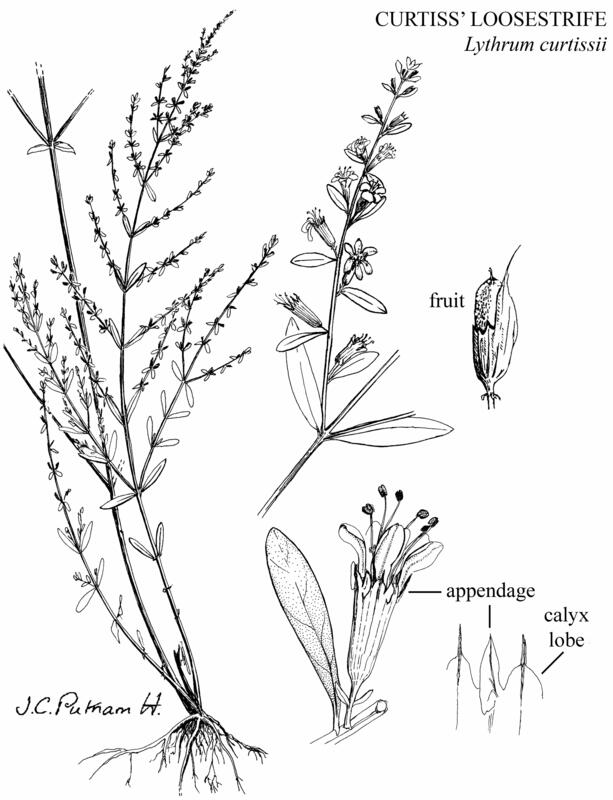
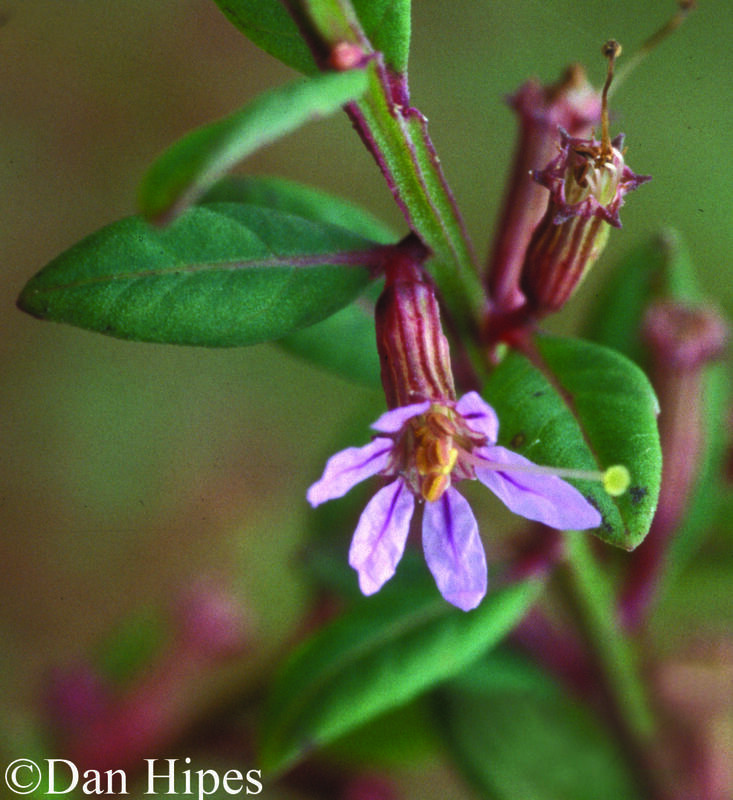
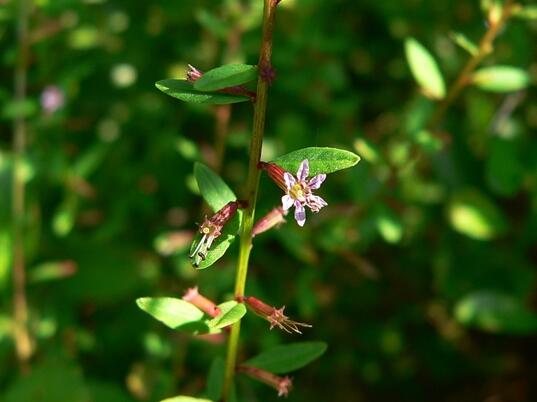
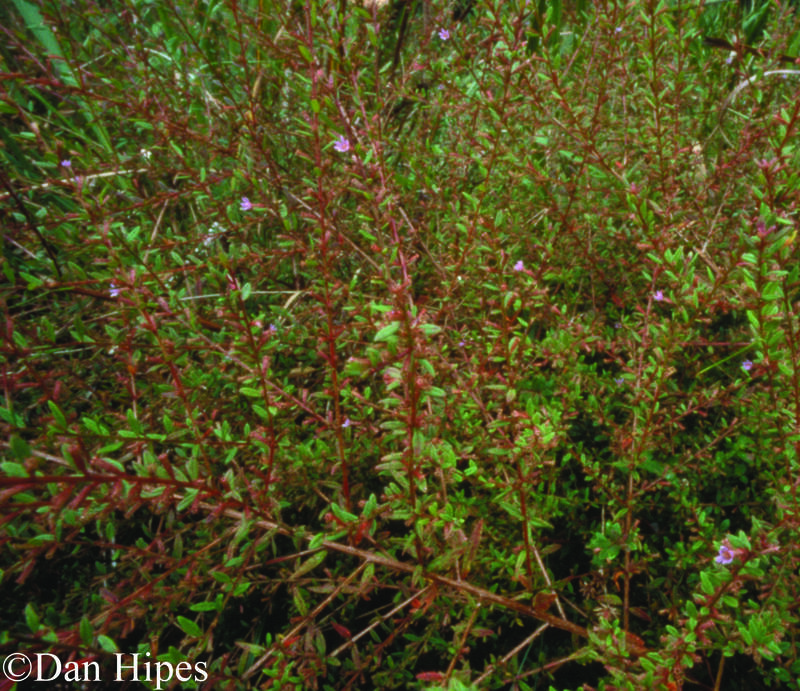
Perennial herb rising from a woody, persistent base, with one to several erect or leaning, much-branched stems. Upper branches are four-sided or slightly winged. The leaves are widely spaced with very short or no leaf stalks; leaves on lower stems are up to 2 inches (5 cm) long, opposite, usually shed by flowering time; leaves on upper branches are smaller and usually alternate. The flowers are slightly asymmetrical, and are held in the angle between stem and upper leaves. Each flower consists of 6 pink-purple petals about 0.1 inch long (3 mm) and a green and purple, ribbed calyx tube about 0.1 inch long (3 mm); the calyx lobes alternate with 6 appendages (see drawing, below) that are the same size as the lobes; petals fall soon after flowering. The fruit is a tiny, cylindrical, reddish-brown capsule.
Winged Loosestrife (Lythrum alatum) also occurs in freshwater wetlands, sometimes with Curtiss’ Loosestrife. Its leaves are smaller, crowded, and overlapping in the upper branches; the flowers are larger and the sepal appendages are twice as long as the adjacent sepals.
None in Georgia.
Swamps over limestone, clearings in wet pine flatwoods, sunny patches in stream thickets and floodplain forests in southwest Georgia.
Curtiss’ Loosestrife is a perennial herb that reproduces sexually by seed, primarily through outcrossing. Flowers of the Loosestrife (Lythrum) genus are especially adapted to promote cross-pollination. The flowers on one plant will have long styles and short stamens (“thrum” flowers), while flowers of another plant in the same population will have short styles and long stamens (“pin” flowers). Insects that visit these flowers will pick up pollen on different areas of their bodies, depending on the length of the stamen; they will be able to contribute that pollen only to the other type of flower, thus preventing self-pollination.
This species is especially hard to see in wetland thickets. Plants are most conspicuous during flowering (June–early September).
Southwest Georgia and Florida Panhandle. It is rare throughout its range.
Draining, ditching, and conversion of wetland habitat for agriculture and pine plantations. Fire suppression, building firebreaks in wetland ecotones, use of herbicides on roadsides and in utility rights-of-way.
| Threat 1 | Threat 2 | Threat 3 | |
|---|---|---|---|
| General Threat | Natural system modifications | Transportation & service corridors | Climate change & severe weather |
| Specific Threat | None | None | None |
Lythrum curtissii is ranked S1 by the Georgia Department of Natural Resources, indicating that it is critically imperiled in Georgia. It is listed by the State of Georgia as Threatened. Eight populations have been documented in Georgia, but only two in the last twenty years and both of these on conservation land.
Avoid drainage and mechanical disturbance in wetlands. Burn flatwoods every 2 - 3 years to maintain open canopy; allow fires to burn into streamside thickets and edges of floodplains. Avoid herbicide use on roadsides and in utility rights-of-way.
Allison, J.R. 1991. The status of Cacalia diversifolia and Lythrum curtissii in southwest Georgia. Report to the Georgia Department of Natural Resources, Wildlife Resources Division, Social Circle, Georgia.
Chafin, L.G. 2007. Field guide to the rare plants of Georgia. State Botanical Garden of Georgia and University of Georgia Press, Athens.
Chafin, L.G. 2000. Field guide to the rare plants of Florida. Florida Natural Areas Inventory, Tallahassee.
GADNR. 2020. Element occurrence records for Lythrum curtissii. Georgia Department of Natural Resources, Wildlife Resources Division, Social Circle, Georgia.
Godfrey, R.K. and J.W. Wooten. 1981. Aquatic and wetland plants of southeastern United States, Vol. 2, dicotyledons. University of Georgia Press, Athens.
Graham, S.A. 1964. The genera of Lythraceae in the southeastern United States. Journal of the Arnold Arboretum 45: 235-250.
Graham, S.A. 1975. Taxonomy of the Lythraceae of the southeastern United States. Sida 6:80-103.
Kral, R. 1983. A report on some rare, threatened, or endangered forest-related vascular plants of the South. Technical Publication R8-TP2. United States Forest Service, Atlanta.
NatureServe. 2019. Lythrum curtissii comprehensive report. NatureServe Explorer. Arlington, Virginia. http://explorer.natureserve.org/servlet/NatureServe?searchName=Lythrum+curtissii
Patrick, T.S., J.R. Allison, and G.A. Krakow. 1995. Protected plants of Georgia. Georgia Department of Natural Resources, Natural Heritage Program, Social Circle.
Weakley, A.S. 2015. Flora of the southern and mid-Atlantic States. University of North Carolina Herbarium, University of North Carolina, Chapel Hill. http://www.herbarium.unc.edu/flora.htm
Linda G. Chafin
L. Chafin, June 2008: original account
K. Owers, Feb. 2010: added pictures
L. Chafin, March 2020: updated original account.