

Loading profile. Please wait . . .
Tillandsia bartramii Ell.
Bartram's Airplant




Federal Protection: No US federal protection
State Protection: No Georgia state protection
Global Rank: G4
State Rank: S2
Element Locations Tracked in Biotics: Yes
SWAP 2015 Species of Greatest Conservation Need (SGCN): No
SWAP 2025 Species of Greatest Conservation Need (SGCN): Yes
2025 SGCN Priority Tier: High Conservation Concern
Element Occurrences (EOs) in Georgia: 20
Habitat Summary for element in Georgia: Epiphytic in bay swamps, freshwater tidal swamps; beech-magnolia bluff forests
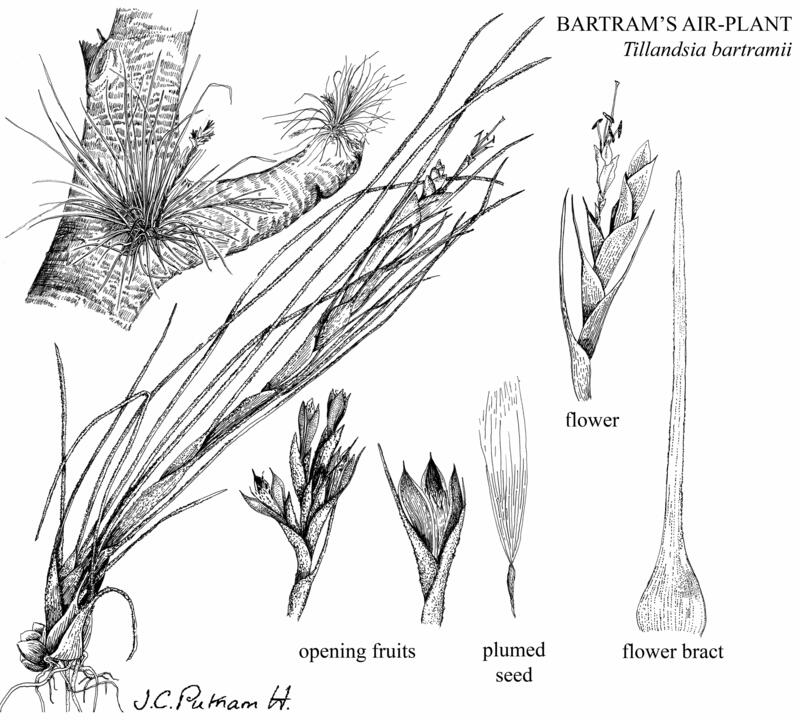
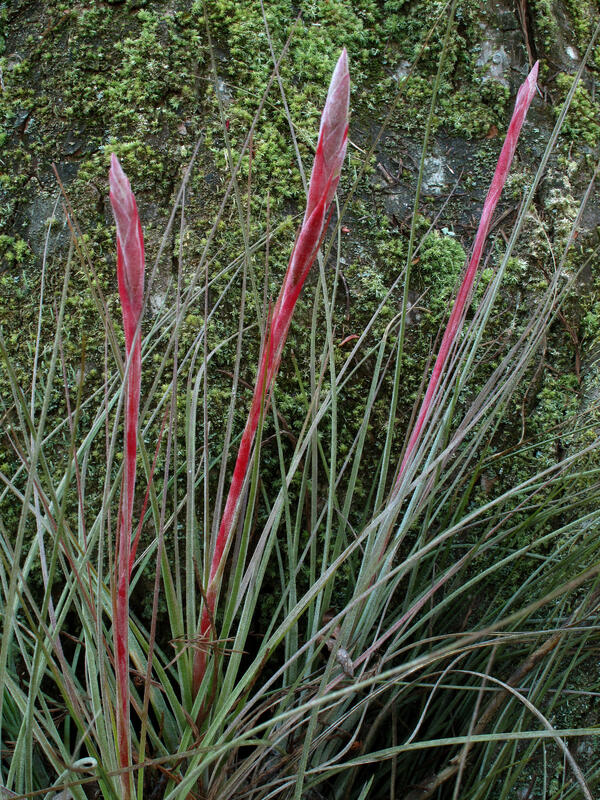
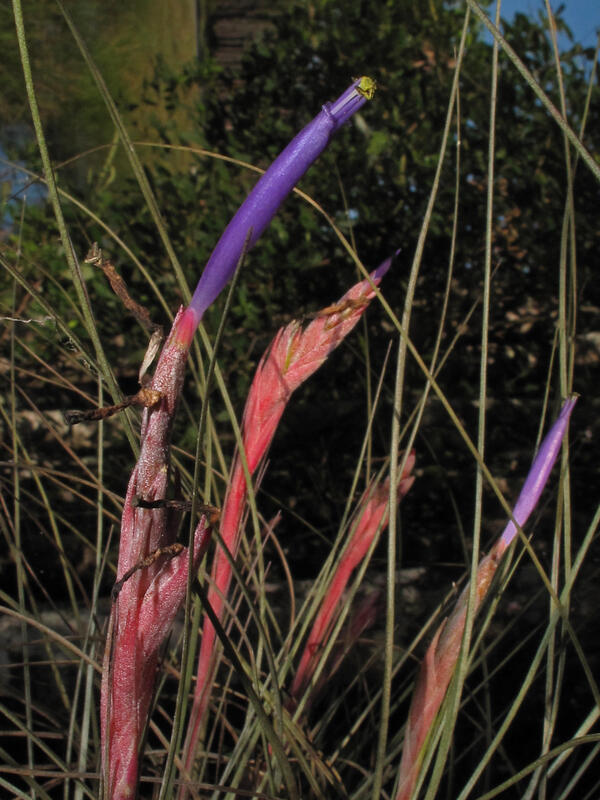
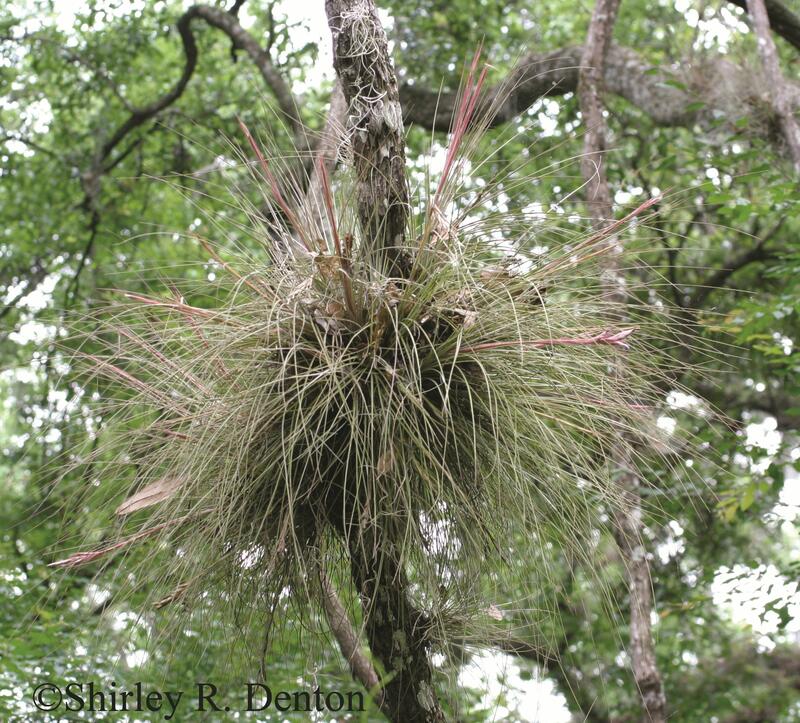
Perennial, evergreen herb attached to tree trunks and branches, forming dense clusters of stiffly spreading, narrow leaves. The leaves 6 - 16 inches (15 - 40 cm) long and less than 0.25 inch (0.5 cm) wide except for the wide, flat, triangular base; the leaves are covered with pinkish-gray scales. Flower spikes are held at the tips of long, sometimes branched flower stalks that are 3 - 6 inches (8 - 15 cm) long and sometimes branched; each spike has 5 - 20 flowers that emerge from beneath red, pointed, overlapping bracts. Flowers are 1 - 1.8 inch (3 - 4.5 cm) long with 3 pale green sepals (covered by bracts) and 3 purple petals rolled into a narrow tube. Fruits are narrow, brown capsules about 1 inch (2.5 - 3 cm) long that open into 3 parts to release plumed seeds.
See "Related Rare Species" below.
Three other species of air-plants are of Special Concern in Georgia:
Quill-leaf Air-plant (Tillandsia fasciculata) has stiff, leathery leaves up to 1 inch (2.5 cm) wide at the base; it is known from one site in Camden County where it grows on Live Oaks in a maritime hammock. For more information, see: http://entnemdept.ufl.edu/frank/savebromeliads/floridas-bromeliads/Tillandsia-fasciculata.html
Ball-moss (Tillandsia recurvata) occurs in Camden and Glynn Counties where it forms dense “balls” of curved leaves on Live Oaks in maritime forests. For more information, see: http://entnemdept.ufl.edu/frank/savebromeliads/floridas-bromeliads/Tillandsia-recurvata.html
Needle-leaved Air-plant (Tillandsia setacea) leaves resemble pine needles; it grows on evergreen hardwood trees in bluff forests in Glynn, Laurens, and Ben Hill Counties. For more information, see: http://entnemdept.ufl.edu/frank/savebromeliads/floridas-bromeliads/Tillandsia-setecea.html
Limbs and trunks of Loblolly Bay, Live Oak, Red Cedar, and other trees in bay swamps, tidal swamp forests, and moist maritime forests.
Bartram’s Air-plant is a perennial herb that reproduces sexually as well as vegetatively by offsets. It is an epiphyte held on the limbs and trunks of trees by wiry roots which serve only to anchor the plant to its supporting limb and do not take up water or nutrients from the tree. Air-plants have evolved several strategies for surviving without roots. Their leaves are densely covered with scales that reduce water loss and also absorb moisture and nutrients from the air. They conduct photosynthesis by a special method known as CAM, which reduces moisture loss. The overlapping leaf bases form shallow cups that catch rain water as well as plant fragments and insects; as these materials decompose, the released nutrients are absorbed by the air-plant's leaves.
Most air-plant flowers are cross-pollinated by hummingbirds and bees, although pollinators of Bartram’s Air-plant have not been reported. Nectar is produced at the base of the ovary and there is little to no fragrance, the colorful bracts and petals serving as pollinator attractants. After flowering, a plant stops growing new leaves and eventually dies. Before dying, it usually produces plantlets (known as “pups” or “offsets”) around its base, often forming large clumps of multi-aged plants. Pollinated flowers produce fruits that open to release plumed, wind-dispersed seeds.
The plants are most conspicuous during flowering (spring–summer), but their evergreen leaves and growth form are recognizable all year.
Georgia, Florida, and South Carolina; Tamaulipas, Mexico.
Clearing, logging, draining, and commercial and residential development in maritime forests, coastal hammocks, and swamps.
| Threat 1 | Threat 2 | Threat 3 | |
|---|---|---|---|
| General Threat | Energy production & mining | Agriculture & aquaculture | None |
| Specific Threat | None | None | None |
Tillandsia bartramii is ranked S2 by the Georgia Department of Natural Resources, indicating that the species is imperiled in Georgia. About 16 populations have been documented in Georgia, but only three have been confirmed since 2000; 3 occur on conservation lands, 3 on a military base.
Prevent logging, clearing, draining, and development of maritime forests, coastal hammocks, and swamps.
Bromeliad Society International. 2009. What are bromeliads? https://www.bsi.org/new/what-are-bromeliads/http://www.bsi.org/
Callison, A. 1992 (July - August). Native Tillandsia species of Georgia. Journal of the Bromeliad Society 42(4): 172-174. https://journal.bsi.org/PDF/V42/BSI_V42(4).pdf
Chafin, L.G. 2007. Field guide to the rare plants of Georgia. State Botanical Garden of Georgia and University of Georgia Press, Athens.
Gardner, C.S. 1986. Inferences about pollination in Tillandsia (Bromeliaceae). Selbyana 9(1): 76-87. https://www.jstor.org/stable/41888788?seq=1#metadata_info_tab_contents
Luther, H.E. and G.K. Brown. 2000. Flora of North America, Vol. 22. Oxford University Press, New York. http://beta.floranorthamerica.org/Tillandsia_bartramii
GADNR. 2020. Element occurrence records for Tillandsia bartramii. Georgia Department of Natural Resources, Wildlife Resources Division, Social Circle, Georgia.
Judson, O. 2008. The wild side: pineapple dreams. New York Times, 18 March 2008. https://opinionator.blogs.nytimes.com/2008/03/18/pineapple-dreams/
Larson, B.C., J.H. Frank, G.M. Allen and M.B. Main. 2004. Florida's native bromeliads. Circular 1466 (UW205), Department of Wildlife Ecology & Conservation, Florida Cooperative Extension Service, Institute of Food and Agricultural Sciences, University of Florida, Gainesville. https://edis.ifas.ufl.edu/uw205
NatureServe. 2020. Tillandsia bartramii species account. NatureServe Explorer. NatureServe, Arlington, Virginia. https://explorer.natureserve.org/Taxon/ELEMENT_GLOBAL.2.137330/Tillandsia_bartramii
Patrick, T.S., J.R. Allison, and G.A. Krakow. 1995. Protected plants of Georgia. Georgia Department of Natural Resources, Natural Heritage Program, Social Circle.
Weakley, A.S. 2015. Flora of the southern and mid-Atlantic States. University of North Carolina Herbarium, University of North Carolina, Chapel Hill. http://www.herbarium.unc.edu/flora.htm
Linda G. Chafin
L. Chafin, Jan. 2009: original account
K. Owers, Feb. 2010: added pictures
Z. Abouhamdan, Apr. 2016: updated link
L. Chafin, Jun. 2020: updated original account.