

Loading profile. Please wait . . .
Salix floridana Chapman
Florida Willow




Federal Protection: No US federal protection
State Protection: Endangered
Global Rank: G2G3
State Rank: S1
Element Locations Tracked in Biotics: Yes
SWAP 2015 Species of Greatest Conservation Need (SGCN): Yes
SWAP 2025 Species of Greatest Conservation Need (SGCN): Yes
2025 SGCN Priority Tier: Highest Conservation Concern
Element Occurrences (EOs) in Georgia: 7
Habitat Summary for element in Georgia: Spring runs; seepy, sphagnous wetlands with Eleocharis tortilis, Itea, Alnus, Orontium, Arnoglossum sulcatum
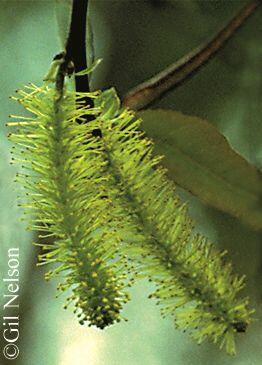
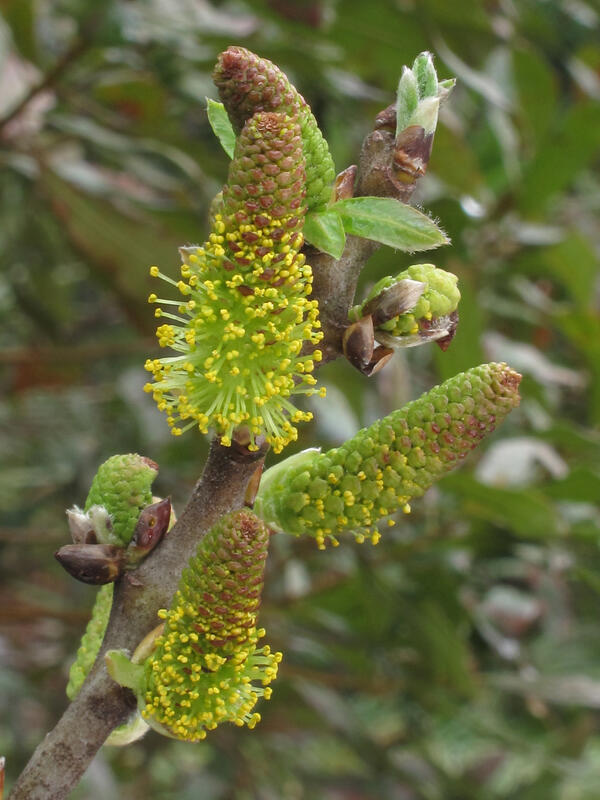
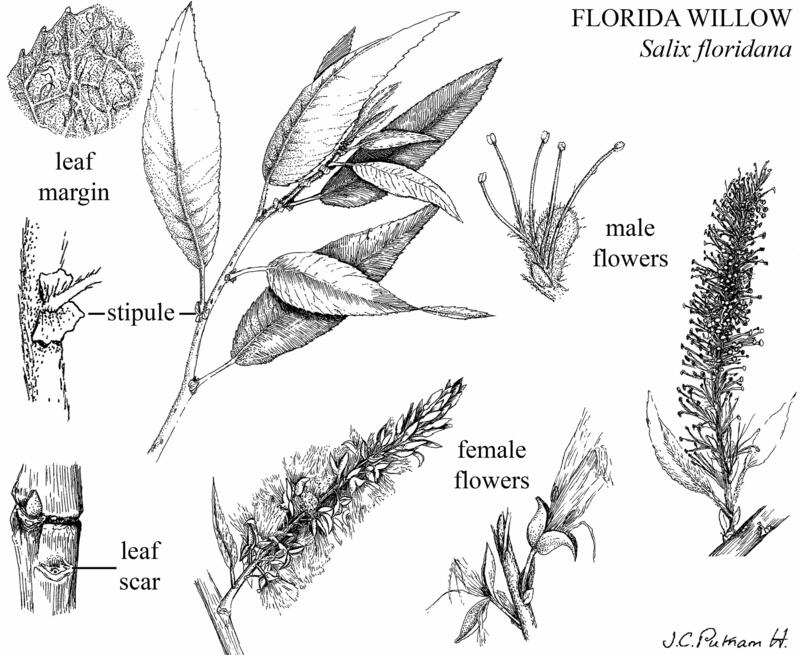
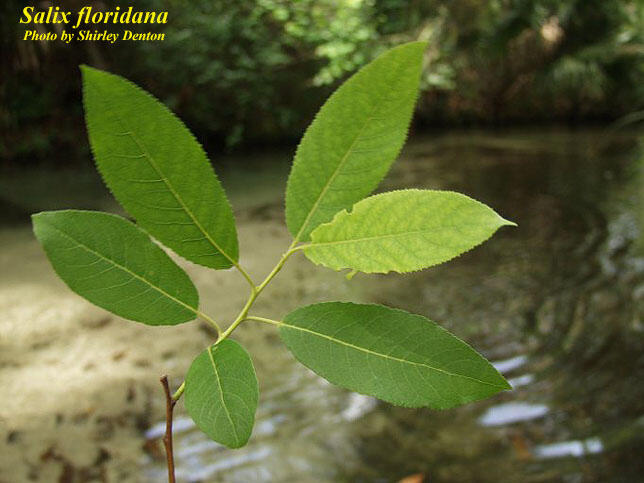
Small, slender tree or shrub to 20 feet (6 meters) tall, with gray bark and brittle, reddish-brown twigs. The leaves are 2 - 6 inches (5 - 15 cm) long and 0.8 - 2 inches (2 - 5 cm) wide, deciduous, alternate, oblong with rounded or heart-shaped bases and pointed tips; margins toothed with tiny, knobbed glands; the upper leaf surface is bright green, the lower surface grayish-white with hairy, brown veins; leaves on new growth often have semi-circular stipules (leafy structures at the base of the leaf stalk). Female and male flowers occur on separate plants, in superficially similar catkins 1.6 - 3 inches (4 - 7.5 cm) long (male catkins are shown in photos). Fruit is an oval, reddish-brown capsule, 0.25 inch (6 - 7 mm) long.
Carolina Willow (Salix caroliniana) is a tree to about 30 feet (10 meters) tall, with leaves 2 - 8.7 inches long and less than 1.4 inch wide (5 - 22 cm long and 1 - 3.5 cm wide), 5 - 10 times as long as wide, with grayish-blue lower surfaces.
Black Willow (Salix nigra) is a large tree with leaves 2 - 7.5 inches long and less than 1 inch wide (5 - 19 cm long and 6 - 2.3 cm wide), 6 - 13 times as long as wide, with green lower surfaces; the stipules are small and early-deciduous.
None in Georgia.
Edges of spring-fed streams and springheads, openings in wet woods with sphagnum moss, alder, Virginia willow, and club moss.
Unlike the majority of catkin-bearing plants, which are wind-pollinated, most willows are pollinated primarily by insects, especially bees, which collect nectar from glands at the base of each flower. Florida Willow may also reproduce vegetatively, its brittle branches easily breaking off and rooting.
Surveys are best conducted during fruiting (March–April), since leaves and fruits are both useful for positive identification.
Georgia and Florida.
Pollution and sedimentation of springs and spring-runs, logging and clearing in floodplains, alterations of hydrology that affect spring flow.
| Threat 1 | Threat 2 | Threat 3 | |
|---|---|---|---|
| General Threat | Transportation & Service Corridors | Climate change & severe weather | Residential & commercial development |
| Specific Threat | None | None | None |
Salix floridana is ranked S1 by the Georgia Department of Natural Resources, indicating that it is critically imperiled in the state. It is listed as Endangered by the State of Georgia. Six populations have been seen since 1902, but only two have survived; one of these is on a conservation area.
Protect springs and spring runs from pollution, sedimentation, and hydrologic changes. Protect floodplains and other wetlands from clearcutting, ditching, draining, and filling.
Argus, G.W. 1986. The genus Salix (Salicaceae) in the southeastern United States. Systematic Botanical Monographs 9: 1-170. https://www.jstor.org/stable/25027618?seq=1#metadata_info_tab_contents
Chafin, L.G. 2007. Field guide to the rare plants of Georgia. State Botanical Garden of Georgia and University of Georgia Press, Athens.
Godfrey, R.K. 1988. Trees, shrubs, and woody vines of northern Florida and adjacent Georgia and Alabama. University of Georgia Press, Athens.
Kirkman, L.K., C.L. Brown, and D.J. Leopold. 2007. Native trees of the southeast. Timber Press, Portland, Oregon.
Kral, R. 1983. A report on some rare, threatened, or endangered forest-related vascular plants of the South. Technical Publication R8-TP2. United States Forest Service, Atlanta.
NatureServe. 2020. Salix floridana species account. NatureServe Explorer. NatureServe, Arlington, Virginia. https://explorer.natureserve.org/Taxon/ELEMENT_GLOBAL.2.137381/Salix_floridana
Nelson, G. 1996. Shrubs and woody vines of Florida. Pineapple Press, Sarasota, Florida.
Patrick, T.S., J.R. Allison, and G.A. Krakow. 1995. Protected plants of Georgia. Georgia Department of Natural Resources, Natural Heritage Program, Social Circle.
Weakley, A.S. 2015. Flora of the southern and mid-Atlantic States. University of North Carolina Herbarium, University of North Carolina, Chapel Hill. http://www.herbarium.unc.edu/flora.htm
Linda G. Chafin
L.Chafin, Aug. 2008: original account
D.Weiler, Feb. 2010: added pictures
L. Chafin, May 2020: updated original account.