Loading profile. Please wait . . .
Philadelphus pubescens Loisel.
Hairy Mockorange




Federal Protection: No US federal protection
State Protection: No Georgia state protection
Global Rank: G5?
State Rank: S1
Element Locations Tracked in Biotics: Yes
SWAP 2015 Species of Greatest Conservation Need (SGCN): Yes
SWAP 2025 Species of Greatest Conservation Need (SGCN): No
2025 SGCN Priority Tier:
Element Occurrences (EOs) in Georgia: 4
Habitat Summary for element in Georgia: Limestone ledges and rocky banks
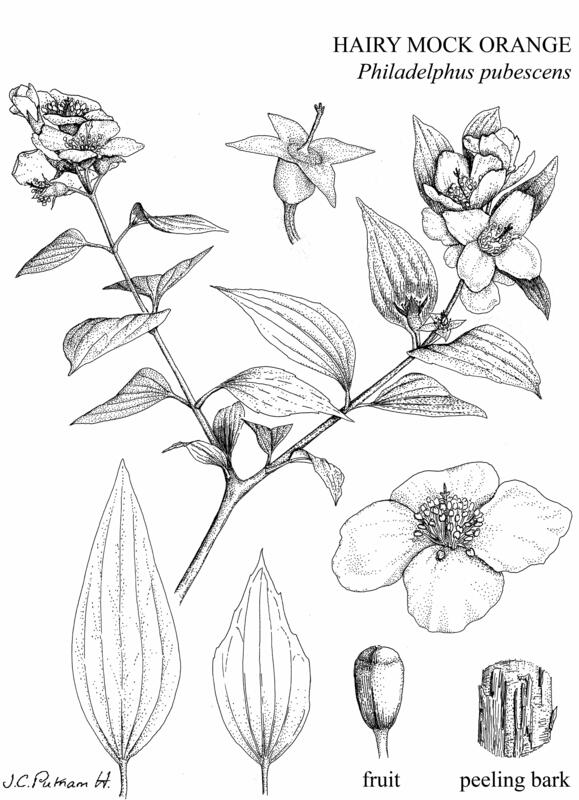
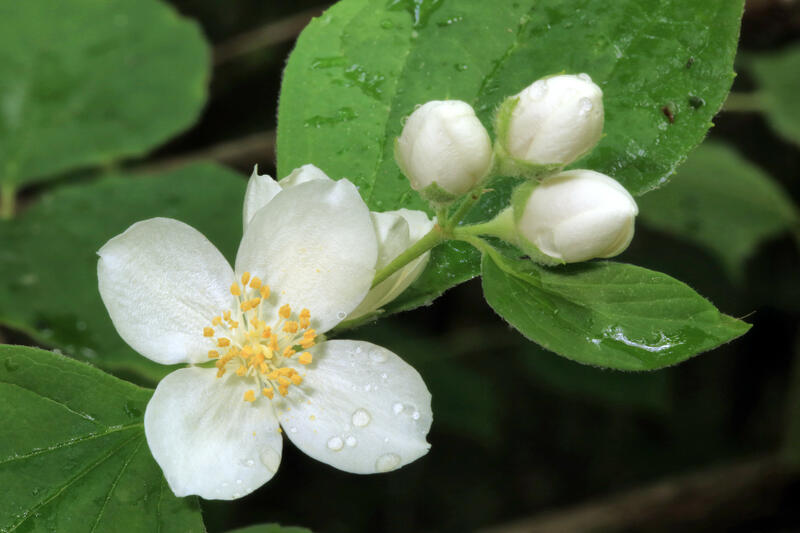
Shrub with stiff, erect branches up to 21 feet (6.5 meters) tall. The current year’s twigs are gray and hairless; the bark on older twigs and branches is tight, never shredding into papery strips. The leaf blades are 1 - 6.3 inches (3 - 16 cm) long and 0.6 - 4.3 inches (1.6 - 11 cm) wide, opposite, oval to elliptic with a pointed tip and rounded to wedge-shaped base, hairless on the upper surface and softly hairy with twisted hairs on the lower surface; the margins may or may not have teeth. The leaf stalks are up to 0.8 inch (1 - 20 mm) long. Flower clusters have 5 - 9 flowers or, rarely, flowers are solitary. The flowers are 1 - 1.7 inch (2.4 - 4.2 cm) wide, perfect, with 4 white petals, 4 hairy green sepals, and 25 - 50 stamens; not fragrant or only slightly so. Fruit is a brown, 4-parted, oval or cone-shaped capsule, up to 0.4 inch (0.6 - 1.1 mm) long.
Appalachian Mock Orange (Philadelphus inodorus) is found throughout Georgia. Its current-year twigs are hairless but the flower clusters have only 1 - 3 (rarely up to 9) odorless flowers, each flower has 60 - 90 stamens.
Cumberland or Cliff Mock Orange (Philadelphus hirsutus) twigs are brown in the first year, gray the second year, and are very hairy; its leaves are roughly hairy, almost sandpapery in texture. The flower clusters usually have 1 - 3 flowers, and the flowers have 14 - 35 stamens.
English Mock Orange (Philadelphus coronaria) is often found at old home sites or escaped into nearby woods. It has reddish-brown, shredding bark on older stems, 5 - 9 flowers per cluster, and its flowers are fragrant and have 20 - 50 stamens.
None in Georgia.
Limestone ledges and bluffs, stream banks with limestone outcrops.
Mock Orange (Philadelphus spp.) flowers are pollinated by bees and flies which are attracted to the nectar-producing disk that surrounds the base of the style. Its seeds are dispersed by gravity and insects.
Surveys are best conducted during flowering (April–May) and fruiting (June–August).
Georgia, north to Massachusetts and west to Oklahoma and Ontario.
Destruction of habitat by logging, clearing, and development; invasion by exotic pest plants.
Philadelphus pubescens is ranked S1 by the Georgia Department of Natural Resources, indicating that the species is critically imperiled in Georgia. Four populations are known, all on conservation land.
Avoid logging and clearing. Protect roadside populations from cutting and spraying. Eradicate exotic pest plants.
Chafin, L.G. 2007. Field guide to the rare plants of Georgia. State Botanical Garden of Georgia and University of Georgia Press, Athens.
Freeman, C.C. 2016. Philadelphus pubescens species account. Flora of North America, Vol. 12. Oxford University Press, New York. http://www.efloras.org/florataxon.aspx?flora_id=1&taxon_id=242416976
GADNR. 2020. Element occurrence records for Philadelphus pubescens. Georgia Department of Natural Resources, Wildlife Resources Division, Social Circle, Georgia.
NatureServe. 2019. Philadelphus pubescens comprehensive report. NatureServe Explorer. Arlington, Virginia. http://explorer.natureserve.org/servlet/NatureServe?searchName=Philadelphus+pubescens
Tenaglia, D. 2008. Philadelphus pubescens Loisel., Hoary Mock Orange. Missouri plants: photographs and descriptions of flowering and non-flowering plants of Missouri. http://missouriplants.com/Philadelphus_pubescens_page.html
Weakley, A.S. 2015. Flora of the southern and mid-Atlantic States. University of North Carolina Herbarium, University of North Carolina, Chapel Hill. http://www.herbarium.unc.edu/flora.htm
Linda G. Chafin
L. Chafin, Jul. 2008: original account
K. Owers, Feb. 2010: added pictures
L. Chafin, Mar. 2020: updated original account