


Loading profile. Please wait . . .
Leavenworthia exigua var. exigua
Tennessee Gladecress




Federal Protection: No US federal protection
State Protection: Threatened
Global Rank: G4T3
State Rank: S2
Element Locations Tracked in Biotics: Yes
SWAP 2015 Species of Greatest Conservation Need (SGCN): Yes
SWAP 2025 Species of Greatest Conservation Need (SGCN): Yes
2025 SGCN Priority Tier: High Conservation Concern
Element Occurrences (EOs) in Georgia: 25
Habitat Summary for element in Georgia: Limestone glades
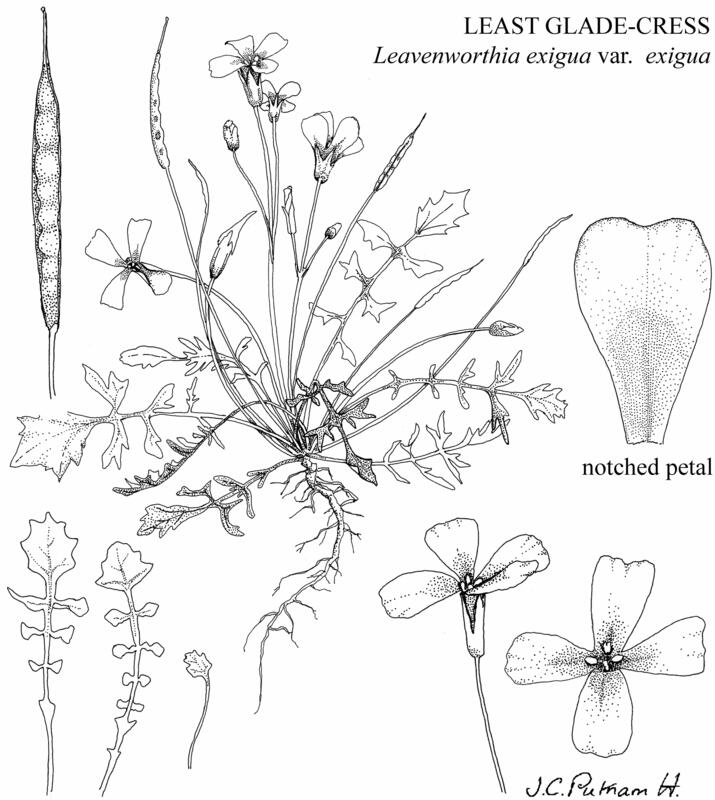
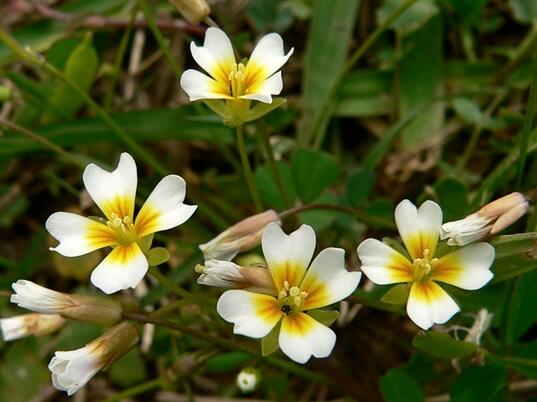
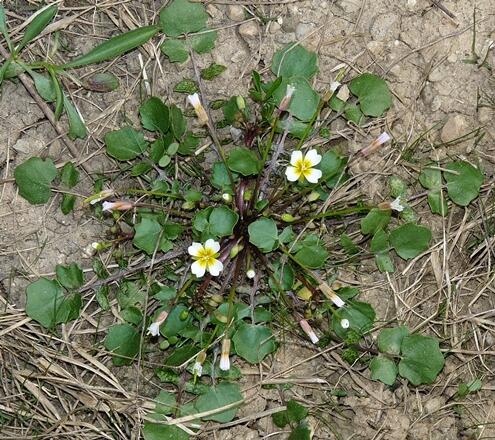
Annual herb germinating in the fall and overwintering as a leaf rosette about 1 inch (1 - 3 cm) wide. Spring and summer basal leaves are 1.6 - 4 inches (3.7 - 10 cm) long, including the leaf stalk, varying in shape from a single lobe at the end of the leaf stalk to many segments or lobes paired along the stalk, with the end lobe always larger than the other segments. A single flower is held at the top of each flower stalk, opening only on sunny days. Petals are 4 in number, about 0.28 inch (0.6 - 0.8 cm) long, shallowly notched at the tip, white with a yellow base, very fragrant. Fruits are flattened, oblong pods, about 0.7 inch (1.5-2.2) long, with a short beak; the pod splits lengthwise into 2 curling sections, exposing a papery membrane that holds round, flat, winged seeds.
See Related Rare Species, below.
Twelve species and varieties of Leavenworthia are rare or endemic to limestone cedar glades in the southeastern United States, however only one other member of the genus can be found in Georgia.
Michaux's Gladecress (Leavenworthia uniflora, Special Concern) occurs on Georgia’s cedar glades. It resembles Tennessee Gladecress but its petals are pure white, entire and rounded, not notched at the tip. The leaf segments are dentate, and the terminal lobe of the leaf is only slightly larger than the other segments.
Limestone cedar glades with thin, gravelly soils, and potentially in disturbed areas near them.
Tennessee Gladecress is an annual herb whose seeds germinate in the fall; new plants emerge during the fall and winter, with 8 - 16 leaves present by late December. Flower buds are also produced during the fall and winter, and the flower stalks begin to elongate in late February. The flowers open during March and April and set fruit by mid-May. By mid-June, the seeds have dispersed and lie on the soil until autumn rains stimulate germination. This type of life cycle is an adaptation to the wet winter and dry summer conditions on the limestone glades. Tennessee Gladecress flowers are self-compatible and produce viable seeds after self-fertilization; other Leavenworthia species have been extensively studied as examples of inbreeding.
Surveys are best conducted during flowering (March–April) and fruiting (April-May), after which the plants wither and die. Plants are more visible on sunny afternoons when flowers are fully open.
Georgia and Tennessee.
Conversion of cedar glades habitat to developments or pasture. Degradation of habitat by trash dumping, off-road vehicle use, and excessive foot and horse travel. Invasion by exotic and woody species.
| Threat 1 | Threat 2 | Threat 3 | |
|---|---|---|---|
| General Threat | Natural system modifications | Invasive & other problematic species, genes & diseases | Pollution |
| Specific Threat | None | None | None |
Leavenworthia exigua var. exigua is ranked S2 by the Georgia Department of Natural Resources, indicating that it is imperiled in the state. Leavenworthia exigua var. exigua has been documented at 24 cedar glades, 17 of which are on conservation lands.
Protect limestone glades from trash dumping, off-road vehicles, and conversion to pasture or development. Limit foot and horse traffic on glades. Control woody species with fire or hand-clearing.
Baskin, J.M. and C.C. Baskin. 1972. Ecological life cycle of the cedar glade endemic Leavenworthia exigua var. exigua. Canadian Journal of Botany 50: 1711-1723. https://www.nrcresearchpress.com/doi/abs/10.1139/b72-212
Beck, J.B., I.A. Al-Shehbaz, and B.A. Schaal. 2006. Leavenworthia (Brassicaceae) revisited: testing classic systematic and mating system hypotheses. Systematic Botany 31(1):151-159. https://bioone.org/journals/Systematic-Botany/volume-31/issue-1/036364406775971732/Leavenworthia-Brassicaceae-Revisited--Testing-Classic-Systematic-and-Mating-System/10.1600/036364406775971732.full
Chafin, L.G. 2007. Field guide to the rare plants of Georgia. State Botanical Garden of Georgia and University of Georgia Press, Athens.
GADNR. 2020. Element occurrence records for Leavenworthia exigua var. exigua. Georgia Department of Natural Resources, Wildlife Resources Division, Social Circle, Georgia.
Kral, R. 1983. A report on some rare, threatened, or endangered forest-related vascular plants of the South. Technical Publication R8-TP2. United States Forest Service, Atlanta.
NatureServe. 2019. Leavenworthia exigua comprehensive report. NatureServe Explorer. Arlington, Virginia. NatureServe. 2019. http://explorer.natureserve.org/servlet/NatureServe?searchName=Leavenworthia+exigua
Nourse, H. and C. Nourse. 2007. Favorite wildflower walks in Georgia. University of Georgia Press, Athens.
Patrick, T.S., J.R. Allison, and G.A. Krakow. 1995. Protected plants of Georgia. Georgia Department of Natural Resources, Natural Heritage Program, Social Circle.
Solbrig, O.T. and R.C. Collins. 1977. The evolution of autogamy in species of the mustard genus Leavenworthia. Evolution 31(2): 265-281. https://www.jstor.org/stable/2407748?seq=1#metadata_info_tab_contents
Weakley, A.S. 2015. Flora of the southern and mid-Atlantic States. University of North Carolina Herbarium, University of North Carolina, Chapel Hill. http://www.herbarium.unc.edu/flora.htm
Linda G. Chafin
L. Chafin, Apr. 2007: original account
K. Owers, Feb. 2010: added pictures
L. Chafin, March 2020: updated original account.
Nate Thomas, December 2025. Updated original account.