


Loading profile. Please wait . . .
Evolvulus sericeus var. sericeus
Creeping Morning-glory




Federal Protection: No US federal protection
State Protection: Endangered
Global Rank: G5T3T5
State Rank: S1
Element Locations Tracked in Biotics: Yes
SWAP 2015 Species of Greatest Conservation Need (SGCN): Yes
SWAP 2025 Species of Greatest Conservation Need (SGCN): Yes
2025 SGCN Priority Tier: Moderate Conservation Concern
Element Occurrences (EOs) in Georgia: 23
Habitat Summary for element in Georgia: Altamaha Grit outcrops; open calcareous uplands
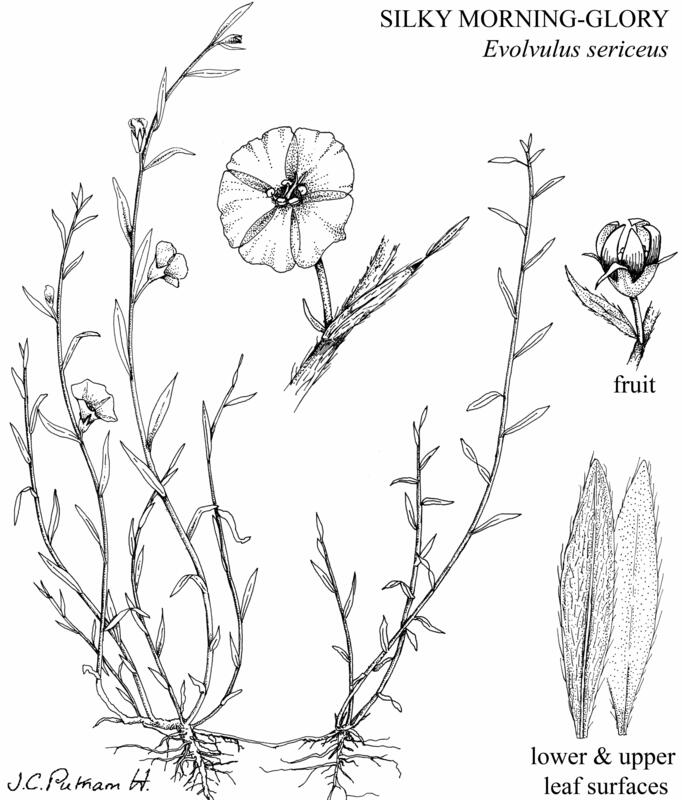
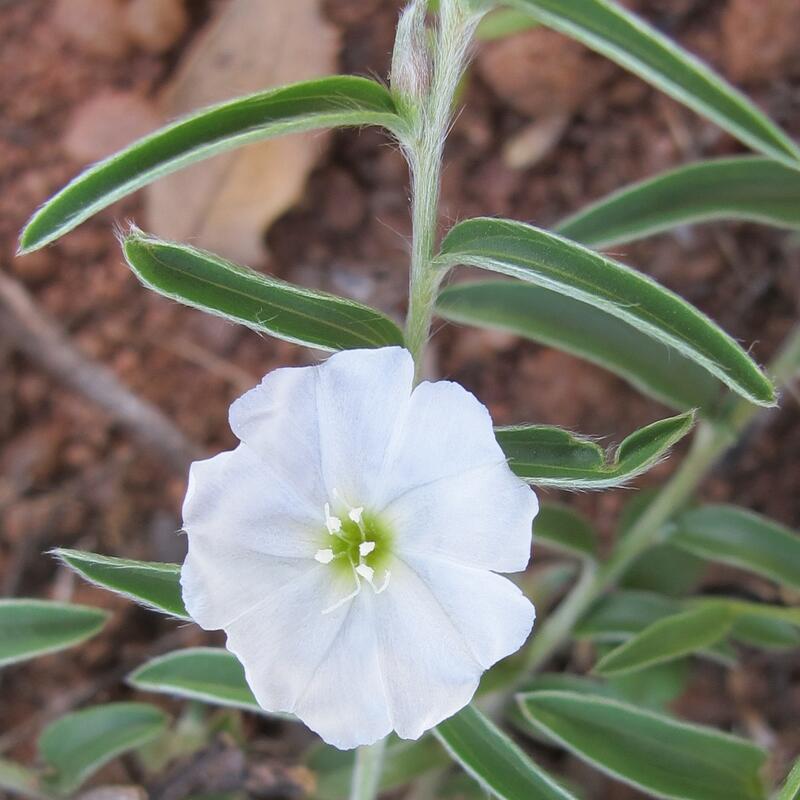
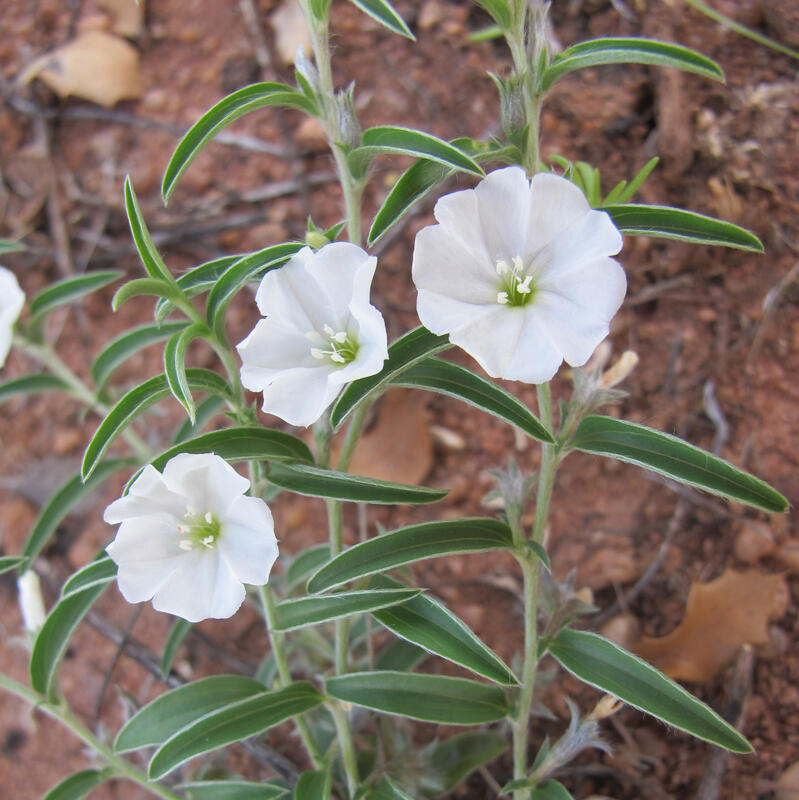
Perennial herb with stems to 12 inches (30 cm) long, leaning or trailing along the ground, not twining on other plants, slightly woody at the base, covered with gray, white, or yellowish hairs. Leaves are 0.2 - 1 inch (0.5 - 2.5 cm) long, alternate, two-ranked, narrowly oval with a pointed tip and tapering base; the lower leaf surface is covered with silky, silver hairs; the upper surface is green and either hairy or hairless; the leaf stalk is very short or absent. The flower is 0.3 - 0.5 inch (0.8 - 1.2 cm) wide, solitary on a very short stalk held in the angle between leaf and stem, funnel-shaped, white with a faint 5-pointed star on the upper surface; 5 white-tipped stamens extend beyond the throat of the flower. Fruit is a round, 4-seeded, hairless capsule about 0.24 inch (5 - 7 mm) wide.
Other morning-glories with white flowers have long flower stalks (such as Stylisma patens and S. humistrata), deeply lobed or triangular leaves (such as Ipomoea lacunosa and Calystegia sepium), or long, twining stems.
Pickering’s Morning-glory (Stylisma pickeringii var. pickeringii) occurs in open, dry oak scrub found on sandhills in the Coastal Plain. For more information, see: https://www.georgiabiodiversity.org/portal/profile?group=plants&es_id=21939
Outcrops of sandstone-like rock (Altamaha Grit), wet flatwoods, seepages, bogs, and moist depressions in upland hardwood forests in the Coastal Plain.
Creeping Morning-glory is a perennial herb that reproduces sexually by seed. No studies have been published on its reproductive system, but closely related species of Evolvulus in India produce nectar and are pollinated by bees and snails and produce fruits that disperse their seeds explosively. Silky Morning-glory has a deep taproot, enabling it to survive drought and fire.
Surveys are best conducted during flowering (April–July) and fruiting (July–September). The very short or absent flower and fruit stalks are important for identification.
Georgia, Florida, Louisiana, Arkansas, Texas, New Mexico, Arizona, Central America, South America, and the West Indies.
Fire suppression, conversion of habitat to pine plantations and agriculture, invasion by exotic pest plants.
| Threat 1 | Threat 2 | Threat 3 | |
|---|---|---|---|
| General Threat | Natural system modifications | Agriculture & aquaculture | Residential & commercial development |
| Specific Threat | None | None | None |
Evolvulus sericeus is ranked S1 by the Georgia Department of Natural Resources, indicating that it is critically imperiled in the state. It is listed as Endangered by the State of Georgia. Twelve populations have been documented, ten in the last 20 years. Nine populations occur on two private conservation lands.
Allow prescribed fire in surrounding pine forests to burn across depressional wetlands and Altamaha Grit outcrops. Eradicate exotic pest plants from these habitats. Protect wet flatwoods and other Coastal Plain wetlands from conversion to pine plantations and agriculture.
Austin, Daniel F. 1998. Evolvulus sericeus species account, page 61 in Convolvulaceae, Journal of the Arizona-Nevada Academy of Science Vol. 30(2), Vascular Plants of Arizona: Part 4, pp 61-83.
Bridges, E.L. and S.L. Orzell. 1989. Evolvulus sericeus (Convolvulaceae) in Georgia, with floristic and ecological notes. Sida 13(4): 509-512. https://www.jstor.org/stable/41967523
Chafin, L.G. 2007. Field guide to the rare plants of Georgia. State Botanical Garden of Georgia and University of Georgia Press, Athens.
GADNR. 2020. Element occurrence records for Evolvulus sericeus. Georgia Department of Natural Resources, Wildlife Resources Division, Social Circle, Georgia.
Lakshminarayana, G. and J.S. Raju Aluri. 2017. Reproductive biology and ecology of Evolvulus alsinoides and Evolvulus nummularius (Convolvulaceae). Phytologia Balcanica 23(3):381-389. https://tinyurl.com/yavyxmkc
NatureServe. 2019. Evolvulus sericeus comprehensive report. NatureServe Explorer. Arlington, Virginia. http://explorer.natureserve.org/servlet/NatureServe?searchName= Evolvulus+sericeus
Patrick, T.S., J.R. Allison, and G.A. Krakow. 1995. Protected plants of Georgia. Georgia Department of Natural Resources, Natural Heritage Program, Social Circle.
Singh, K.P., B. Dhakre, and G. Dhakre, 2010. Reproductive biology of Evolvulus alsinoides L. (medicinal herb). International Journal of Botany 6: 304-309. https://www.cabdirect.org/cabdirect/abstract/20113139010
Taylor, W.K. 1992. Guide to Florida wildflowers. Taylor Publishing Company, Dallas, Texas.
Weakley, A.S. 2015. Flora of the southern and mid-Atlantic States. University of North Carolina Herbarium, University of North Carolina, Chapel Hill. http://www.herbarium.unc.edu/flora.htm
Wunderlin, R.P and B.F. Hansen. 2003. Guide to the vascular plants of Florida, 2nd edition. University Press of Florida, Gainesville.
Linda G. Chafin
L. Chafin, Apr. 2007: original account
K. Owers, Jan. 2010: added pictures
L. Chafin, Feb 2020: updated original account.