

Loading profile. Please wait . . .
Forestiera godfreyi L.C. Anders.
Godfrey's Wild Privet




Federal Protection: No US federal protection
State Protection: Endangered
Global Rank: G2
State Rank: S1
Element Locations Tracked in Biotics: Yes
SWAP 2015 Species of Greatest Conservation Need (SGCN): Yes
SWAP 2025 Species of Greatest Conservation Need (SGCN): Yes
2025 SGCN Priority Tier: Highest Conservation Concern
Element Occurrences (EOs) in Georgia: 1
Habitat Summary for element in Georgia: Mesic, maritime forests over shell mounds
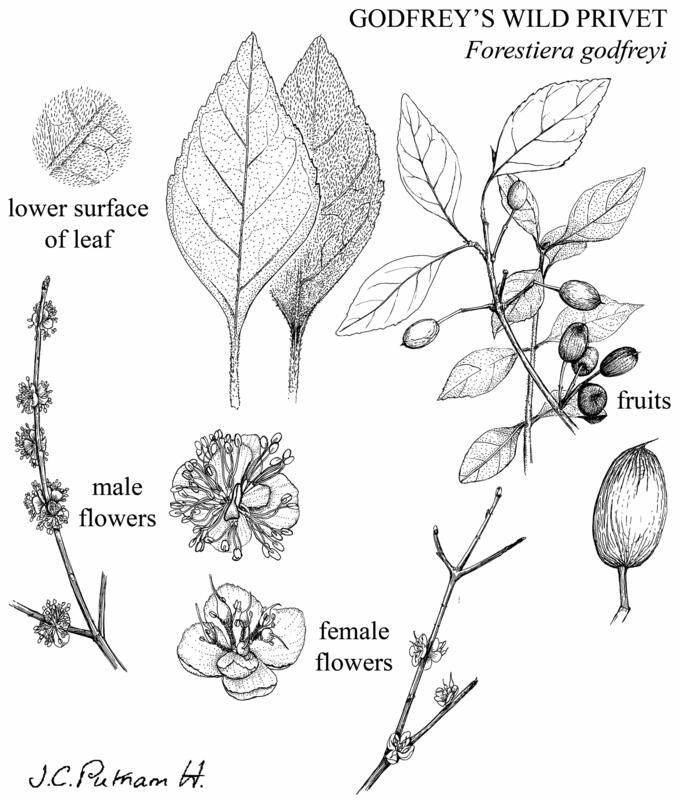
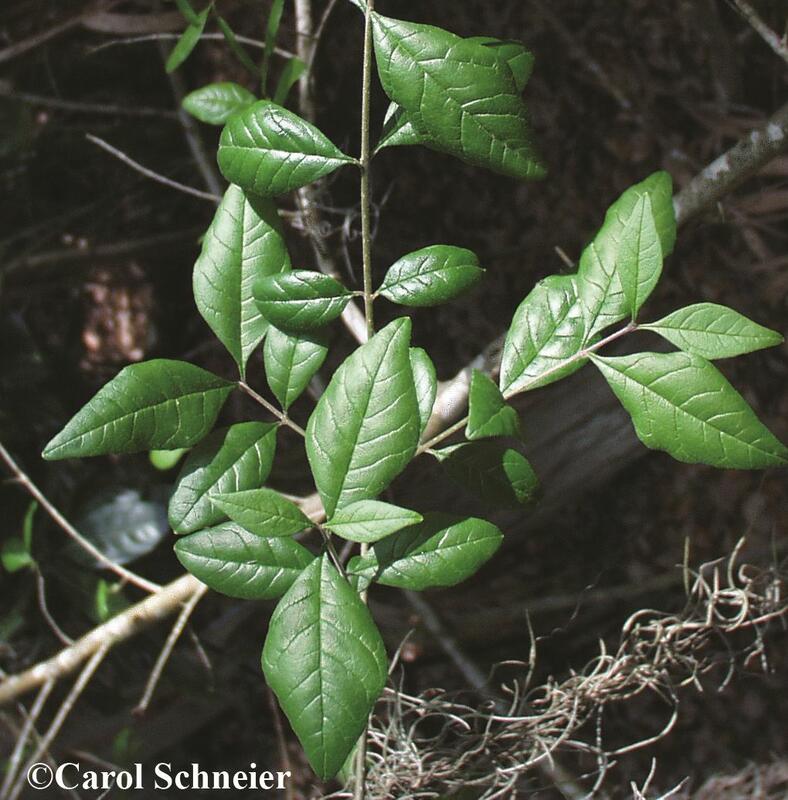
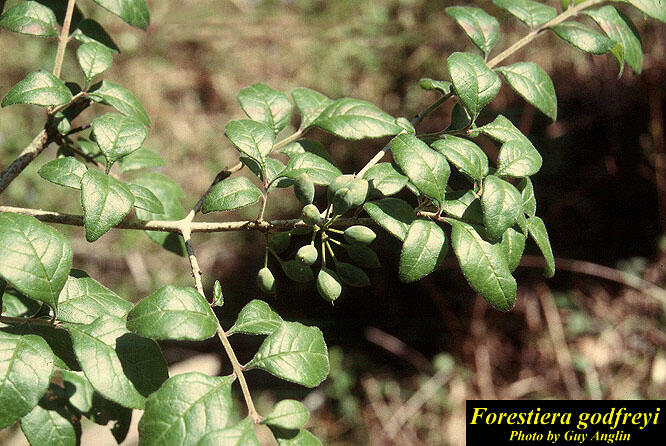
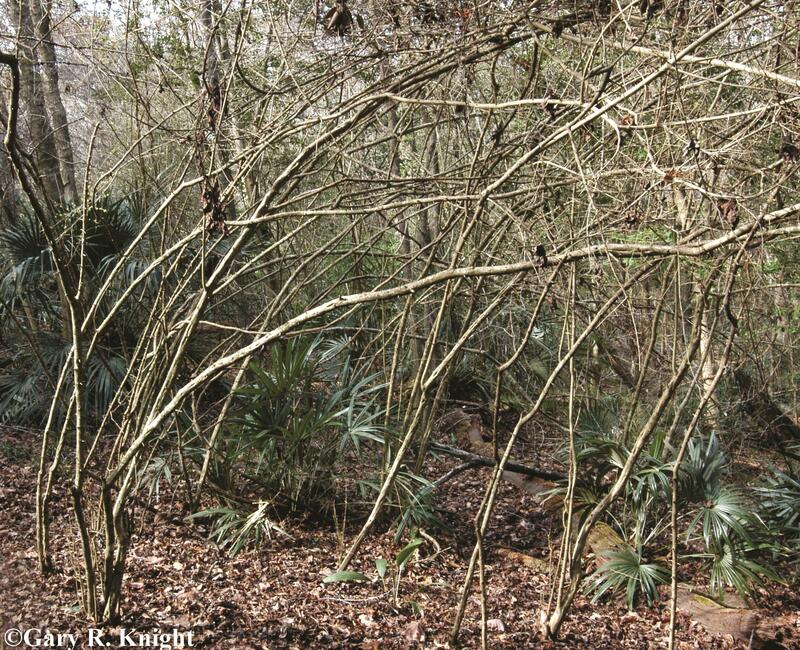
Deciduous shrub or small tree, 8 - 16 feet (2.5 - 5 meters) tall, main stems arching or leaning. Leaves are 2 - 3 inches (5 - 8 cm) long, 1 - 1.5 inches (2.3 - 4 cm) wide, opposite, oval, margins finely toothed above the middle, hairy on the lower surface. Leaf stalks and twigs hairy. Female and male flowers are on separate plants; neither have petals and the sepals are small and inconspicuous. Female flowers are in clusters of 5 - 10, each flower with 1 pistil, 2 - 4 non-functional stamens, and 6 small bracts, fringed at the top. Male flowers are in clusters of 12 - 15 flowers, each flower with 3 - 5 showy, white, yellow-tipped stamens, and 4 - 5 tiny sepals; each male flower cluster is surrounded by 4 small and 2 tiny, pale yellow bracts. Both female and male flower clusters are held close to the stem and appear to be single flowers with many petals. Fruits are up to 0.5 inch (0.8 - 1.2 cm) long, oval, waxy, and dark blue.
Swamp Privet (Forestiera acuminata) occurs in wetlands, and has long-pointed leaf tips and small teeth all along the leaf margins.
Upland Privet (F. ligustrina) has two lines of hairs on the twigs, small teeth all along the leaf margins, and nearly hairless leaf stalks; it flowers mid–late summer.
Wild Privet (Forestiera segregata) occurs in coastal/maritime forests and shrub-scrub areas over shell mounds on or near barrier islands or bordering salt marshes. For more information, see: https://www.georgiabiodiversity.org/portal/profile?group=plants&es_id=21613on this website.
Coastal maritime forests over shell mounds on barrier islands.
Godfrey’s Privet is dioecious, meaning that female and male flowers are on different plants. The female-flowering plants of Godfrey’s Privet often grow in patches somewhat separated from patches of male-flowering plants. Typically, late winter-flowering plants are wind-pollinated, but the clustered arrangement of Godfrey’s Privet flowers mimics a single, showy flower and suggests that the plant has evolved to attract insect pollinators, although none have been documented. The fruits are probably dispersed by small animals.
Surveys are best conducted during flowering (late January–late February) and fruiting (February–May). Leaves may be recognizable through the summer and the arching stems are distinctive year-round.
Georgia, Florida, and South Carolina
Destruction of habitat by clearing and development, and by unauthorized excavation of shell mounds. Invasion by exotic pest plants. Godfrey’s Wild Privet habitat is threatened by salt water intrusion into the Upper Floridan Aquifer and by sea level rise caused by global climate change.
| Threat 1 | Threat 2 | Threat 3 | |
|---|---|---|---|
| General Threat | Invasive & other problematic species, genes & diseases | Climate change & severe weather | None |
| Specific Threat | None | None | None |
Godfrey’s Wild Privet is ranked S1 by the Georgia Department of Natural Resources, indicating that it is critically imperiled in the state. It is listed as Endangered by the State of Georgia. Only one population of Godfrey’s Wild Privet is known in Georgia; it occurs in a coastal state park.
Protect coastal forests from clearing and development. Protect shell mounds from digging and disturbance. Eradicate exotic pest plants. Direct trails and recreation activity away from plants. Reduce carbon emissions causing climate change. Reduce freshwater extraction from the aquifer that leads to salt water intrusion. Address climate change.
Anderson, L.C. 1985. Forestiera godfreyi (Oleaceae), a new species from Florida and South Carolina. Sida 11(1): 1-5. https://www.jstor.org/stable/23909121
Chafin, L.G. 2007. Field guide to the rare plants of Georgia. State Botanical Garden of Georgia and University of Georgia Press, Athens.
Chafin, L.G. 2000. Field guide to the rare plants of Florida. Florida Natural Areas Inventory, Tallahassee.
Foote, L.E. and S.B. Jones, Jr. 1989. Native shrubs and woody vines of the southeast. Timber Press, Portland, Oregon.
Godfrey, R.K. 1988. Trees, shrubs, and woody vines of northern Florida and adjacent Georgia and Alabama. University of Georgia Press, Athens.
NatureServe. 2019. Forestiera godfreyi comprehensive report. NatureServe Explorer. Arlington, Virginia. http://explorer.natureserve.org/servlet/NatureServe?searchName=Forestiera+godfreyi
Nelson, G. 1996. Shrubs and woody vines of Florida. Pineapple Press, Sarasota, Florida.
Weakley, A.S. 2015. Flora of the southern and mid-Atlantic States. University of North Carolina Herbarium, University of North Carolina, Chapel Hill. http://www.herbarium.unc.edu/flora.htm
Zomlefer, W.B., D.E. Giannasi, K.A. Bettinger, S.L. Echols, and L.M. Kruse. 2008. Vascular plant survey of Cumberland Island National Seashore, Camden County, Georgia. Castanea 73(4): 251-282. https://bioone.org/journals/Castanea/volume-73/issue-4/08-003R1.1/Vascular-Plant-Survey-of-Cumberland-Island-National-Seashore-Camden-County/10.2179/08-003R1.1.short
Linda G. Chafin
L. Chafin, Feb. 2008: original account
K. Owers, Jan. 2010: added pictures
L. Chafin, Feb 2020: updated original account.