


Loading profile. Please wait . . .
Portulaca biloba Urban
Grit Portulaca




Federal Protection: No US federal protection
State Protection: No Georgia state protection
Global Rank: G1G2
State Rank: S1
Element Locations Tracked in Biotics: Yes
SWAP 2015 Species of Greatest Conservation Need (SGCN): Yes
SWAP 2025 Species of Greatest Conservation Need (SGCN): Yes
2025 SGCN Priority Tier: Highest Conservation Concern
Element Occurrences (EOs) in Georgia: 6
Habitat Summary for element in Georgia: Altamaha Grit outcrops
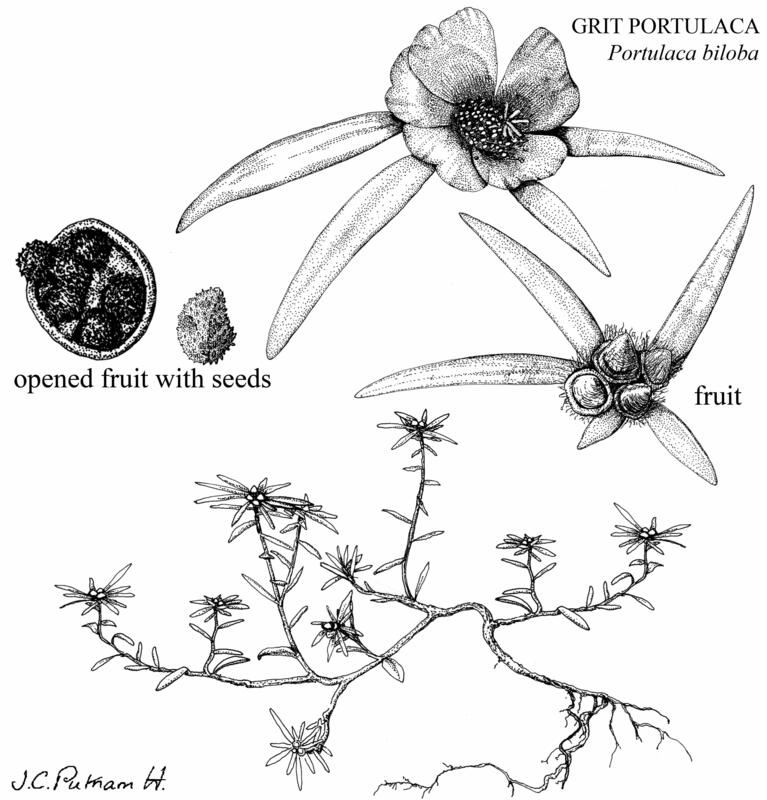
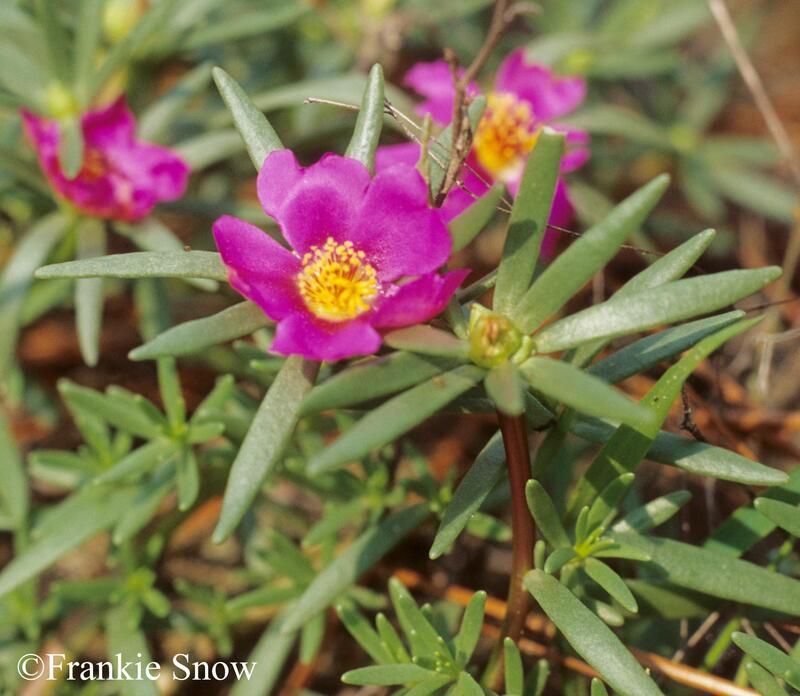
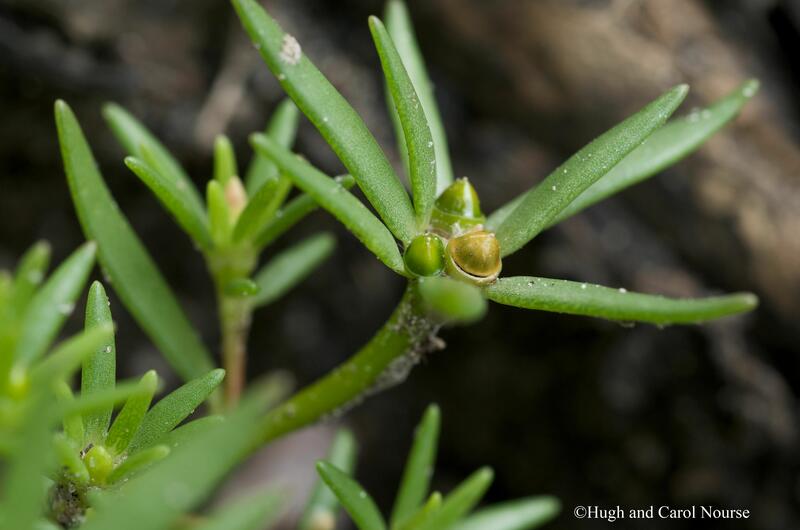
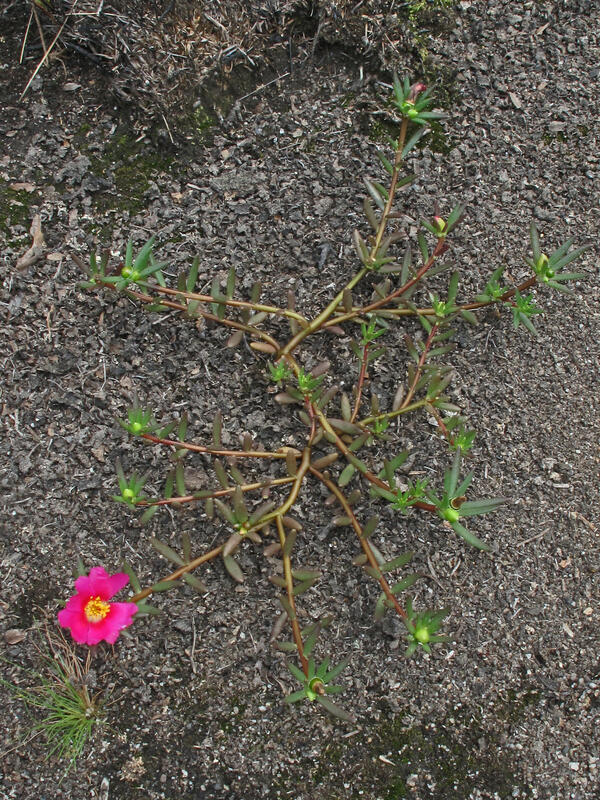
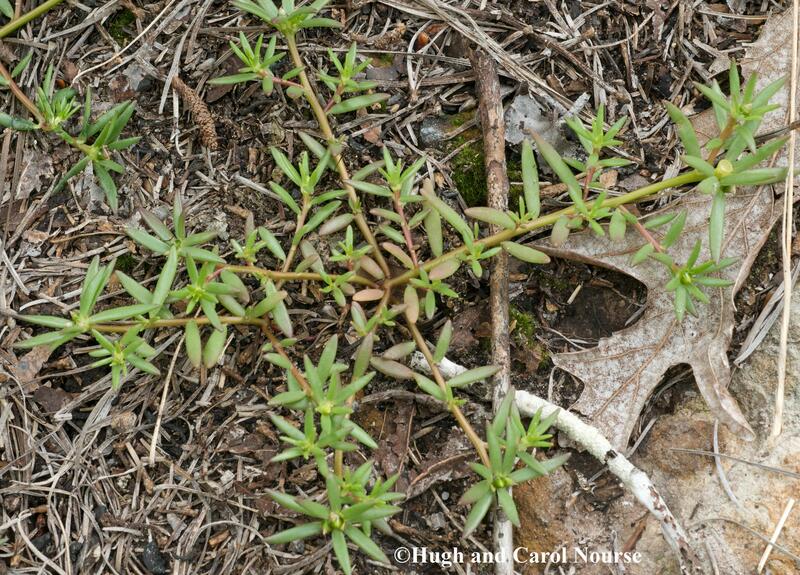
Annual herb with sprawling or sometimes semi-erect stems. The stems are fleshy, slightly woody at the base, with branches up to 10 inches (25 cm) long; the leaf nodes have only a few, tiny hairs. The leaves are 0.2 - 0.5 inch long and less than 0.1 inch wide (6-14 mm long and 0.5-3 mm wide), fleshy, round in cross-section, with pointed (occasionally blunt) tips. Flower clusters are held at the tips of branches with 1 - 3 buds or, occasionally, open flowers; flower buds rarely open but they self-fertilize and produce fruits with abundant seed. Open flowers are about 1 inch wide, dark pink, with 5 deeply notched petals that are joined at the base and more than 40 stamens. Fruits are round capsules 0.1 - 0.2 inch (2.5 - 5 mm) wide with a pointed cap that opens to reveal a “nest” of black seeds.
Grit Portulaca occurs with two other succulent herbs: Wingpod Purslane (Portulaca umbraticola ssp. coronata, see below) and Fameflower (Talinum teretifolium, synonym Phemeranthus teretifolius).
Fameflower also has narrow, pointed, fleshy leaves and dark pink flowers but it grows as a single, erect plant about 4 inches (10 cm) tall, and its flower cluster is at the top of a long stalk.
Pink Purslane (Portulaca pilosa) petals are not notched or lobed, its pink-purple flowers usually have 5 - 12 stamens, and the stem nodes are hairy; it occurs in Georgia's Coastal Plain in disturbed areas with thin or sandy soils.
Small’s Purslane (Portulaca smallii) has white to medium or pale pink flowers and the stem nodes are hairy; it occurs on Georgia's Piedmont granite outcrops.
Wingpod Purslane (Portulaca umbraticola ssp. coronata, Special Concern) occurs on granite outcrops and Altamaha Grit outcrops, where it grows with Grit Portulaca. It has fleshy, sprawling stems and flattened, oval leaves with rounded tips. Its flowers have 5 yellow petals, and its fruit is surrounded by a circular wing or flange. For more information, see: https://www.georgiabiodiversity.org/portal/profile?group=plants&es_id=19611
Patches of thin, bare soil on Altamaha Grit outcrops.
Grit Portulaca is an annual herb that produces abundant seed from closed (cleistogamous), self-pollinating flowers; open flowers, presumably cross-pollinated, are rarely seen. Its unusual disjunct distribution – Georgia and Cuba – may be due to the migration patterns of nighthawks. These birds nest on the surface of grit outcrops and eat grasshoppers that may have grit portulaca seeds in their guts; the seeds could then be transported to Cuba when the nighthawks migrate. Another theory attributes the disjunct distribution to tropical storms which may have carried seeds of Cuban plants to southeast Georgia.
Portulaca biloba flowers in late July–August, and is most conspicuous when the open (chasmogamous) flowers are blooming, but the plants seldom produce open flowers and may be recognized instead by their sprawling habit, succulent stems, leaf shape, and unusual fruit type.
Four counties in Georgia's Coastal Plain and in Cuba.
Fire suppression in surrounding pinelands and on outcrops, off-road vehicle traffic, and mechanical clearing.
| Threat 1 | Threat 2 | Threat 3 | |
|---|---|---|---|
| General Threat | Invasive & other problematic species, genes & diseases | Pollution | None |
| Specific Threat | None | None | None |
Portulaca biloba is ranked S1 by the Georgia Department of Natural Resources, indicating that it is critically imperiled in Georgia. Four populations are known, only one on conservation lands.
Protect Altamaha Grit outcrops from mechanical disturbances. Apply prescribed fire to surrounding pinelands every 2 - 3 years, allowing fire to burn across outcrops. Exclude off-road vehicles from outcrops. Purchase lands with Altamaha Grit outcrops or acquire conservation easements for them.
GADNR. 2020. Element occurrence records for Portulaca biloba. Georgia Department of Natural Resources, Wildlife Resources Division, Social Circle, Georgia.
Matthews, J.F. 2004. Portulaca biloba species account. Flora of North America, Vol. 4. Oxford University Press, New York. http://www.efloras.org/florataxon.aspx?flora_id=1&taxon_id=242415807
Matthews, J.F., W.R. Faircloth, and J.R. Allison. 1991. Portulaca biloba Urban (Portulacaceae), a species new to the United States. Systematic Botany 16(4): 736-740. https://www.jstor.org/stable/2418875?seq=1#metadata_info_tab_contents
Matthews, J.F., and P.A. Levins. 1985. The genus Portulaca in the south-eastern United States. Castanea 50: 96-104. https://www.jstor.org/stable/4033134
NatureServe. 2019. Portulaca biloba comprehensive report. NatureServe Explorer. Arlington, Virginia. http://explorer.natureserve.org/servlet/NatureServe?searchName=Portulaca+biloba
Snow, F. 2008. Personal communication regarding the "nighthawk theory" of disjunct distribution of Portulaca biloba.
Weakley, A.S. 2015. Flora of the southern and mid-Atlantic States. University of North Carolina Herbarium, University of North Carolina, Chapel Hill. http://www.herbarium.unc.edu/flora.htm
Linda G. Chafin
L. Chafin, Sep. 2008: original account
K. Owers, Feb. 2010: added pictures
L. Chafin, Mar. 2020: updated original account