

Loading profile. Please wait . . .
Sideroxylon thornei (Cronq.) T.D. Pennington
Swamp Buckthorn




Federal Protection: No US federal protection
State Protection: Rare
Global Rank: G3
State Rank: S2
Element Locations Tracked in Biotics: Yes
SWAP 2015 Species of Greatest Conservation Need (SGCN): Yes
SWAP 2025 Species of Greatest Conservation Need (SGCN): Yes
2025 SGCN Priority Tier: High Conservation Concern
Element Occurrences (EOs) in Georgia: 43
Habitat Summary for element in Georgia: Forested limesink depressions; calcareous swamps
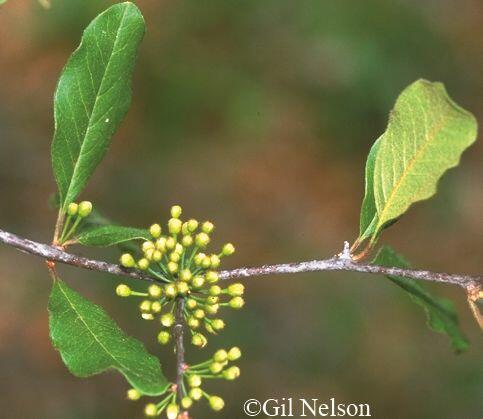
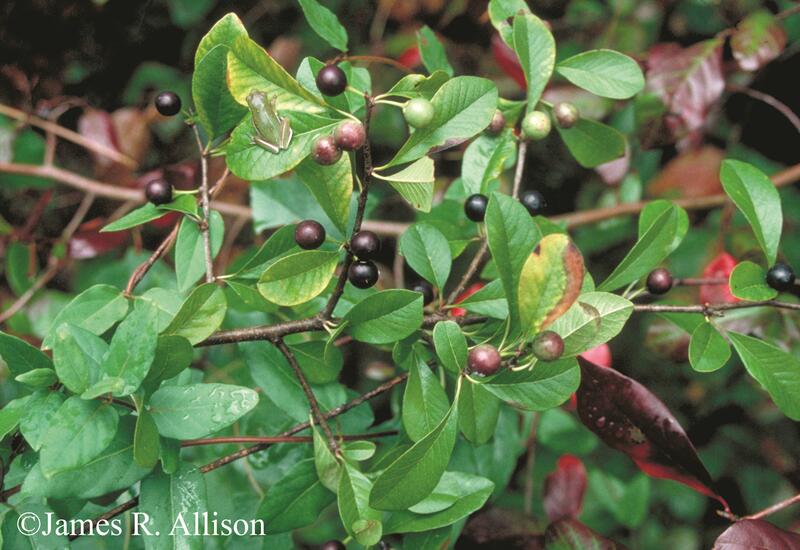
Shrub up to 8 feet (2.5 meters) tall, usually spindly with a few main branches; some plants are up to 20 feet (6 meters) tall with many branches. The twigs have thorns, and short spur-shoots that produce clusters of leaves and flowers, and produce milky latex when cut; they are hairy early in the spring, later becoming smooth and dark brown. The leaves are 0.4 - 2.8 inches (1 - 7 cm) long, alternate except on spur-shoots; varying in size and shape, with rounded or bluntly pointed tips and smooth or slightly wavy margins; the upper leaf surface is smooth or with a few pale hairs along the midvein, the lower surface has dense patches of tawny, gray, or rust-colored hairs; the leaf stalks are hairy. Flowers are small, white with 5 petals, often in clusters on spur-shoots. Mature fruits are about 0.3 inch (8 - 10 mm) long and wide, round, green when immature, black when mature; the sepals and style remain attached to the fruit.
Smooth Buckthorn (Sideroxylon reclinatum) is a much-branched shrub with small leaves and small round or oval fruits less than 0.3 inch (8 mm) long and 0.2 inch (4 - 6 mm) in diameter; the upper leaf surface has raised veins, and its leaves and leaf stalks are hairless by mid-summer.
Woolly Buckthorn (Sideroxylon lanuginosum) is a small, upland tree with densely hairy twigs and leaves.
Big-fruited Buckthorn (Sideroxylon macrocarpum) occurs in Longleaf Pine woodlands in the Coastal Plain. For more information, see: https://www.georgiabiodiversity.org/portal/profile?group=plants&es_id=20327
Silver Buckthorn (Sideroxylon alachuense) occurs in coastal maritime forests and on shell middens. For more information, see: https://www.georgiabiodiversity.org/portal/profile?group=plants&es_id=21718
Forested limesink depressions and swamps over limestone.
Swamp Buckthorn is tardily deciduous, dropping its leaves in late winter and then quickly leafing out again. As with all buckthorns, it has two types of growth: rapid primary growth producing long shoots with relatively large leaves, and slower-growing spur shoots which produce short stems crowded with nodes, smaller leaves, and flower clusters. Alternating periods of slow and rapid growth result in a crooked branch system. It flowers in late spring; the flowers are mildly fragrant and attract a variety of insect pollinators. Although pollination studies have not been conducted for this species, most buckthorns are capable of both cross- and self-pollination. The fruit is fleshy and attractive to animals, which disperse the seeds.
Surveys are best conducted during fruiting, August–early October; look for berry size and patches of hairs on lower surface of leaves. Flowers May–June.
Georgia, Alabama, and Florida.
Ditching, draining, and filling in wetlands. Clearcutting in floodplains and swamps. Lowering of the water table by excessive withdrawal from the aquifer.
| Threat 1 | Threat 2 | Threat 3 | |
|---|---|---|---|
| General Threat | Natural system modifications | Biological resource use | Human intrusions & disturbance |
| Specific Threat | None | None | None |
Sideroxylon thornei is ranked S2 by the Georgia Department of Natural Resources, indicating that the species is imperiled in Georgia. It is listed as Rare by the State of Georgia. Forty-one populations have been documented in Georgia, 23 since 2000, 10 on conservation lands.
Avoid ditching, draining, and filling in wetlands. Avoid clearcutting in wetlands and floodplains. Limit withdrawal of water from the aquifer.
Anderson, L.C. 1996. New geographical and morphological data for Sideroxylon thornei (Sapotaceae). Sida 17(2): 343-348. https://www.jstor.org/stable/41967215?seq=1#metadata_info_tab_contents
Chafin, L.G. 2000. Field guide to the rare plants of Florida. Florida Natural Areas Inventory, Tallahassee.
Chafin, L.G. 2007. Field guide to the rare plants of Georgia. State Botanical Garden of Georgia and University of Georgia Press, Athens.
Corogin, P.T. 2015. Sideroxylon section Frigoricola (Sapotaceae): a clade endemic to temperate North America. Dissertation, University of Florida, Gainesville. https://search.proquest.com/docview/1992164999?pq-origsite=gscholar
Elisens, W.J. and J.M. Jones. 2009. Sideroxylon thornei species account. Flora of North America, vol. 8. http://beta.floranorthamerica.org/Sideroxylon_thornei
GADNR. 2020. Element occurrence records for Sideroxylon thornei. Georgia Department of Natural Resources, Wildlife Resources Division, Social Circle, Georgia.
Godfrey, R.K. 1988. Trees, shrubs, and woody vines of northern Florida and adjacent Georgia and Alabama. University of Georgia Press, Athens.
Huegel, C. 1992. Bumelias. The Palmetto12(3): 1 - 3. http://www.fnps.org/palmetto/v12i3p6hugel.pdf
NatureServe. 2020. Sideroxylon thornei species account. NatureServe Explorer. NatureServe, Arlington, Virginia. https://explorer.natureserve.org/Taxon/ELEMENT_GLOBAL.2.152872/Sideroxylon_thornei
Nelson, G. 1996. Shrubs and woody vines of Florida. Pineapple Press, Sarasota, Florida.
Patrick, T.S., J.R. Allison, and G.A. Krakow. 1995. Protected plants of Georgia. Georgia Department of Natural Resources, Natural Heritage Program, Social Circle.
Pennington, T.D. 1991. The genera of Sapotaceae. Royal Botanic Gardens, Kew and New York Botanical Gardens, Bronx, New York.
Weakley, A.S. 2015. Flora of the southern and mid-Atlantic States. University of North Carolina Herbarium, University of North Carolina, Chapel Hill. http://www.herbarium.unc.edu/flora.htm
Linda G. Chafin
L. Chafin, Aug. 2008: original account
K. Owers, Feb. 2010: added pictures
L. Chafin, May 2020: updated original account.