


Loading profile. Please wait . . .
Notophthalmus perstriatus (Bishop, 1941)
Striped Newt




Federal Protection: No US federal protection
State Protection: Threatened
Global Rank: G2
State Rank: S2
Element Locations Tracked in Biotics: Yes
SWAP 2015 Species of Greatest Conservation Need (SGCN): Yes
SWAP 2025 Species of Greatest Conservation Need (SGCN): Yes
2025 SGCN Priority Tier: Highest Conservation Concern
Element Occurrences (EOs) in Georgia: 43
Habitat Summary for element in Georgia: Pine flatwoods, sandhills; isolated wetlands
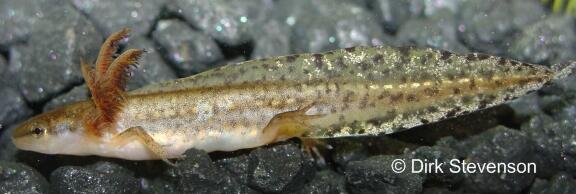
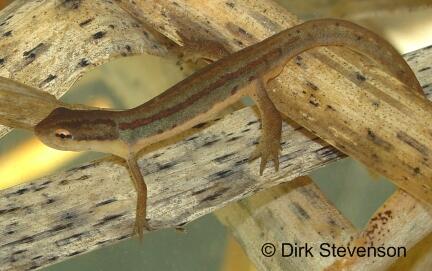
As an aquatic adult, the striped newt is olive or greenish-brown and marked with two parallel red stripes, one on each side of the back and extending onto the tail. A ventrolateral row of red spots is usually present. Small black spots are scattered on a yellow belly. Terrestrial forms, known as "efts," also have a pair of red stripes but differ by having rougher skin, a more rounded tail and a dull orange or reddish-brown overall color. Adult striped newts are typically 6-10 cm (2½ - 4 inches) in total length. The aquatic larvae have bushy external gills, a dark mottled pattern on the tail and sides, and a cream or silvery belly with black spots. A series of pale dashes usually precede the development of the conspicuous red stripes present in older larvae, metamorphs, efts, and adults.
Adults are easily distinguished from the more common and sympatric central newt (Notophthalmus viridescens louisianensis) by the distinctive red stripes. Larvae of central newts may have small, widely scattered black flecks on the body and tail, but lack the extensive black mottling of striped newt larvae.
Striped newts are associated with longleaf pine-wiregrass communities. Sandhills and well-drained pine flatwoods are favored adult habitats. Breeding and larval development occur in isolated, usually ephemeral, wetlands such as pond cypress domes, sinkhole ponds (lime sinks), and even borrow pits. Ponds are usually vegetated with an abundance of emergent grasses, sedges, and forbs. Maidencane (Panicum hemitomon) may be common at breeding ponds.
An assortment of invertebrates such as insects and crustaceans, as well as frog eggs, are eaten.
Breeding occurs in late winter and early spring when fluctuating ponds are filled with rainwater. After hatching, larvae typically develop over a period of two or three months and, following transformation, begin a life cycle unique to our two species of newts. Transformed individuals have a 1- 3 year intermediate life stage, or "eft" stage, in which they are exclusively terrestrial. Following this stage, and upon reaching sexual maturity, efts usually return to isolated ponds during winter rains, where they remain as aquatic adults until drought forces them back to land. Occasionally, when ponds remain filled throughout the dry season, striped newts will omit the terrestrial eft stage and develop into larviform, or neotenic, adults that retain bushy gills. After breeding, these neotenic animals transform and become terrestrial.
Striped newts are best surveyed for as larvae or aquatic adults, where they can be dipnetted or minnow-trapped from breeding ponds. Aquatic surveys should focus on areas with abundant emergent and submerged plants. Terrestrial adults are very difficult to find, but are occasionally encountered during breeding migrations by slowly driving roads that cross between their upland habitat and breeding wetlands. Drift fences equipped with funnel or pitfall traps placed adjacent to breeding ponds capture migrating adults and dispersing efts, but are costly and labor-intensive.
Striped newts have a relatively small range that extends from the Georgia side of the Savannah River into northern and peninsular Florida. In Georgia, striped newts occur in the lower and middle Coastal Plain and at one site in the Upper Coastal Plain, but are apparently absent from the Red Hills of southwestern Georgia.
The striped newt is threatened by the loss of both upland and wetland habitats. The Coastal Plain landscape of Georgia has been drastically altered by extensive agricultural and silvicultural practices. These activities have replaced natural, open-canopied longleaf pine communities with frequently tilled fields and dense monocultures of off-site pine species. In many areas, fire suppression has led to an unnatural succession of pine forests into densely forested, mixed hardwood communities. Drainage of isolated wetlands has significantly reduced the availability of suitable breeding sites for striped newts. Since 1990, only 7 striped newt populations have been documented from Georgia. At this time, only the Jones Center at Ichauway and Fort Stewart are thought to support long-term viable populations. However, since 2002, striped newts have been found at only 2 wetlands at the Jones Center and only 1 wetland at Fort Stewart despite intensive annual sampling. Other sites are either based on the presence of only a single known breeding pond, are threatened because of fire suppression, and/or their private land status makes their future less than secure.
| Threat 1 | Threat 2 | Threat 3 | |
|---|---|---|---|
| General Threat | Climate change & severe weather | Other options | Natural system modifications |
| Specific Threat | None | None | None |
Protected populations in Georgia occur at Fort Stewart Military Reservation, Sandhills Wildlife Management Area, Ohoopee Dunes Wildlife Management Area, Alapaha River Wildlife Management Area, Okefenokee National Wildlife Refuge, and Joseph W. Jones Ecological Research Center at Ichauway.
More research is needed to better understand the full range of requirements necessary for the survival of this unusual species. All efforts should be made to create low impact buffer zones surrounding breeding sites that incorporate a substantial amount of upland habitat. In areas known to contain striped newts, forest managers should minimize heavy soil disturbance, incorporate longer rotations, and reduce the basal area of planted pines. Habitat management for the gopher tortoise is appropriate for the striped newt. Periodic fires are necessary to control woody midstory vegetation in upland habitats and should be allowed to burn into isolated wetlands. Drainage of isolated wetlands should be avoided.
Bishop, S. O. 1943. Handbook of salamanders. Comstock Publishing Company, Ithaca, New York. 555pp.
Christman, S. P., and D. B. Means. 1992. Striped newt. Pages 62-65 in P. E. Moler, ed. Rare and Endangered Biota of Florida, Volume 3, Amphibians and Reptiles. University Press of Florida, Gainesville.
Dodd, C. K., Jr. 1993. Cost of living in an unpredictable environment: the ecology of striped newts (Notophthalmus perstriatus) during a prolonged drought. Copeia 1993: 605-614.
Dodd, C. K., Jr., and L. V. LaClaire. 1995. Biogeography and status of the striped newt (Notophthalmus perstriatus) in Georgia, U.S.A. Herpetological Natural History 3: 37-46.
Johnson, S. A. 2002. Life history of the striped newt at a north-central Florida breeding pond. Southeastern Naturalist 1: 381-402.
Johnson, S. A. 2003. Orientation and migration distances of a pond-breeding salamander (Notophthalmus perstriatus, Salamandridae). Alytes 21: 3-22.
Mecham, J. S. 1967. Notophthalmus perstriatus. Catalogue of American Amphibians and Reptiles 38.1-38.2.
Stevenson, D. J., and W. B. Cash. 2008. Striped newt Notophthalmus perstriatus. Pp. 251-253 in Jensen, J. B., C. D. Camp, J. W. Gibbons, and M. J. Elliott (eds.). Amphibians and Reptiles of Georgia. University of Georgia Press, Athens. 575 pp.
Stevenson, D.J. 2000. A review of habitat quality at Georgia historical striped newt (Notophthalmus perstriatus) localities and additional habitat surveys. Report to U.S. Fish and Wildlife Service, Order No. 1448-43910-99-M521. 31 pp.
Vitt, L. J. 1981. A survey of the status, distribution, and abundance of potentially threatened and endangered vertebrate species in Georgia, Part II: reptiles and amphibians. Unpublished report to Georgia Department of Natural Resources. 210pp.
Dirk J. Stevenson, W. Ben Cash, and John B. Jensen
D. Stevenson, W. B. Cash, and J. Jensen, Dec. 2007: original account
K. Owers, Sept. 2009: updated status and ranks, added pictures
J. Jensen, Apr. 2018: edited account