


Loading profile. Please wait . . .
Justicia angusta (Chapman) Small
Pineland Water-willow




Federal Protection: No US federal protection
State Protection: No Georgia state protection
Global Rank: G3Q
State Rank: S1
Element Locations Tracked in Biotics: Yes
SWAP 2015 Species of Greatest Conservation Need (SGCN): Yes
SWAP 2025 Species of Greatest Conservation Need (SGCN): Yes
2025 SGCN Priority Tier: High Conservation Concern
Element Occurrences (EOs) in Georgia: 3
Habitat Summary for element in Georgia: Roadside ditches; perhaps with Hartwrightia in shallow sloughs and wet savannas
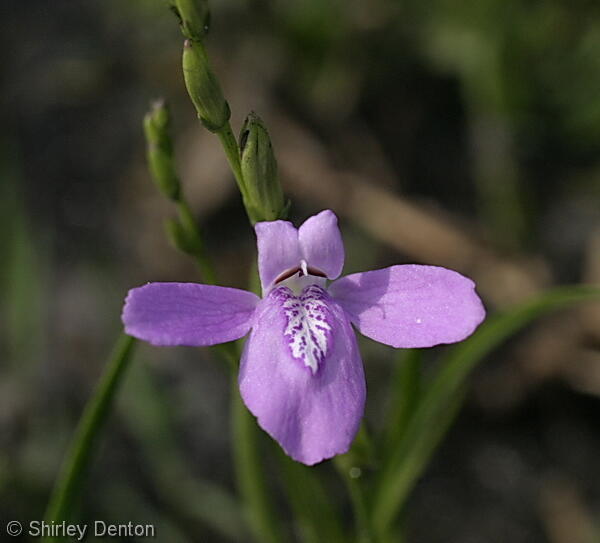
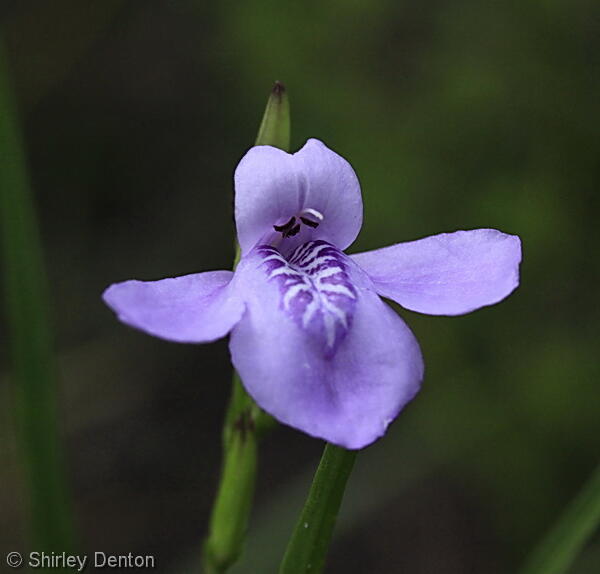
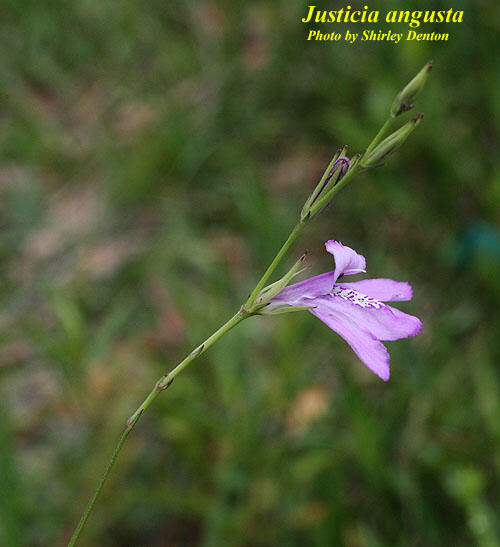
Perennial herb with slender, erect, 4-angled stems 8 - 20 inches (20 - 50 cm) tall, or taller in deep water, forming colonies by the spread of rhizomes. Leaves of the upper stem have blades 1.5 - 2.75 inches (4 - 7 cm) long, more than 8 times as long as wide, opposite, linear to narrowly lance-shaped, not channeled along the midvein, tough but not fleshy, widely separated along the stem; leaf stalks are very short or indistinct. Flowers 0.7 - 1 inch (1.8 - 3 cm) long, deep pink, lavender, or purple, with two lips: the upper lip notched and curved backwards; the lower lip with 3 spreading lobes, the central lobe with a raised white- and purple-striped area; two stamens are slightly exserted from under the upper lip. The calyx segments are very narrow and about 0.25 inch long (5 - 7 mm long and less than 1 mm wide). Fruit is a club-shaped capsule about 0.5 inch (1.2 cm) long with 4 seeds.
As with many members of the Acanthus plant family (Acanthaceae), Justicia angusta has cystoliths in the epidermal cells of its leaves; in this species, the cystoliths on the leaves are parallel to the midvein (cystoliths are hardened mineral deposits, mostly calcium carbonate, visible as streaks on the leaf surface; they may function to discourage herbivory).
Thick-leaf Water-willow (Justicia crassifolia) occurs in Georgia’s Coastal Plain and the Florida Panhandle in wet flatwoods and cypress ponds. Its upper leaf blades are 3 - 5.3 inches (8 - 13.5 cm) long and more than 8 times as long as wide, channeled, fleshy, with cystoliths parallel to the midvein. Calyx segments are 0.4 - 0.6 inch (1.1 - 1.5 cm) long.
Loose-flowered Water-willow (Justicia ovata) occurs in the Coastal Plain of Georgia, west to Texas and north to Illinois and Kentucky in swamps and marshes. Its flower is pale lavender to white and less than 0.5 inch (0.8 - 1.3 cm) long. Its leaves are 2 - 6 times as long as wide. The cystoliths in the leaves are parallel to the secondary, lateral veins. Justicia angusta is lumped by some botanists with Justicia ovata.
Three other species in the Acanthus family (Acanthaceae) are rare in Georgia:
Hygrophila lacustris (Hygrophila) occurs in shallow water of marshy shores in southwest Georgia. For more information: http://explorer.natureserve.org/servlet/NatureServe?searchName=Hygrophila+lacustris
Ruellia noctiflora (Night-blooming Wild Petunia) occurs in open, slash pine flatwoods in southeast Georgia. For more information: https://georgiabiodiversity.org/portal/profile.html?group=plants&es_id=22444&fus_tab_id=1HsRRHkW2qqMS1MunY5KMrvThVR_5C8sAX2-pFapk&group=plant
Ruellia pinetorum (Pineland Wild Petunia) occurs in seasonally moist pine savannas in south-central Georgia. For more information: https://georgiabiodiversity.org/portal/profile.html?group=plants&es_id=21797&fus_tab_id=1HsRRHkW2qqMS1MunY5KMrvThVR_5C8sAX2-pFapk&group=plant
In Georgia, Narrow-leaf Water-willow occurs in Pond Cypress/Swamp Black Gum depressions. In Florida, it occurs in wet pine flatwoods, marshes, floodplains, and lake margins.
Narrow-leaf Water-willow is a perennial herb that goes dormant in the winter. New stems emerge in early spring, elongating to lift the developing flower clusters above water level. Flowering continues spring through fall. Its flowers are bisexual and, though capable of selfing, are usually cross-pollinated because the anthers of a particular flower shed their pollen before that flower's stigmas become receptive. The flowers are visited by bees and butterflies drawn by the prominent nectar guides on the lower lip of the flower. Hummingbirds may also visit the flowers. Narrow-leaf Water-willow also reproduces vegetatively by the spread of rhizomes. Its seeds are dispersed explosively a considerable distance away from the parent plant. The wall of the fruit is made up of fibrous layers oriented in different directions. As the fruit dries, the layers pull apart, curling rapidly and flinging seeds in all directions. A similar species, Loose-flowered Water-willow (Justicia ovata), is a larval host plant for Phaon Crescent butterflies which may also use Narrow-leaf Water-willow.
Narrow-leaf Water-willow is very inconspicuous when not in flower, so surveys should be conducted late spring–early fall during flowering.
Southeast Georgia to southern peninsular Florida. It is rare throughout this range.
The Georgia habitat of Narrow-leaf Water-willow – isolated depression ponds – is threatened by lowering of the water table by excessive withdrawal from the aquifer. Ponds are also ditched and drained and converted to pine plantations, pastures, and other agricultural uses. Changes in hydrology due to altered temperature and rainfall patterns related to climate change are likely to negatively effect this species.
| Threat 1 | Threat 2 | Threat 3 | |
|---|---|---|---|
| General Threat | Agriculture & aquaculture | Energy production & mining | Transportation & service corridors |
| Specific Threat | None | None | None |
Justicia angusta is ranked S1 by the Georgia Department of Natural Resources, indicating that it is critically imperiled in the state. Three populations have been documented, all on private land, and only one has been seen in this century.
Protect isolated wetlands from conversion, ditching, and draining. Protect groundwater reserves from excessive withdrawal and pollution. Monitor sites for changes due to climate change.
Carter, R., W.W. Baker, and M.W. Morris. 2009. Contributions to the flora of Georgia, U.S.A. Vulpia 8: 1-54. https://scholar.google.com/scholar_lookup?title=Contributions+to+the+flora+ of+Georgia,+USA.&volume=8&publication_year=2009&pages=1-54
GADNR. 2019. Element occurrence records for Justicia angusta. Georgia Department of Natural Resources, Wildlife Resources Division. Social Circle, Georgia.
Godfrey, R.K. and J.W. Wooten. 1981. Aquatic and wetland plants of the southeastern United States. University of Georgia Press, Athens.
Les, D.H. Aquatic Dicotyledons of North America: Ecology, Life History, and Systematics. Taylor & Francis Group, CRC Press, Baton Rouge. https://www.taylorfrancis.com/books/9781315118116
NatureServe. 2019. Species account for Justicia angusta. NatureServe Explorer: an online encyclopedia of life, Version 7.1. NatureServe, Arlington, Virginia. Accessed 11 November 2019. http://explorer.natureserve.org/servlet/NatureServe?searchName=Justicia+angusta
Weakley, A.S. 2015. Flora of the southern and mid-Atlantic States. University of North Carolina Herbarium, University of North Carolina, Chapel Hill. http://www.herbarium.unc.edu/flora.htm
Linda G. Chafin
Linda G. Chafin, 12 November 2019: original account