Loading profile. Please wait . . .
Thalictrum debile Buckl.
Trailing Meadowrue




Federal Protection: No US federal protection
State Protection: Threatened
Global Rank: G2G3
State Rank: S1
Element Locations Tracked in Biotics: Yes
SWAP 2015 Species of Greatest Conservation Need (SGCN): Yes
SWAP 2025 Species of Greatest Conservation Need (SGCN): Yes
2025 SGCN Priority Tier: Highest Conservation Concern
Element Occurrences (EOs) in Georgia: 5
Habitat Summary for element in Georgia: Mesic hardwood forests over limestone
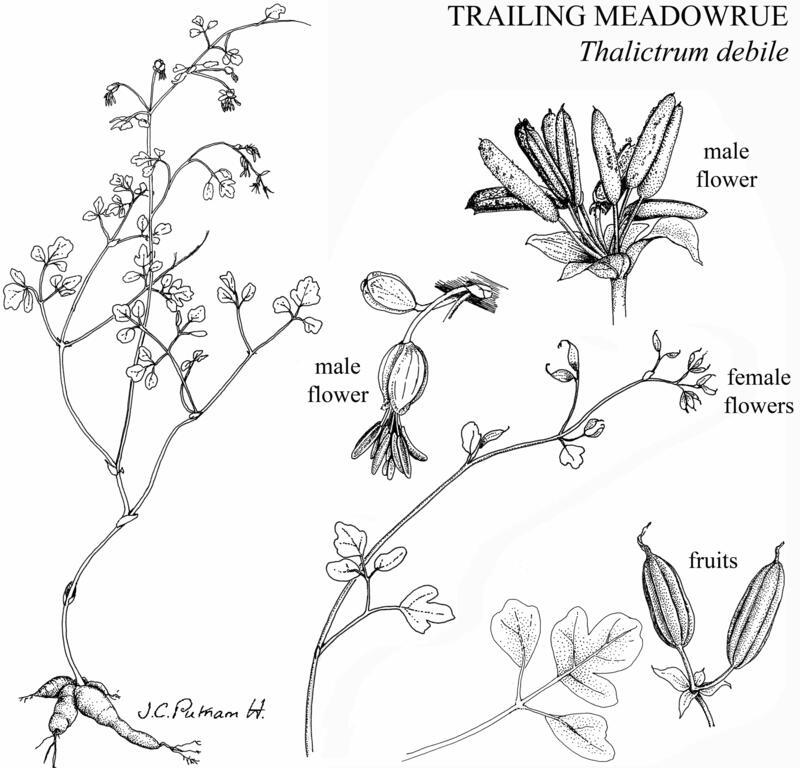
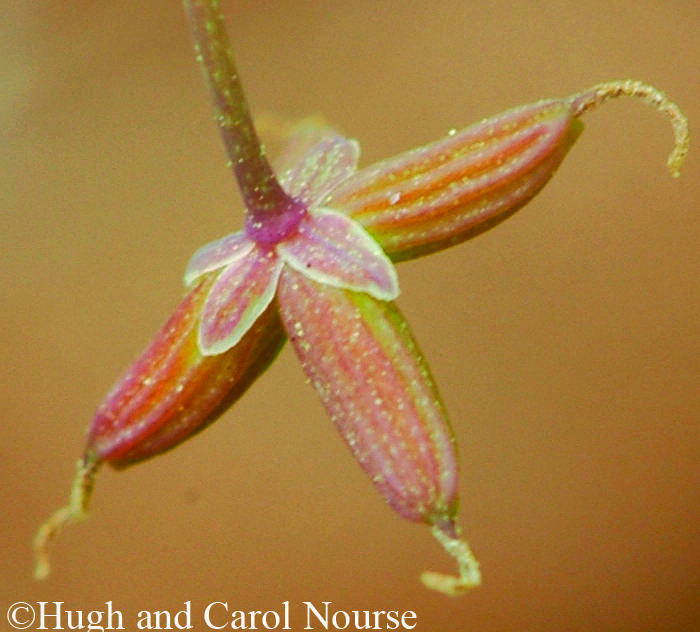
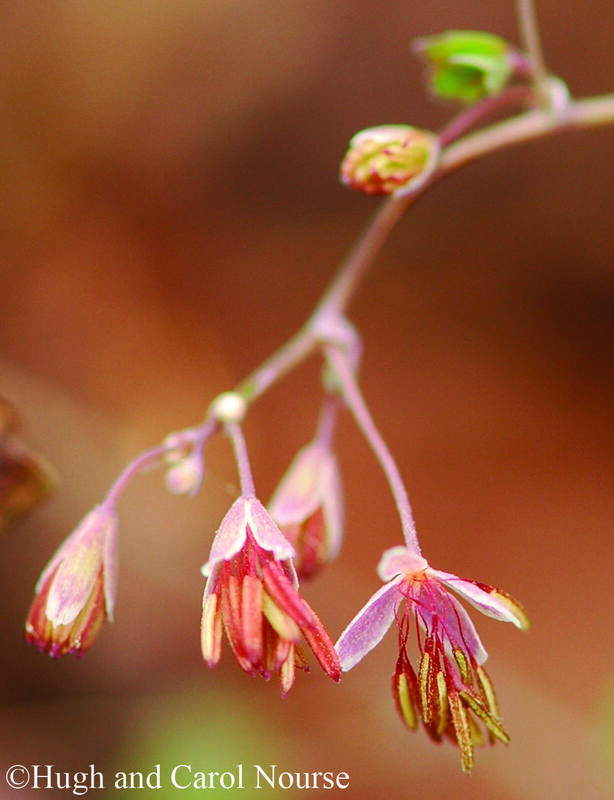
Perennial herb with slender, sprawling stems 4 - 18 inches (10 - 45 cm) long. Leaves alternate and compound, each leaf divided into many rounded, 3- or 5-lobed leaflets up to 0.6 inch (0.5 - 1.5 cm) long and wide, upper surface green, lower surface pale. Plants are dioecious, i.e. female and male flowers are held on separate plants, in open, branching clusters on slender stalks up to half the length of the plant. Both female and male flowers lack petals but have 4 pale green or purple sepals, about 0.1 inch (1 - 3.5 mm) long; female flowers produce 3 - 5 tiny, ribbed fruits; male flowers contain 12 - 18 yellow stamens.
Early Meadow-rue (Thalictrum dioicum) is also dioecious; it is an erect plant 12 - 32 inches (30 - 80 cm) tall that flowers April to early May in north Georgia.
Skunk Meadowrue (Thalictrum revolutum) is also dioecious and flowers in late spring to mid-summer. Its leaflets are either unlobed or have a large middle lobe and 2 smaller side lobes. The stems and leaves smell like skunk musk when crushed. Its male flowers have white staminal filaments with yellow or brown anthers. It occurs throughout Georgia in moist to dry forests, woodlands, and barrens, over mafic or ultramafic bedrock.
There are four rare species of Thalictrum in Georgia:
Thalictrum cooleyi (Cooley's Meadowrue) occurs in pond margins and wet savannas in southeast Georgia. For more information, see: https://georgiabiodiversity.org/portal/profile?group=plants&es_id=18704
Thalictrum coriaceum (Leatherleaf Meadowrue) occurs in sunny openings in rich, moist, rocky woods at high elevation. For more information, see: https://www.georgiabiodiversity.org/portal/profile?group=plants&es_id=18753
Thalictrum dasycarpum (Purple Meadowrue) occurs in wet prairies in the Coosa River valley. For more information, see: http://beta.floranorthamerica.org/Thalictrum_dasycarpum
Thalictrum debile (Trailing Meadowrue) occurs in moist hardwood forests over limestone in northwest Georgia. For more information, see: https://georgiabiodiversity.org/portal/profile?group=plants&es_id=16784
Forested floodplains over limestone.
Trailing Meadowrue is a perennial herb with a tuberous rootstock; it dies back to the rootstock each winter and resprouts in the spring, producing one or more stems per tuber cluster. The plants flower in early spring before trees leaf out and produce fruits until late May. The stems die back quickly after the fruits mature. Trailing Meadowrue lacks rhizomes and does not seem to reproduce vegetatively. The female flowers are on separate plants from the male plants and are pollinated by wind. Since Trailing Meadowrue is dependent on sexual reproduction to maintain or increase population size, disturbances which fragment populations and separate female plants from male plants will eventually eliminate those populations.
Surveys are best conducted during flowering (early March–late April) and fruiting (mid-March–May). Plants wither away by the end of May.
Georgia, Alabama, and Mississippi.
Logging and other clearing in floodplains. Invasion by exotic pest plants. Impoundment of streams.
| Threat 1 | Threat 2 | Threat 3 | |
|---|---|---|---|
| General Threat | Residential & commercial development | Invasive & other problematic species, genes & diseases | Biological resource use |
| Specific Threat | None | None | None |
Thalictrum debile is ranked S1 by the Georgia Department of Natural Resources, indicating that the species is critically imperiled in Georgia. It is listed as Threatened by the State of Georgia. Only two populations, both on private land, are extant.
Eradicate exotic pest plants, avoid logging and clearcutting in floodplains, protect floodplains from erosion and and sedimentation during road construction, avoid stream impoundments.
Chafin, L.G. 2007. Field guide to the rare plants of Georgia. State Botanical Garden of Georgia and University of Georgia Press, Athens.
GADNR. 2020. Element occurrence records for Thalictrum debile. Georgia Department of Natural Resources, Wildlife Resources Division, Social Circle, Georgia.
Godfrey, R.K. and J.W. Wooten. 1981. Aquatic and wetland plants of southeastern United States, Vol. 2, dicotyledons. University of Georgia Press, Athens.
Kral, R. 1983. A report on some rare, threatened, or endangered forest-related vascular plants of the South. Technical Publication R8-TP2. United States Forest Service, Atlanta.
NatureServe. 2020. Thalictrum debile species acccount. NatureServe Explorer. Arlington, Virginia. https://explorer.natureserve.org/Taxon/ELEMENT_GLOBAL.2.141309/Thalictrum_debile
Park, M.M. and D. Festerling, Jr. 1997. Thalictrum debile species acccount. Flora of North America, Vol. 3. Oxford University Press, New York. http://beta.floranorthamerica.org/Thalictrum_debile
Patrick, T.S., J.R. Allison, and G.A. Krakow. 1995. Protected plants of Georgia. Georgia Department of Natural Resources, Natural Heritage Program, Social Circle.
Weakley, A.S. 2015. Flora of the southern and mid-Atlantic States. University of North Carolina Herbarium, University of North Carolina, Chapel Hill. http://www.herbarium.unc.edu/flora.htm
Linda G. Chafin
L. Chafin, Oct. 2008: original account.
K. Owers, Feb. 2010: added pictures.
L. Chafin, June 2020: updated original account.