


Loading profile. Please wait . . .
Vaccinium crassifolium Andr.
Evergreen Lowbush Blueberry




Federal Protection: No US federal protection
State Protection: No Georgia state protection
Global Rank: G4G5
State Rank: S1
Element Locations Tracked in Biotics: Yes
SWAP 2015 Species of Greatest Conservation Need (SGCN): No
SWAP 2025 Species of Greatest Conservation Need (SGCN): No
2025 SGCN Priority Tier:
Element Occurrences (EOs) in Georgia: 2
Habitat Summary for element in Georgia: Pocosin-sandhill ecotones
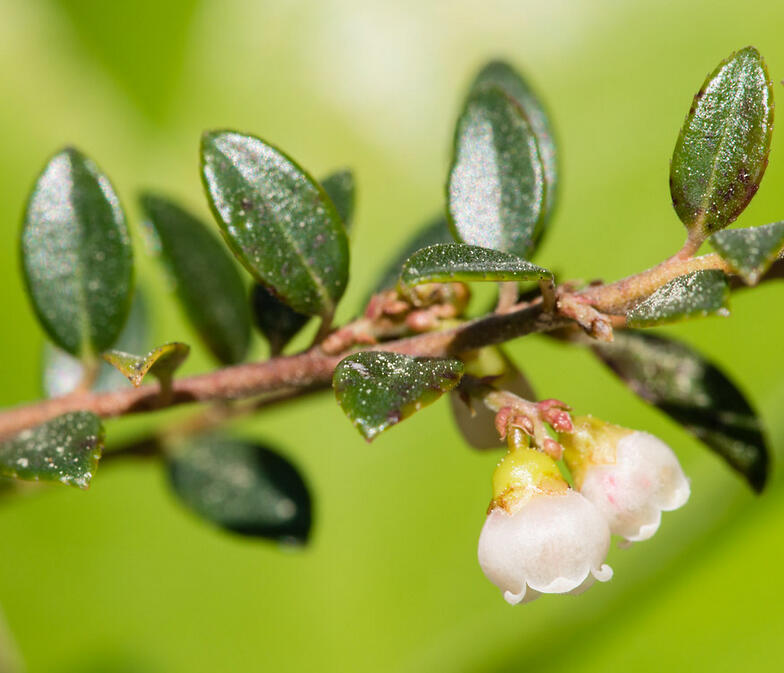
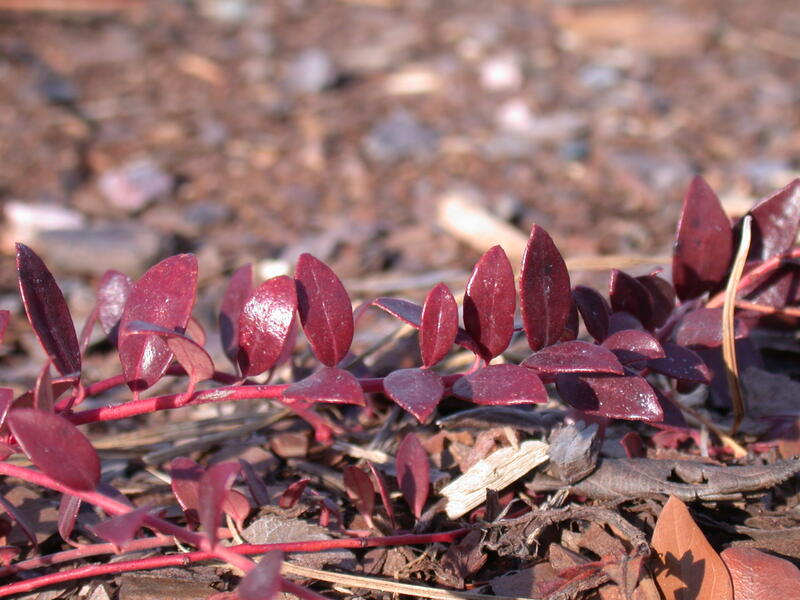
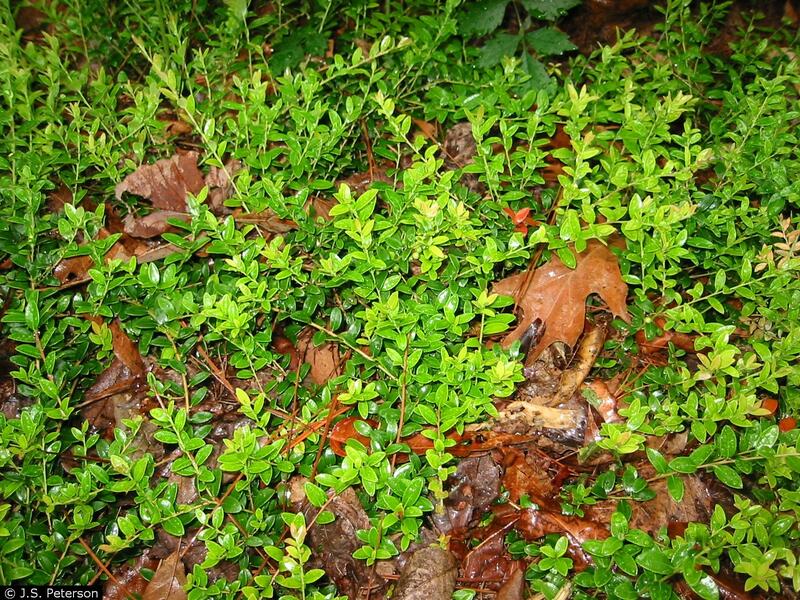
Low shrub with creeping or trailing stems up to 3 feet (1 meter) long that rise from an extensive root system with tuber-like thickenings. The stems often have short, erect branches, especially when fire-suppressed. The creeping stems root at the nodes and form large mats. Leaves up to 0.8 inch long and 0.4 inch wide (0.5 - 2 cm long and 3 -1 0 mm wide), alternate, elliptic or oval, leathery with thickened margins and low, gland-tipped teeth, upper surface with very short hairs, lower surface hairless; turning dark red and persisting for several years. Flower cluster usually produced on previous year’s growth, bearing 3 - 7 flowers. Flowers 2-4 mm long and wide, white or pink, cup-shaped with 5 very short lobes. Berry 6 - 8 mm long and wide, juicy, black or purplish-black.
Two other species in the blueberry genus Vaccinium grow in similar habitats and have similar leaves; both are low shrubs with erect stems (Southern Evergreen Blueberry, Vaccinium myrsinites, and Darrow's Blueberry, Vaccinium darrowii). Vine-wicky or Climbing Fetterbush (Pieris phillyreifolia) is another evergreen vine in the heath family found in Georgia’s Coastal Plain. Its vining, woody stem grows under the bark of wetland trees and extends branches laterally from under the tree’s bark; its leaves are 1-2.75 inches long and its flowers are held in racemes. Partridgeberry (Mitchella repens), in the Madder Family, is another evergreen vine found in Georgia’s Coastal Plain; it has opposite leaves and red berries.
Vaccinium erythrocarpum (Bearberry) occurs in acidic oak-heath forests at high elevations in Georgia’s Blue Ridge mountains. For more information, see: http://explorer.natureserve.org/servlet/ NatureServe?searchName=Vaccinium%20erythrocarpum
Moist, upland pine savannas and flatwoods dominated by Longleaf Pine; moist transition zones between sandhills and wet, evergreen shrub bogs. There is often an impermeable soil layer near the surface.
Evergreen Lowbush Blueberry, also known as Creeping Blueberry, is a member of the Heath Family (Ericaceae). Like many heath species, its leaves persist for 4 - 5 years if not stressed by drought or disease. It reproduces primarily by the formation of large, clonal mats of creeping stems that rise from tubers and root at the nodes. Research has found that few of its fruits ever reach maturity and those that do have very few viable seeds. Although a number of insects have been observed visiting the flowers (including solitary bees, honey bees, moths, ants, and thrips), poor fruit and seed production may be due to low levels of cross-pollination, a common problem in large and widely separated clonal colonies. It flowers March–April and fruits mature May–June. The fruits are eaten by birds and mammals. Though edible by humans, they are not very tasty.
Evergreen Lowbush Blueberry exhibits a number of adaptions to frequent fire, including predominantly vegetative reproduction and a tuberous root system that allows for quick re-sprouting after fire. It is among the first species to recover following fire, with stems sprouting and extending dramatically and new leaves quickly attaining full size. It is also adapted to low nutrient soils and alternating periods of drought and flooding, conditions which limit competing vegetation and allow this species to become a dominant groundcover in some areas.
Evergreen Lowbush Blueberry is recognizable year-round.
Southeast Georgia, north to southeastern Virginia, only in the Coastal Plain.
Logging, clearing, fire-suppression, conversion of habitat to pine plantations, pastures, and other development.
Vaccinium crassifolium is ranked SH (“historic”) by the Georgia Department of Natural Resources, indicating that it has not been seen in Georgia for many decades. Documented twice in Effingham County in the mid-1900s, it has not been seen since.
Protect Longleaf Pine flatwoods and savannas from conversion. Apply prescribed fire to sandhills, flatwoods, and savannas every 2 -3 years in the growing season, allowing fire to burn through ecotones and into wetland edges. Conduct targeted field surveys.
GADNR. 2019. Element occurrence records for Vaccinium crassifolium. Georgia Department of Natural Resources, Wildlife Resources Division. Social Circle, Georgia.
Vander Kloet, S.P. 2009. Species account for Vaccinium crassifolium. Flora of North America North of Mexico, vol. 8. http://beta.floranorthamerica.org/Vaccinium_crassifolium
Kirkman, W.B. and J.R. Ballington. 1990. Creeping blueberries (Ericaceae: Vaccinium sect. Herpothamnus) – a new look at V. crassifolium including V. sempervirens. Systematic Botany 15(4): 679-699. https://www.jstor.org/stable/2419164?seq=1#metadata_info_tab_contents
Kirkman, W.B., T.R. Wentworth, and J.R. Ballington. 1989. The ecology and phytosociology of the creeping blueberies, Vaccinium section Herpothamnus. Bulletin of the Torrey Botanical Club 116:114-133. https://www.jstor.org/stable/2997195?seq=1#metadata_info_tab_contents
NatureServe. 2019. Species account for Vaccinium crassifolium. NatureServe Explorer. NatureServe, Arlington, Virginia. https://explorer.natureserve.org/Taxon/ELEMENT_GLOBAL.2.129705/Vaccinium_crassifolium
NC State Extension. Vaccinium crassifolium. North Carolina Extension Gardener Plant Toolbox, North Carolina State University, Raleigh. https://plants.ces.ncsu.edu/plants/vaccinium-crassifolium/
Weakley, A.S. 2015. Flora of the southern and mid-Atlantic States. University of North Carolina Herbarium, University of North Carolina, Chapel Hill. http://www.herbarium.unc.edu/flora.htm
Linda G. Chafin
Linda G. Chafin, 29 December 2019: original account