


Loading profile. Please wait . . .
Astranthium integrifolium (Michx.) Nutt.
Eastern Western-daisy




Federal Protection: No US federal protection
State Protection: No Georgia state protection
Global Rank: G5
State Rank: S1?
Element Locations Tracked in Biotics: Yes
SWAP 2015 Species of Greatest Conservation Need (SGCN): No
SWAP 2025 Species of Greatest Conservation Need (SGCN): No
2025 SGCN Priority Tier:
Element Occurrences (EOs) in Georgia: 6
Habitat Summary for element in Georgia: Limestone glades and remnants, and roadsides and rights-of-way through these habitats.
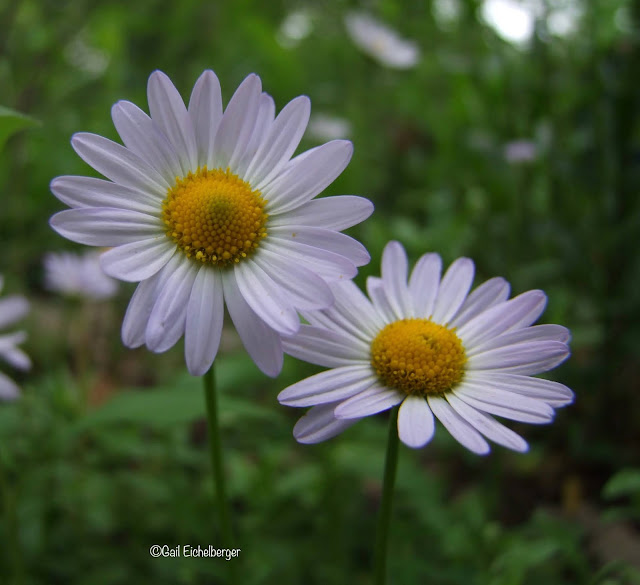
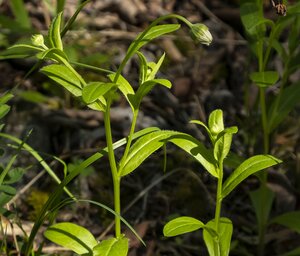
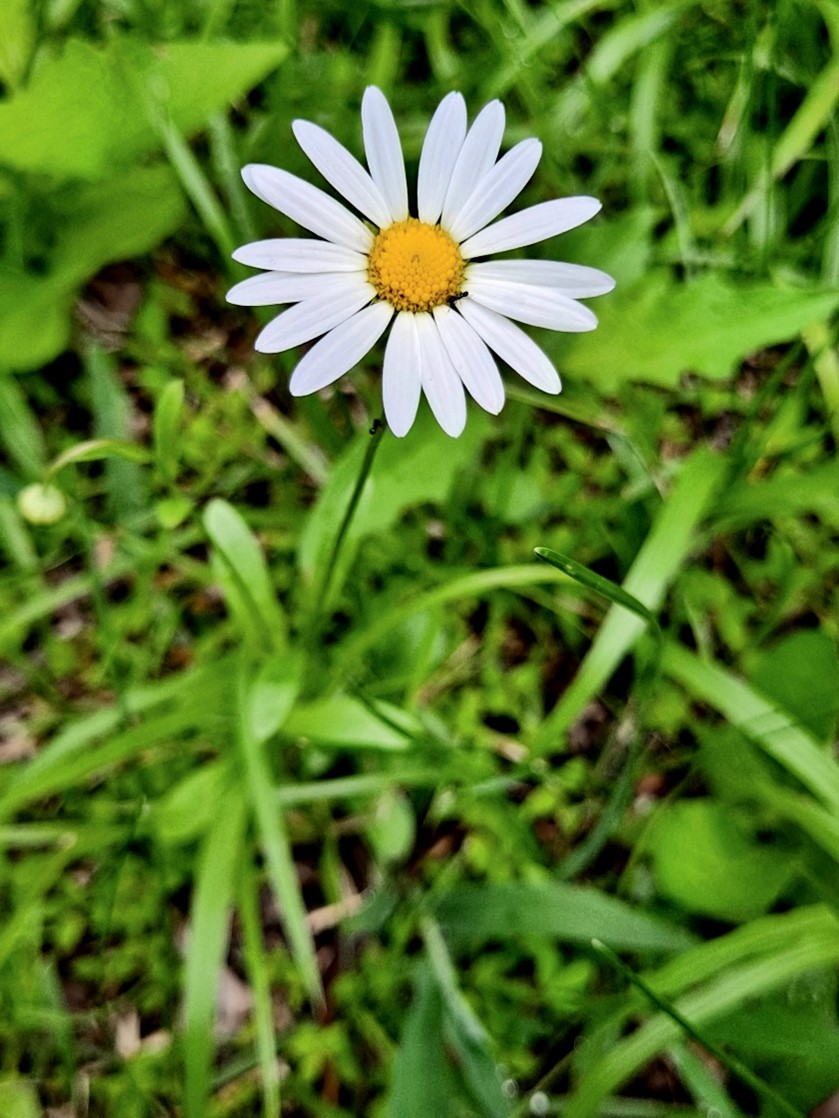
Herbaceous annual growing to 20 in. (50 cm) in height, erect. Roots are fibrous. Stems are erect to sometimes decumbent-erect, typically single, green, with hirsute trichomes. Leaves are basal and cauline (lower); sessile, simple, spatulate to oval, 1.0–2.5 in. (25–63 mm) long and 0.3–0.9 in. (7–22 mm) wide, with ciliate margins and upper surfaces. Flowers are composites, with bracts at the base. Each flower head has 5–25 white, sometimes lightly bluish, ray florets (typically 12–25), and yellow-gold disk florets. The blooming period occurs in spring into early summer, rarely extending into July, and lasts about 1 month or more. Fruits are cypselae (1-seeded fruit), dry, with a pebbly surface, faint striations, and generally glabrous.
In Georgia, Astranthium integrifolium is found in the northwest corner of the state and is the only member of its genus. Current taxonomic treatment recognizes A. integrifolium and A. ciliatum as distinct species, largely based on geography (Southeast vs. Midwest).The genus Erigeron is similar to Eastern Western-daisy, as both are annuals with basal and cauline leaves, and composite flowers that grow in similar habitats. Erigeron species differ by having stems with flattened trichomes, toothed leaves, smaller flower heads, more numerous florets (often more than twice as many as in Astranthium, but smaller), and smaller disk florets
Erigeron allisonii (syn. Erigeron strigosus var. calcicola) is also found in limestone glades, remnants, and roadsides or rights-of-way within these habitats. Like other Erigeron species, it has smaller flowers, more ray florets, and glabrous cauline leaves except along the veins and margins.
Eastern Western-daisy is found in limestone glades and remnants, and roadsides and rights-of-way through these habitats.
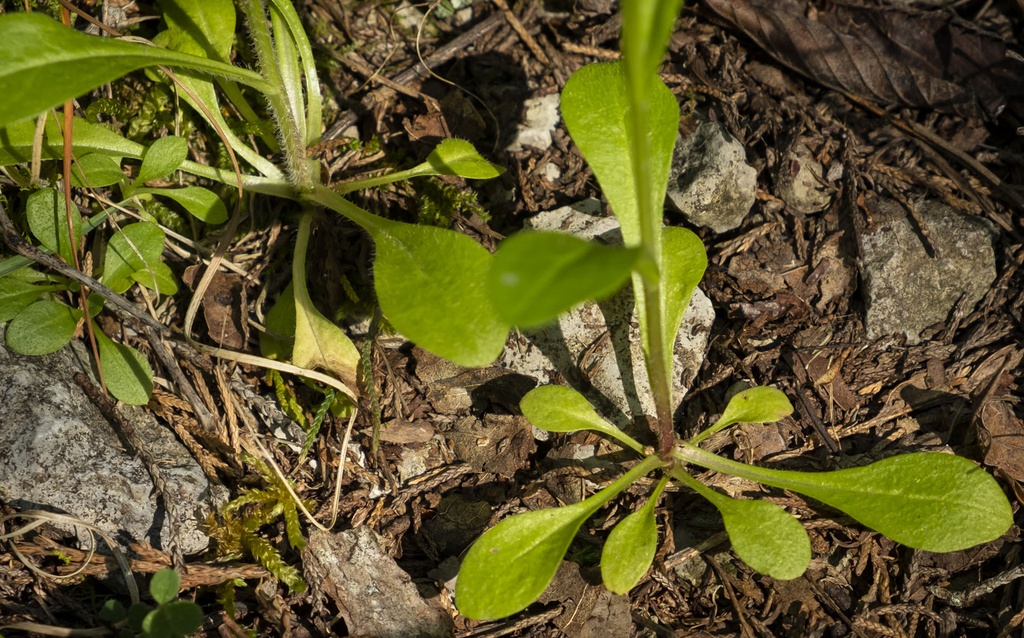
Astranthium integrifolium is an herbaceous annual. Fibrous roots produce basal leaves in winter, and typically one stem with lower leaves emerges in the spring. Flowers emerge in late spring to early summer, typically lasting about a month. The flowers are pollinated by small pollinators, including butterflies, bees, flies, and gnats. Seeds (cypselae) develop from the flowers and are released by mid-summer.
Astranthium integrifolium may be identified in late winter to early spring by its basal rosettes, and in spring to early summer by its stem with hirsute trichomes, ciliate leaves, and composite flowers with white ray florets and yellow-gold disk florets.
Southeastern North America, excluding Florida, extending north to Kentucky, West Virginia, and Arkansas. In Georgia, Eastern Western-daisy is known only from the northwest corner of the state, in 3 counties (See Range Map).
Conversion of habitat, habitat destruction, and roadside and right-of-way mowing and spraying.
Astranthium integrifolium is ranked S1? by the Georgia Department of Natural Resources, indicating that it is imperiled in Georgia, but needs review. Eastern Western-daisy has been observed in five locations in Georgia. Most of these populations occur on federal land.
Protect known populations from habitat destruction, habitat conversion, and improper roadside and right-of-way maintenance.
Arkansas Native Plant Society, 2017. https://anps.org/2017/05/12/know-your-natives-western-daisy/.
Flora of North America, 2020. http://www.efloras.org/florataxon.aspx?flora_id=1&taxon_id=220001299.
Clay and Limestone, 2021. https://www.clayandlimestone.com/2021/04/wildflower-wednesday-entireleaf-western.html.
GADNR. 2025. Element occurrence records for Astranthium integrifolium. Georgia Department of Natural Resources, Wildlife Resources Division, Wildlife Conservation Section. Social Circle, Georgia.
Lady Bird Johnson Wildflower Center. https://www.wildflower.org/plants/result.php?id_plant=ASIN9.
NatureServe. 2025. Species account for Astranthium integrifolium, ssp. integrifolium. NatureServe Explorer: an online encyclopedia of life. NatureServe Network Biodiversity Location Data accessed through NatureServe Explorer [web application]. NatureServe, Arlington, Virginia. Available https://explorer.natureserve.org/. Accessed 2025 March 6.
Nesom, 2005. Taxonomic review of Astranthium integrifolium (Asteraceae: Astereae). Sida 21: 2015–2021.
TN KY Plant Atlas, 2023. https://tennessee-kentucky.plantatlas.usf.edu/plant.aspx?id=1347#plant-photos.
Weakley, A.S. 2020. Flora of the southeast United States. University of North Carolina at Chapel Hill Herbarium, North Carolina Botanical Garden. University of North Carolina, Chapel Hill.
Weakley, Alan & Poindexter, Derick & LeBlond, Richard & Sorrie, Bruce & Franck, Alan & Schori, Melanie & Keener, Brian & Diamond, Alvin & Floden, Aaron & Noyes, Richard & Orzell, Steve & Bridges, Edwin. (2018). New combinations, rank changes, nomenclatural & taxonomic comments in the vascular flora of the southeastern United States III. Journal of the Botanical Research Institute of Texas. 12. 27-67. 10.17348/jbrit.v12.i1.910.
Nathan Thomas
13 March 2025