Loading profile. Please wait . . .
Coreopsis latifolia Michx.
Broadleaf Tickseed




Federal Protection: No US federal protection
State Protection: Rare
Global Rank: G3
State Rank: S1
Element Locations Tracked in Biotics: Yes
SWAP 2015 Species of Greatest Conservation Need (SGCN): No
SWAP 2025 Species of Greatest Conservation Need (SGCN): Yes
2025 SGCN Priority Tier: High Conservation Concern
Element Occurrences (EOs) in Georgia: 13
Habitat Summary for element in Georgia: Mature deciduous forests with open understory
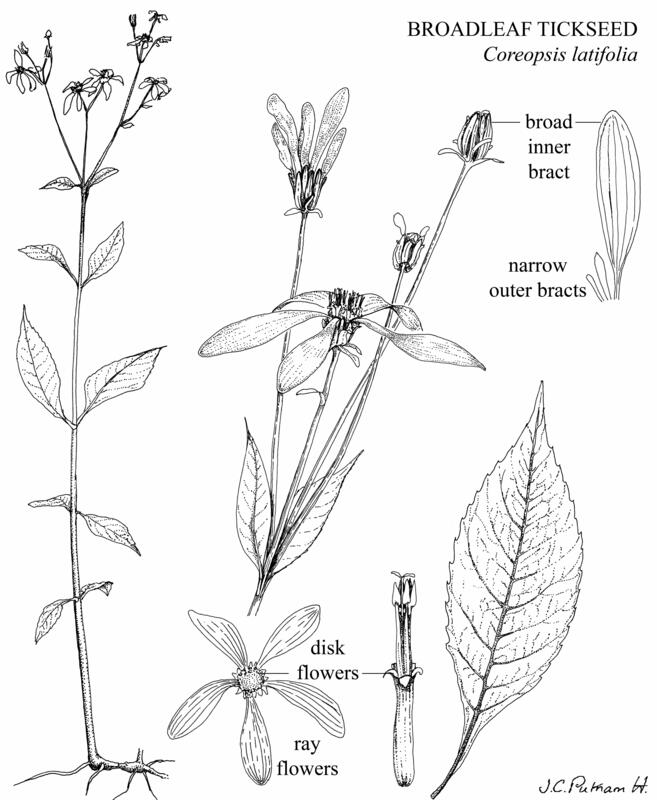
Perennial herb with unbranched stems up to 5 feet tall (1.5 meters). Leaves are 4 - 8 inches (10 - 20 cm) long and 2 - 4 inches (5 - 10 cm) wide, mostly opposite, broadly oval with pointed tips and tapering bases, smooth except for a few hairs on the lower surface, with toothed margins and leaf stalks up to 1 inch long. Flower heads are about 1.5 inches (4 cm) wide and 0.4 inch (1 cm) high, with two series of bracts underneath: outer bracts 5 per head, narrowly oblong, spreading or curved backwards; inner bracts erect, not overlapping, broadly oblong, usually longer than the outer bracts. Ray flowers are 4 - 5 per head, up to 0.8 inch (2 cm) long, yellow, with pointed tips; 1 or 2 rays may be underdeveloped, giving the head a lopsided look. Disk flowers 10 - 18 per head, yellow or orange with 5 lobes and black anthers extending well above the tips of the lobes. Fruits are about 0.3 inch (7 - 9 mm) long, dry, seed-like, flattened, ribbed, and without wings.
Broadleaf Tickseed is distinguished from other Tickseeds by the broad, toothed, opposite leaves. It also resembles several sunflowers (such as Helianthus divaricatus, H. microcephalus, and H. decapetalus) but differs in having 2 different types of involucral bracts in 2 separate whorls.
There are 3 rare species of Coreopsis in Georgia:
Ciliate-leaf Tickseed (Coreopsis integrifolia) occurs on streambanks and in floodplains of blackwater streams in the Coastal Plain. For more information see: https://georgiabiodiversity.org/portal/profile.html?group=plants&es_id=17909&fus_tab_id=1HsRRHkW2qqMS1MunY5KMrvThVR_5C8sAX2-pFapk&group=plant
Broad-leaved Tickseed (Coreopsis latifolia) occurs in mature deciduous forests with open understory in the mountains. For more information, see: https://georgiabiodiversity.org/portal/profile?group=plants&es_id=16819
Pink Tickseed (Coreopsis rosea) occurs in a wet meadow in Georgia's Blue Ridge and on a shoreline of an artificial lake in the upper Piedmont. For more information, see: https://www.georgiabiodiversity.org/portal/profile?group=plants&es_id=20663
Moist hardwood forests in mountain coves, usually in canopy gaps, near openings, or along trails and forest roads where there is more light.
Broadleaf Tickseed reproduces vegetatively by sprouting from underground stems (rhizomes). It also reproduces sexually, attracting bees and other pollinators to its brightly colored flower heads. Its fruits lack the wings and bristles that aid in seed dispersal and are characteristic of other tickseed species. Research has shown that Broadleaf Tickseed has low genetic diversity compared to other plants with similar biology. It is also lower than several other species of Coreopsis. This deficiency may be due to the combination of its small population sizes, the long distances between populations (its pollinators are bees with limited flight distances), and a reliance on clonal reproduction, all of which limits outcrossing.
Surveys are best conducted during flowering (August–September).
Georgia, Tennessee, South Carolina, and North Carolina. It is rare throughout this range.
Logging, conversion of habitat to residential development, construction of trails, campgrounds, and roads through its habitat.
| Threat 1 | Threat 2 | Threat 3 | |
|---|---|---|---|
| General Threat | Pollution | Climate change & severe weather | None |
| Specific Threat | None | None | None |
Coreopsis latifolia is ranked S1 by the Georgia Department of Natural Resources, indicating that it is critically imperiled in Georgia. It is listed as Rare by the State of Georgia. Eleven populations have been documented in Georgia, all on U.S. Forest Service or state conservation lands.
Limit logging in mature hardwood forests in the mountains. Avoid disturbing plants during construction and maintenance of trails and roads.
Chafin, L.G. 2007. Field guide to the rare plants of Georgia. State Botanical Garden of Georgia and University of Georgia Press, Athens.
Crawford, D. J., B. J. Post, and R. Whitkus. 1988. Allozyme variation within and between populations of Coreopsis latifolia (Asteraceae). Plant Species Biology 3: 1-5. https://esj-journals.onlinelibrary.wiley.com/doi/abs/10.1111/j.1442-1984.1988.tb00165.x
Cronquist, A. 1980. Vascular flora of the southeastern United States, Vol. 1, Asteraceae. University of North Carolina Press, Chapel Hill.
GADNR. 2019. Element occurrence records for Coreopsis latifolia. Georgia Department of Natural Resources, Wildlife Resources Division, Social Circle, Georgia.
Kral, R. 1983. A report on some rare, threatened, or endangered forest-related vascular plants of the South. Technical Publication R8-TP2. U.S. Forest Service, Atlanta, Georgia.
Massey, J.R., D.K.S. Otte, T.A. Atkinson, and R.D. Whetstone. 1983. Atlas and illustrated guide to the threatened and endangered vascular plants of the mountains of North Carolina and Virginia, Technical Report SE-20. Department of Agriculture, Southeastern Forest Experiment Station, Asheville, North Carolina. https://www.fs.usda.gov/treesearch/pubs/download/684.pdf
NatureServe. 2019. Coreopsis latifolia comprehensive report. NatureServe Explorer. Arlington, Virginia. http://explorer.natureserve.org/servlet/NatureServe?searchName= Cloreopsis%20latifolia
Smith, E.B. 1976. A biosystematic survey of Coreopsis in eastern United States and Canada. Sida 6(3): 123-215. https://www.jstor.org/stable/41966494
Strother, J.L. 2006. Coreopsis latifolia species account. Flora of North America, Vol. 21. Oxford University Press, New York. http://beta.floranorthamerica.org/Coreopsis_integrifolia
Weakley, A.S. 2015. Flora of the southern and mid-Atlantic States. University of North Carolina Herbarium, University of North Carolina, Chapel Hill. http://www.herbarium.unc.edu/flora.htm
Linda G. Chafin
L. Chafin, Oct. 2007: original account
K. Owers, Jan. 2010: updated status and ranks, added pictures
L. Chafin, Jan. 2020: updated original account.