


Loading profile. Please wait . . .
Schoenoplectus etuberculatus (Steudel) Sojak
Canby's Bulrush




Federal Protection: No US federal protection
State Protection: No Georgia state protection
Global Rank: G3G4
State Rank: S2
Element Locations Tracked in Biotics: Yes
SWAP 2015 Species of Greatest Conservation Need (SGCN): Yes
SWAP 2025 Species of Greatest Conservation Need (SGCN): Yes
2025 SGCN Priority Tier: High Conservation Concern
Element Occurrences (EOs) in Georgia: 14
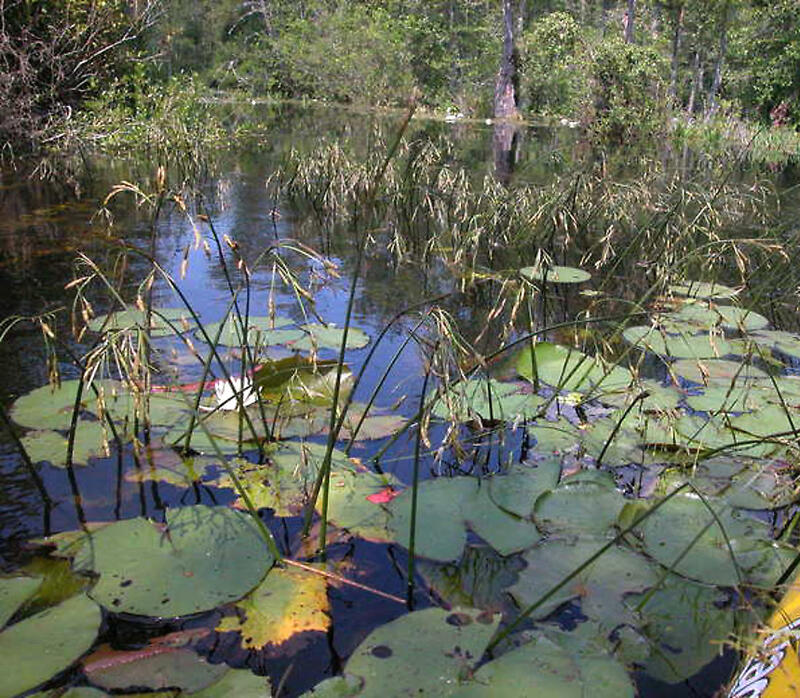
Habitat Summary for element in Georgia: Marshes; shallow ponds; peaty swamps, as Okefenokee Swamp and Atlantic whitecedar swamps
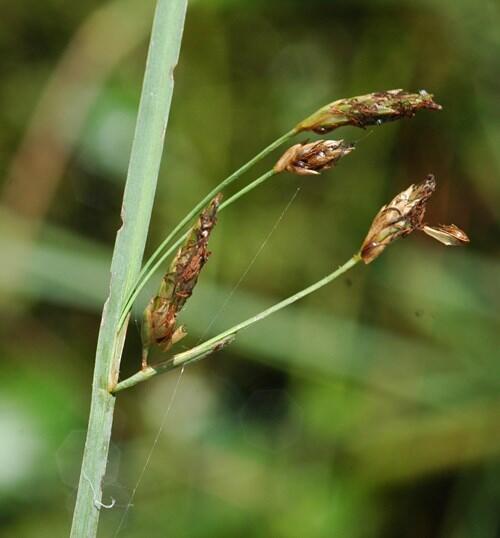
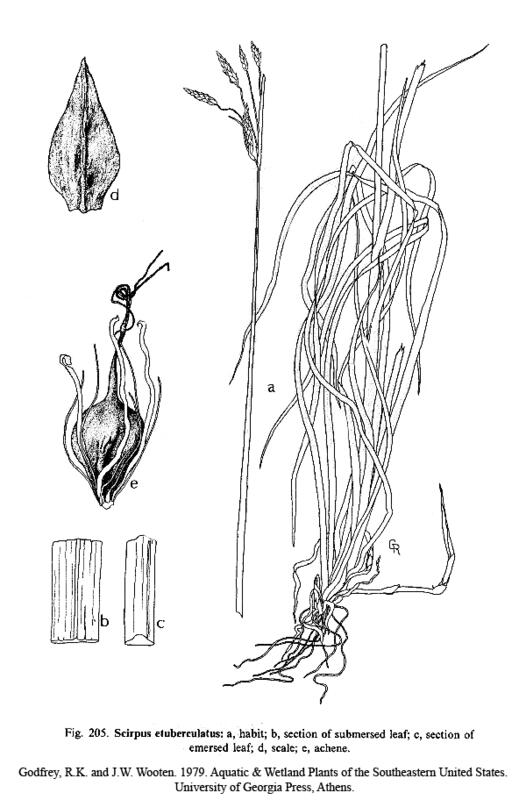
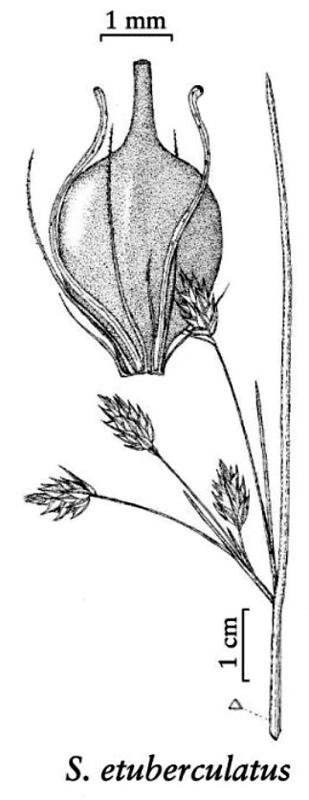
Perennial, aquatic herb, with stout, reddish rhizomes and erect, sharply three-angled stems up to 6 feet (2 meters) tall and 0.2 inch (5 mm) wide (stems are round near the submerged base). Aerial leaves are 2 - 3 in number, about the same height as the stems, less than 0.4 inches (2 - 10 mm) wide, stiff, deeply channeled, V-shaped or three-sided in cross-section; flexible, flattened, submerged leaves are also usually present. A branched flower cluster appears to emerge from the side of the stem because a stem-like bract (2.75-12.5 inches, 7–32 cm tall) extends above the cluster. Each flower cluster contains 3 - 20 narrowly oval spikelets up to 1 inch (2.54 cm) long on slender, nodding stalks. Spikelets are up to 1 inch long and 0.2 inch wide (1 - 2.5 cm long and 0.5 - 0.6 cm wide), covered with many straw-colored to reddish, oval scales; each scale conceals a single flower with 2 - 3 stamens and a three-sided ovary with an elongated, three-branched style. Fruit is a seed-like achene less than 4 mm long, surrounded at its base by 4 - 6 bristles. Achenes are three-angled, flattened on one side, smooth (not warty or wrinkled), shiny, olive-brown to brownish-black with an elongated point at the top.
There are a number of large, emergent, aquatic plants in this genus and in the related genus Scirpus in the Georgia Coastal Plain. Clearwater Bulrush is distinguished by having strongly three-angled upper stems, both submerged and emergent leaves, stalked spikelets, and a single, stem-like bract above the flower cluster.
All Schoenoplectus species in our area were once included in the genus Scirpus.
Raynal's Bulrush, Schoenoplectus erectus ssp. raynalii), occurs around seasonal ponds such as depression ponds in pine flatwoods. It is distinguished by its clumping habit, cylindric (not three-angled) stems, reddish-brown spikelet scales, horizontally ridged achene, and a lack of bristles at the base of the achene. For more information, see: https://georgiabiodiversity.org/portal/profile?group=plants&es_id=34960
Clearwater Bulrush occurs in Georgia’s Coastal Plain in old beaver ponds, peaty swamps, small flatwoods depression ponds, clear seepage streams in sandhills and Atlantic White-Cedar swamps, and swift-flowing blackwater streams.
Clearwater Bulrush is a perennial that reproduces sexually by seed and asexually by the spread of rhizomes, sometimes forming large clonal stands. Its flowers are wind-pollinated and its seeds are dispersed by water. The seeds are an important food source for ducks, and the stems and roots are eaten by waterfowl and muskrats.
Clearwater Bulrush is in flower and fruit from May to October, but surveys are best conducted when the achenes are mature in September and October since well developed fruits are needed for positive identification.
Georgia and Florida, west to Texas and north to Delaware, with disjunct populations in southern Missouri and Rhode Island.
Disturbances in wetlands such as ditching, draining, and stream channelization and impoundment are a threat to this species. Logging and clearing along streams and around flatwoods depression ponds are also a threat. Excessive withdrawal from the Floridan Aquifer. Development in uplands, if leading to sedimentation of streams and ponds, is a threat to Clearwater Bulrush habitat. Invasion by aggressive aquatic species, such as native Cattails (Typha latifolia) and the Asian Marsh Dewflower (Murdannia keisak), is also a threat. Changes in hydrology due to altered temperature and rainfall patterns related to climate change are likely to negatively effect this species.
| Threat 1 | Threat 2 | Threat 3 | |
|---|---|---|---|
| General Threat | Invasive & other problematic species, genes & diseases | Pollution | None |
| Specific Threat | None | None | None |
Schoenoplectus etuberculatus is ranked S2 by the Georgia Department of Natural Resources, indicating that it is imperiled in the state. Fourteen populations have been documented in Georgia, but only five have been seen in this century. None have been documented on conservation lands.
Protect wetlands from hydrologic disturbances, sedimentation, and impoundment. Prevent logging along streams. Regulate groundwater withdrawal. Monitor sites for exotic pest plant invasions. Monitor sites for impacts of climate change.
Enser, R.W. 2001. Schoenoplectus etuberculatus (Steud.) Sojak, Swamp-bulrush – Conservation and Research Plan for New England. New England Wild Flower Society, Framingham, Massachusetts. https://www.nativeplanttrust.org › documents › Schoenoplectusetuberculatus
GADNR. 2019. Element occurrence records for Schoenoplectus etuberculatus. Georgia Department of Natural Resources, Wildlife Resources Division. Social Circle, Georgia.
Godfrey, R.K., and J.W. Wooten. 1979. Aquatic and wetland plants of southeastern United States: monocotyledons. University of Georgia Press, Athens.
NatureServe. 2019. Species account for Schoenoplectus etuberculatus. NatureServe Explorer. NatureServe, Arlington, Virginia. http://explorer.natureserve.org/servlet/NatureServe?searchName=Schoenoplectus%20etuberculatus
Smith, S.G. 2003. Species account for Schoenoplectus etuberculatus. Flora of North America North of Mexico, vol. 23. http://beta.floranorthamerica.org/Schoenoplectus_etuberculatus
Weakley, A.S. 2015. Flora of the southern and mid-Atlantic States. University of North Carolina Herbarium, University of North Carolina, Chapel Hill. http://www.herbarium.unc.edu/flora.htm
Linda G. Chafin
Linda G. Chafin, 11 December 2019: original account