Loading profile. Please wait . . .
Glyptemys muhlenbergii (Schoepff, 1801)
Bog Turtle




Federal Protection: Similarity of Appearance (Threatened)
State Protection: Endangered
Global Rank: G2G3
State Rank: S2
Element Locations Tracked in Biotics: Yes
SWAP 2015 Species of Greatest Conservation Need (SGCN): Yes
SWAP 2025 Species of Greatest Conservation Need (SGCN): Yes
2025 SGCN Priority Tier: Highest Conservation Concern
Element Occurrences (EOs) in Georgia: 14
Habitat Summary for element in Georgia: Mountain bogs; wet meadows; edges of mountain streams
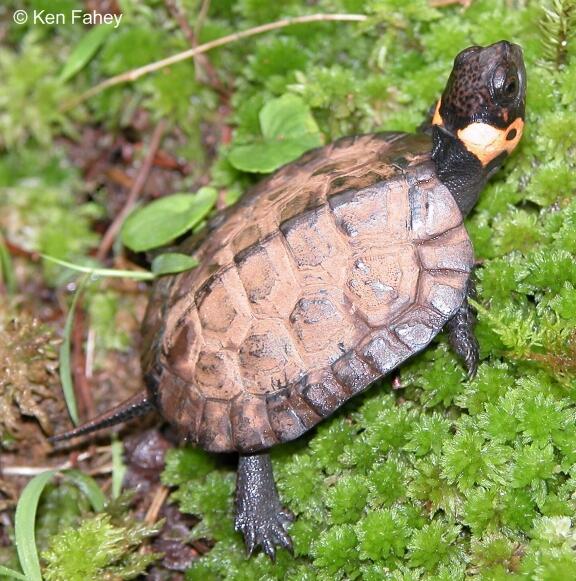
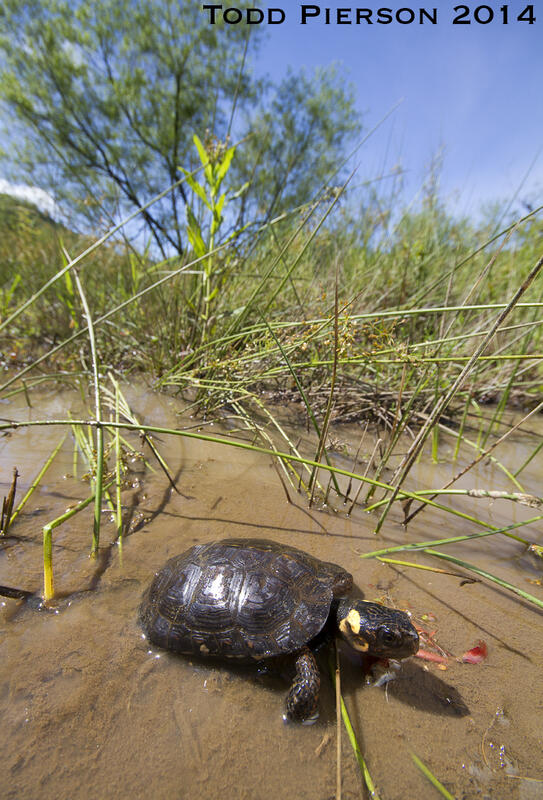
The bog turtle is the smallest turtle species in North America (one of the smallest in the world) reaching only 11.5 cm (4½ inches) in maximum carapace length. The low-keeled, black, brown, or mahogany-colored carapace has a sculpted appearance due to the distinctive growth annuli of the scutes; the genus Glyptemys means “carved turtle.” These annuli often become obscured in older individuals due to wear and accumulation of iron deposits from their mucky habitat. The unhinged plastron is typically black with yellow or cream-colored blotches along the midline. A conspicuous orange, red-orange, or yellow blotch is present on each side of the neck. Skin color is brown to pink and may have some reddish mottling. The plastron (bottom shell) in females is flat and is strongly concave in males. The tail of adult females is short with the vent barely extending beyond the rear edge of the plastron. In males, the tail is long and muscular with the vent well beyond the rear edge of the carapace. Otherwise similar in appearance to adults, juveniles have a yellow plastron with a large black blotch in the center.
Within the range of the bog turtle in Georgia only the eastern mud turtle (Kinosternon subrubrum) and the eastern musk turtle (Sternotherus odoratus) remotely resemble the appearance of the bog turtle. However, both lack the bog turtle’s iconic orange neck blotch.
Georgia wetlands inhabited by this elusive turtle are generally found along slowly flowing spring creeks and seepages within low mountain valleys. Habitats capable of supporting a viable bog turtle population may be as small as an acre. Though the habitat type of this turtle varies from spring seepages, bogs, and wet meadows, the presence of soft, deep, mucky organic soil and open wet areas with shallow water are prerequisites to inhabitation by bog turtles. These bogs (which are technically, by definition, “Southern Appalachian Fens,” since their associated water source is of seepage origin rather than solely from rainfall as is typical in classic boreal forest bogs) are ideally quite open and characterized by a rich growth of sedges, rushes, bulrushes, and, especially, sphagnum moss. Woody vegetation present often includes red maple, tag alder, willow, and swamp rose. In the absence of edaphic factors (e.g., sustained high water table at or near the surface), sources of natural disturbance (e.g., herbivore grazing, periodic beaver impoundment, or natural fire on the landscape), or active habitat management (e.g., mechanical woody plant reduction/removal, prescribed fire), woody vegetation of Southern Appalachian Fens produce a closed canopy, shading out sphagnum and herbaceous ground cover making wetland sites without regular habitat disturbance unsuitable to bog turtles and the myriad of associated rare fen plants.
Bog turtles feed opportunistically on a wide variety of prey including insects, earthworms, snails, slugs, crayfish, millipedes, frogs, tadpoles, salamanders, watersnakes, and the young of mice, but also eat an array of aquatic vegetation, seeds, and berries, and occasionally scavenge on carrion.
Bog turtles are primarily active during spring, early summer, and early fall. Turtles may become relatively inactive if the summer months are extremely hot and dry. Trapping and radio-telemetry studies have dispelled the belief that bog turtles usually aestivate (period of inactivity during hot/dry periods) in summer, but instead are simply more difficult to locate during this time of the year when vegetation is especially dense. Winter hibernacula sites consist of mammal burrows, tussocks of sedges, mucky soil, and other suitable retreats. Turtles may hibernate singly or in association with others. During active periods, bog turtles are diurnal and spend a good deal of time basking on land, on top of grass clumps, or in the shallows of small rivulets. During the warmest parts of the year, turtles actively burrow below the surface. These turtles forage and feed on land and in the water. Male turtles roam widely in search of females shortly after they become active in late March. Courtship and breeding occur from late April to early June, and eggs are subsequently laid from May to July. Eggs are either buried in soft soil or rotted wood, placed in thick beds of sphagnum moss, or deposited in the top of sedge tussocks. These nest sites are usually located in areas receiving plentiful sunlight. Adult females produce only one clutch of one to six elliptical eggs per year, but may not nest every year. In Georgia, incubation time varies from 52 to 60 days with hatchlings typically emerging in late August or September and immediately burrowing into the surrounding substrate. Bog turtles in the wild reach sexual maturity at the age of 7-9 years. Predators of eggs, juveniles, and adults include raccoons, skunks, opossums, foxes, wading birds, and common snapping turtles.
Although bog turtles remain active from late March to early October, visual surveys for bog turtles within suitable mountain fen habitats are most effective during the period of greatest annual turtle activity (spring emergence and breeding) from mid-April to mid-June. In early spring, bog turtles can be found basking as soon as there is sufficient sunlight, while later in the spring and summer, turtles are most active before intense mid-day sun makes it too warm for them on the surface. Other survey methods include the use of probing sticks and specialized traps, but these should only be used by experienced individuals.
Identification of potential bog turtle habitat and undocumented bog turtle populations should remain a high priority where opportunities exist. The use of untapped technologies, such as the GIS analysis of LiDAR and near-infrared photometric remote data should be explored to: 1) evaluate reasons for local gaps in known bog turtle distribution; 2) determine historical extent of mountain fen habitat in Georgia (and the Southern Appalachians); 3) inform and refine metapopulation analysis; & 4) produce the foundation for a landscape-level management strategy for the southern population of the bog turtle.
Bog turtles have a discontinuous range that stretches from western Massachusetts southward to northeastern Georgia. A large gap (ca. 250km/150 miles) in West Virginia and northern Virginia separates the so-called northern and southern populations. Disjunct populations are known from upper New York, northwestern Pennsylvania, northeastern Tennessee, and from the Piedmont of North Carolina. The existence of this species in Georgia was unknown until 1979, when an individual was captured in a trap set for ruffed grouse. Bog turtles reach their southernmost and westernmost limits in northern Georgia and were probably never very abundant at this range periphery. All Georgia localities are confined to the Blue Ridge physiographic province within wetlands above 150 m (1800 feet) in elevation and appear also to be largely confined to the headwaters of the Tennessee River drainage.
The high demand for bog turtles in the black-market pet trade has resulted in the removal of many individuals from sites in other states and may be a threat in Georgia as well. Range-wide, bog turtles have experienced their greatest decline in numbers due to loss of habitat. Alteration of habitat disturbance regimes and agricultural drainage of fen habitat have often led to the extirpation of the bog turtle through the elimination of suitable basking, foraging, and nesting sites. Plants and animals associated with mountain fen habitats have become increasingly rare simply because their habitat is becoming increasingly rare. Because Southern Appalachian mountain fens are early successional habitats that naturally succeed to forested communities, animals such as the bog turtle that depend on them are adapted to seek out new sites once previous ones become densely forested or hydrologically unsuitable. Historically, however, greater equilibrium existed between fen succession and fen creation through natural disturbance. Today, the rate of fen loss far exceeds the rate of fen creation, as most mountain fen wetlands have been drained and converted to other uses over the years, as these flat areas (where private property is concentrated in the mountains) are also ideal locations for towns, roads, reservoirs, and farms. Stream impoundment, stream channelization, and human intolerance for natural beaver disturbance have significantly reduced suitability of fen habitat on the landscape as well. Because natural disturbance factors – grazing by elk, impoundment by beavers, and natural fire – needed to maintain mountain fen habitats in an early stage of succession have been eliminated or significantly reduced, those charged with the conservation of fens and their flora and fauna must maintain the last remaining fen habitats on the landscape by artificially mimicking the effects of natural disturbances.
| Threat 1 | Threat 2 | Threat 3 | |
|---|---|---|---|
| General Threat | Agriculture & aquaculture | Natural system modifications | Biological resource use |
| Specific Threat | Livestock farming & ranching | Other ecosystem modifications | Hunting & collecting terrestrial animals |
Bog turtles were protected under Georgia’s Endangered Wildlife Act in 1992, as part of the “southern population,” were listed as Threatened Due to Similarity of Appearance (to individuals of the “northern population”) in 1997 under the US Endangered Species Act (ESA), and were added to the list of High Priority Species within Georgia’s Wildlife Action Plan in 2005. Conservation and habitat restoration and management remain high priorities for the US Forest Service and the State of Georgia on both public and private lands containing suitable habitat and bog turtle populations. In 2022 the US Fish & Wildlife Service was petitioned to list the southern population as Threatened under ESA.
The bog turtle is currently known from only fifteen localities within the wilds of Georgia (Fannin, Rabun, Towns, and Union counties), though more undoubtedly occur within the rugged terrain of the north Georgia mountains (a reported site in Stephens County is of questionable validity). Within two-thirds of these sites the bog turtle is known only from the observation of just one or a few individuals, and in three of these sites the associated population is apparently extirpated due to past habitat succession and site drainage. Three natural populations are currently known from public lands, but the future viability of one of these populations is uncertain due to low turtle numbers and limited available suitable habitat. A total of five populations (2 on public & 3 on private lands) are currently thought to contain viable populations. In 2004 & 2005 a total of 18 headstarted juveniles were released into a restored fen habitat on the Chattahoochee National Forest; as few as two of these turtles have survived to date. In 2018 Georgia established a captive population of bog turtles (Southern Appalachian genetics) which will be the source of hatchling turtles for a renewed headstarting and population establishment effort within restored mountain fen habitats on federal land.
Since 2008 there has been an extensive effort by the Georgia DNR, Wildlife Conservation Section to locate suitable bog turtle habitat and additional bog turtle populations. A total of 381 wetland habitats have been evaluated, 168 of these, evaluated on-the-ground using US Fish & Wildlife Service bog turtle habitat suitability assessment criteria (Phase I & Phase II protocols); as a direct result of this work, in addition to regular monitoring efforts of known populations, since 2008 a total of 48 wetland sites deemed suitable for bog turtle have been surveyed via intensive trapping efforts. From 2010-2015, five additional bog turtle populations were documented in Georgia, doubling the number of known localities since 2008, including the identification of the five sites thought to support viable bog turtle populations. Collaborative field work with the University of Georgia and Clemson University has resulted in the development an area-constrained standardized survey protocol, publication of a species distribution model (SDM) for the southern population, and related field research evaluating patterns of historical habitat alteration, present wetland habitat suitability, and bog turtle abundance and site occupancy was also published.
Since 1998, extensive vegetative habitat restoration efforts have been periodically conducted cooperatively (i.e., Georgia Plant Conservation Alliance, US Fish & Wildlife Service, US Forest Service, Georgia DNR, and other conservation partners) within nine Southern Appalachian Fen wetlands with documented bog turtle occurrence (six on public lands) through mechanic woody vegetation removal/reduction and/or the use of prescribed fire. From 2008-2012 biologists of the Georgia DNR, Wildlife Conservation Section conducted empirical field research to determine efficacy of various woody vegetation management techniques for the restoration and maintenance of vegetative component of mountain fen wetland habitats.
Restoration of mountain fen hydrology has seldom been attempted, and never in conjunction with bog turtle site repatriation – but this is precisely the long-term conservation goal for restoration of a wetland habitat historically occupied by the bog turtle in Rabun County (part of the US Forest Services’ Foothills Landscape Project). Ironically, the presence of cattle within the margins of mountain fen habitat in many cases has been shown to maintain at least marginally suitable bog turtle habitat presumably by mimicking grazing disturbance of now extirpated elk (four sites in Georgia). Where wetland hydrology is intact, restoration of mountain fen habitats ideally would be achieved through the restoration of natural disturbance regimes. In reality, however, within the current fragmented landscape of the Southern Appalachians, there no longer exists the network of hydrologically intact mountain fen habitats of differing successional stages necessary to naturally perpetuate fen flora and fauna over time across the landscape. Furthermore, the progression of the effects of natural disturbance, such as impoundment by beaver, take many decades to produce habitat suitable for bog turtles. Because the characteristics of early successional fen habitat can be achieved relatively quickly through mechanical woody vegetation removal, this method of artificial disturbance is the one most often employed within restoration efforts despite the method’s limited long-term effectiveness. Since mechanical woody vegetation removal at best only mimics wind throw, its effectiveness is merely temporary when used alone, as compared to a more natural and gradual process of fen creation (e.g., beaver impoundment). Consequently, in order to assure continued existence of rare fen flora and fauna across the Southern Appalachian landscape, conservationists must continually maintain an early successional state within a number of restored mountain fen habitats through mechanical woody vegetation removal, judicious use of herbicides, and prescribed fire.
Periodic monitoring of known bog turtle populations (both of private and public lands) should be conducted in order to maintain up-to-date knowledge of the conservation status of each documented population. Management of known bog turtle sites is difficult since most occur on private land, but the sheer number of bog turtle sites occurring on private lands emphasizes the importance of private landowner cooperation in long-term conservation of this turtle species. Habitat management of sites occupied by bog turtles should continue to be conducted periodically as needed to maintain suitable habitat conditions. The possibility of establishing conservation easements to maintain the early successional fen communities on private land sites should be investigated and utilized whenever feasible. Efforts to locate additional bog turtle sites and mountain fen habitat within the vast federally owned lands and surrounding private landholdings in the northeast Georgia mountains remains a high priority. Conservation and proper management of bog turtle sites also benefits other fen-inhabiting rarities such as swamp pink (Helonias bullata, federally listed as Threatened) and the mountain purple pitcherplant (Sarracenia purpurea montana, state listed as Endangered; candidate for federal listing).
Bury, B. R. 1979. Review of the ecology and conservation of the bog turtle, Clemmys muhlenbergii. U. S. Department of Interior, U.S. Fish and Wildlife Service Special Scientific Report 219: 1-9. Washington, D.C.
Ernst, C. H., J. E. Lovich, and R. W. Barbour. 1994. Turtles of the United States and Canada. Smithsonian Institutional Press, Washington, D.C., and London, England. 578pp.
Fahey, K. M. 2008. Bog turtle Clemmys (Glyptemys) muhlenbergii. Pp. 472-474, In: Jensen, J. B., C. D. Camp, J. W. Gibbons, and M. J. Elliott (eds.). Amphibians and Reptiles of Georgia. University of Georgia Press, Athens. 575 pp.
Fahey, K. M. 1996. Habitat survey and census of bog turtle (Clemmys muhlenbergii) Schoepff populations in Georgia with conservation and management suggestions. Unpublished report to Georgia Department of Natural Resources. 36pp.
Floyd, T. M. and J. M. Moffett. In Prep. The Efficacy of Prescribed Fire, Mechanical Woody Stem Removal, and Herbicide Application in the Restoration and Maintenance of Southern Appalachian Mountain Bog Habitats in an Early Seral State by Mimicking Natural Disturbance.
Herman, D. W. 2003. Status of the bog turtle (Clemmys muhlenbergii Schoepff 1801) in the southern part of its range, including Georgia, North Carolina, South Carolina, Tennessee, and Virginia. Unpublished report to the U.S. Fish and Wildlife Service on the 1996-2002 status survey. 93 pp.
Lovich, J. E., D. W. Herman, and K. M. Fahey. 1992. Seasonal activity and movements of bog turtles (Clemmys muhlenbergii) in North Carolina. Copeia 1992: 1107-1111.
Somers, A. B., K. A. Bridle, D. W. Herman, and A. B. Nelson. 2000. The restoration and management of small wetlands of the mountains and piedmont in the southeast: a manual emphasizing endangered and threatened species habitat with a focus on bog turtles. A joint publication of the Watershed Science and Wetland Science Institutes of the U.S. Department of Agriculture, Natural Resources Conservation Service, The University of North Carolina at Greensboro, and Pilot View Resource Conservation and Development, Inc. 152 pp.
Stratmann, T. S. M., T. M. Floyd, and K. Barrett. 2020. Habitat and history influence abundance of bog turtles. Journal of Wildlife Management 84(2): 331–343.
Stratmann, T. S. M., K. Barrett, and T. M. Floyd. 2016. Locating suitable habitat for a rare species: evaluation of a species distribution model for bog turtles (Glyptemys muhlenbergii) in the southeastern United States. Herpetological Conservation and Biology 11(1): 199–213.
Walton, E. M. 2002. Field techniques for bog turtle research in North Carolina. Unpublished manual: Department of Biology, University of North Carolina, Greensboro. 68 pp.
Vitt, L. J. 1981. A survey of the status, distribution, and abundance of potentially threatened and endangered vertebrate species in Georgia, Part II: reptiles and amphibians. Unpublished report to Georgia Department of Natural Resources. 210pp.
Thomas M. Floyd and John B. Jensen
T. Floyd and J. Jensen, Dec. 2007: original account
K. Owers, Sept. 2009: updated status and ranks, added pictures
T. Floyd and J. Jensen, April 2011: updated Georgia conservation status and elevation range.
T. Floyd, Mar 2023: updated & revised account