


Loading profile. Please wait . . .
Sternula antillarum Lesson, 1847
Least Tern




Federal Protection: No US federal protection
State Protection: Rare
Global Rank: G4
State Rank: S2
Element Locations Tracked in Biotics: Yes
SWAP 2015 Species of Greatest Conservation Need (SGCN): Yes
SWAP 2025 Species of Greatest Conservation Need (SGCN): Yes
2025 SGCN Priority Tier: High Conservation Concern
Element Occurrences (EOs) in Georgia: 32
Habitat Summary for element in Georgia: Sandy beaches; sandbars, dredge islands
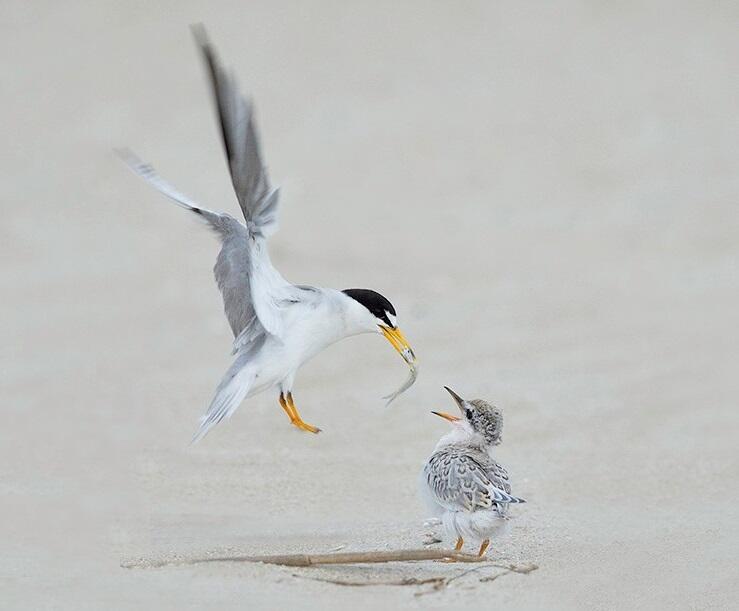
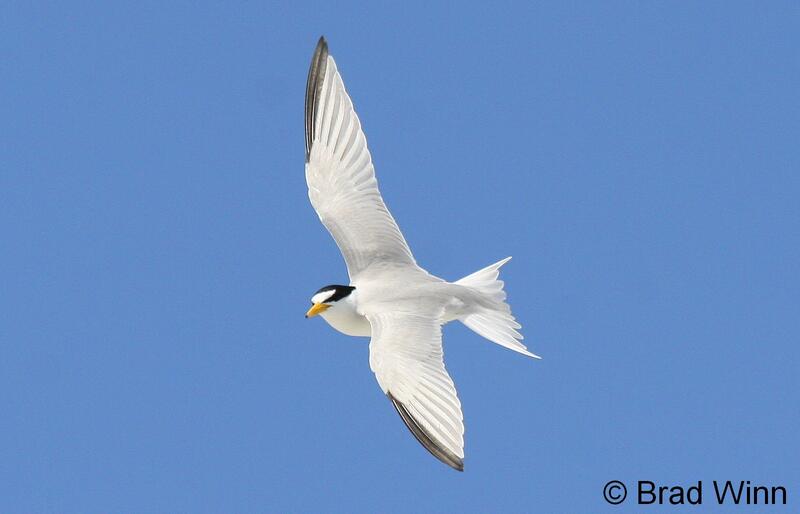
Georgia's smallest tern at about 23 cm (9 in) in length with a 50 cm (20 in) wingspread, the least tern is white with pale gray feathers on the back and upper surfaces of the wings, except for a narrow black stripe along the leading edge of the upper wing feathers. The least tern has a black cap with a small patch of white on the forehead. In summer, the adult has a yellow bill with a black tip and yellow to orange feet and legs. Its tail is deeply forked. In winter, the bill, legs and feet are black. The juvenile has a black bill and yellow legs, and the feathers of the back have dark margins, giving the bird a distinctly "scaled" appearance. The least tern's small size, white forehead, and yellow bill serve to distinguish it from other terns.
The adult sandwich tern (Thalasseus sandvicensis) is the most similar species to the adult least tern, but is much larger at about 38 cm (15 in) in length and has a black bill with a pale (usually yellow) tip and black legs. Juvenile least terns and sandwich terns look very similar in appearance. They both have black bills, although the sandwich tern's usually has a light tip. The legs of the least tern are yellow while the legs of the sandwich tern are black. Gull-billed terns (Gelochelidon nilotica) are similar in appearance, but are also significantly larger at (35-36 cm; 14 in) than least terns with black bill and legs and a much more robust build.
Historically coastal populations of this species nested primarily on bare or sparsely vegetated barrier island beaches, but also used sand flats and spits, and shell islands. Coastal colonies are normally located just above the high tide line in ephemeral habitats that are subject to wash-over by storm tides. Nesting colonies on Cumberland Island periodically occur on the open sand swales between the large dunes of that island. Interior populations traditionally used river sand bars and similar sites for nesting. Today many nesting colonies make use of agricultural fields, parking lots, sand and gravel pits, dredge spoil sites, bare land associated with airports, and flat gravel rooftops. Use of these sites may be an adaptation to human disturbance on beaches where traditional nesting sites were located. Much of the breeding population in Georgia uses dredge-spoil islands and gravel rooftops of large buildings. Foraging habitat of coastal populations includes bays, estuaries, inlets, river mouths, fresh water ponds, and shallow near-shore ocean waters.
Primarily small fishes, some crustaceans and insects.
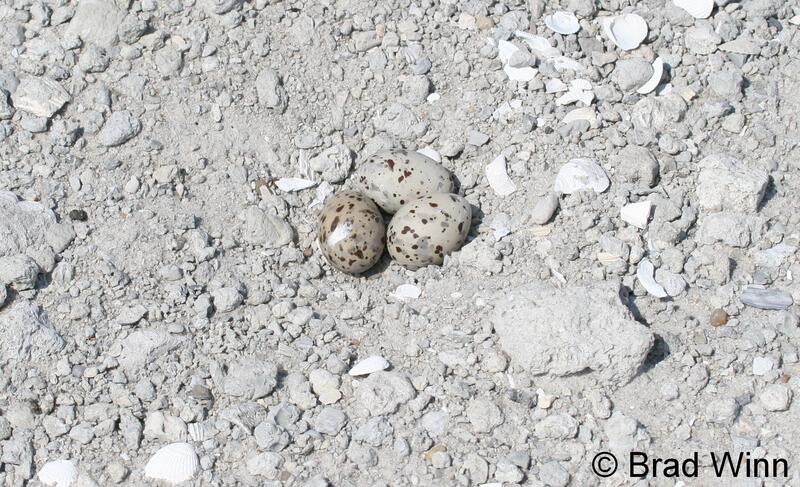
Least terns return to breeding grounds in North America in April. Courtship and pair formation begin soon after arrival at the nesting colony. Courtship feeding, in which the male brings a fish and offers it to the female prior to mating, is a characteristic breeding behavior of this species. Nests on natural substrates are small depressions or scrapes in bare sand that are often lined with shell fragments. On gravel rooftops little or no scrape is formed, depending upon availability of suitable material. Clutch size is normally 2-3 eggs, but ranges from 1-5 eggs. The eggs are small, about 31 mm (1.2 in) in length, and are olive-buff to buff with dark brown markings. Both sexes share incubation duties, which usually last 20-25 days before the eggs hatch. The male brings food to the female while she sits on the eggs. Incubating birds have been observed shaking water from their feathers onto the eggs, apparently to cool them. Adults aggressively defend the colony and characteristically dive at human intruders. Least terns will renest if the eggs are lost but do not raise more than one brood per season. Chicks are precocial and leave the nest 1-2 days after hatching and although they are able to fly about 20 days after hatching, they remain dependent upon the adults for several weeks after fledgling. In September, least terns leave Georgia and migrate south to the tropics. Colonies vary greatly in size from a few pairs to over 1,500 pairs. This species forages in shallow waters by plunging into the water and grabbing small fish or invertebrates within several centimeters of the surface. Rapid, graceful flight and a habit of hovering a few meters above the water before diving to the surface are characteristic.
A minimum of one annual survey of each known natural or artificial nesting site including beaches, dredge spoil sites, and gravel rooftops is recommended. At each site the number of nests should be counted. For sites were an exact count of the number of nests is not possible, due to colony size or other factors, numbers can estimated. New sites where nesting is likely to occur should be checked to see if they are occupied. Where possible, nesting success and productivity should be determined.
The least tern breeds along the Atlantic Coast of the U.S. from Massachusetts to Florida, along the Gulf Coast to Texas, along the coast of the Yucatan peninsula, Belize, and Honduras, on the Pacific Coast of California and Mexico, in the Bahamas and West Indies, and on the coast of Venezuela. Interior U.S. populations breed locally in appropriate habitat primarily along the Mississippi, Missouri, Ohio, and Platte river drainages. Least terns winter along the southern portions of the Atlantic and Pacific coasts of Mexico and the Atlantic Coast of Central and South America as far south as northeastern Brazil. In Georgia, least terns have nested on barrier island beaches, dredge spoil sites, and on rooftops of several large buildings in Savannah, Brunswick, Kingsland, St. Marys, Kings Bay Naval Submarine Base, and well inland at Ft. Stewart. During the Breeding Bird Atlas project they also nested in small numbers on a rooftop in Vidalia.
U.S. breeding populations of least terns were severely depleted by hunting for the millinery trade in the late 1800s. The breeding population in Georgia had apparently recovered by 1925 when some 2,500 pairs nested on Oysterbed Island near the mouth of the Savannah River. By 1959, the population had again declined, and fewer than 200 pairs could be located in Chatham County. A 1973 survey of parts of Georgia's coast located fewer than 500 least terns; however, a 1980 survey estimated 1,300 pairs throughout Georgia's coast in colonies ranging from 3 to 300 pairs. A survey by the Georgia Department of Natural Resources in 1995 located an estimated 905 pairs of least terns in 12 colonies. Three colonies totaling 455 pairs were located on rooftops, five colonies totaling 387 pairs were located on dredge spoil disposal sites, and four colonies totaling 63 pairs were on natural beaches. Studies by a University of Georgia graduate student in 1996 and 1997 located an estimated 1,563 and 1,270 nesting pairs, respectively. Over 70 percent of these nests were on rooftops. The replacement of gravel with plastic sheeting threatens these rooftop colonies. Human disturbance at nest sites remains the greatest threat to least terns in Georgia. There has been a decline in suitable rooftops and the overall number of nesting least terns has declined to an average of 373 pairs between 2011-2018. Another University of Georgia study during 2011 and 2012 nesting seasons documented Aroclor 1268 (a PCB) and Mercury in nesting least terns, with mercury levels at colonies along the Savannah River leading to measurable chick deformities.
| Threat 1 | Threat 2 | Threat 3 | |
|---|---|---|---|
| General Threat | Climate change & severe weather | Human intrusions & disturbance | Invasive & other problematic species, genes & diseases |
| Specific Threat | Storms & flooding | Recreational activities | Problematic native species/diseases |
From 2007-2009 nesting occurred on Cumberland Island, St. Catherines Island Bar, Pelican Spit (Glynn County), Brunswick Channel dredge spoil island, Andrew’s Island dredge deposit site, and rooftops in Savannah and Kingsland. There is still some rooftop nesting, but suitable rooftops are diminishing. Kings Bay will be re-roofing the colony sites in 2019 making them unsuitable. Andrews Island colony failed in 2012 due to Great horned Owl depredation and it has not recovered at that site in any significant numbers. Least Tern have nested on the Brunswick Dredge Spoil island which was created in 2009, but their nest success has varied widely and they do not nest there every year. Most small beach front colonies (Cumberland Island, Ossabaw and Little St. Simons) have not been very productive in recent years due to overwash and mammalian nest depredation. Hurricanes Matthew and Irma significantly reduced the habitat quality on several offshore bars that used to support least terns, including Ogeechee Bar, St. Catherines Island Bar and Pelican Spit, so that by 2017-2018, these historically significant nesting bars produced no least tern.
Efforts to maintain and increase Georgia’s least tern population have been aimed at conserving, and in one case, creating specific nesting sites. In coastal habitats this has consisted primarily of reducing disturbance from pedestrian beach users and vehicles by restricting access to some nesting areas. The Bird Island Rule (a DNR regulation) closes or partially closes five sites to the public in order to protect beach nesting birds. Conservation measures proposed for rooftop nesting birds include covering drain holes and providing sunshades for chicks to decrease mortality, but the increasing use of plastic sheeting or rubberized roofing rather than gravel for commercial rooftops may reduce the importance of these sites in the future and will likely reduce nesting populations. Other management techniques may include predator control, and use of shields to provide cover on roofs or to prevent young from jumping off. Coyotes have recently arrived on several islands and have led to a significant decline in nesting success of all beach nesting birds including least terns. Cumberland Island and Little St. Simons Island have both seen coyote depredation, and staff at both have exerted considerable efforts to control coyotes. At nest sites with heavy human pedestrian or vehicular traffic colonies have been roped off to exclude people and their pets from getting to close to or entering the colony. Signage along the perimeter of the nest site warns people to stay out of the colony,explaining the biological reasons for protecting the colony, and legal consequences if they do enter the colony. Least terns started nesting on St. Simons Island east beach in 2015, and in 2016 we established a volunteer beach stewards program to help protect the colony by educating beach goers about the birds, maintaining signs and ropes, and contacting police if dog rule violations occurred. This colony remained active until 2018, when it was abandoned despite still having good habitat.
Burger, J. 1984. Colony stability in least terns. Condor 86:61-67.
Burleigh, T. D. 1958. Georgia Birds. University of Oklahoma Press, Norman. 746pp.
Corbat, C. A. 1990. Nesting ecology of selected beach-nesting birds in Georgia. Ph.D. Diss., University of Georgia, Athens. 174pp.
Erichsen, W. J. 1921. Notes on the habits of the breeding water birds of Chatham County, Ga. Wilson Bulletin 33:69-82.
George, R. C. 2010. Least Tern (Sternula antillarum). Pp. 174–175 in T. M. Schneider, G. Beaton, T. S. Keyes, and N. A. Klaus, eds. The Breeding Bird Atlas of Georgia. University of Georgia Press, Athens.
Gochfeld, M. 1983. Colony site selection by least terns: physical attributes of sites. Colonial Waterbirds 6:205-213.
Gochfeld, M., and J. Burger. 1996. Family Sternidae (Terns). Pp. 624 – 667 in J. del Hoyo, A. Elliott, and J. Sargatal, eds., Handbook of the Birds of the World. Vol. 3: Hoatzin to Auks. Lynx Edicions, Barcelona, Spain.
Harris, D. C., and R. B. Goodloe. 1995. Least terns and other shorebirds on Andrews Island, Georgia: nesting success and management recommendations. U.S. Fish and Wildlife Service, Brunswick, GA. 47pp.
Harris, M. J. 1999. Least Tern (Sterna antillarum). Pp. 56–57 in T. W. Johnson, J. C. Ozier, J. L. Bohannon, J. B. Jensen, and C. Skelton, eds., Protected Animals of Georgia. Georgia Department of Natural Resources, Wildlife Resources Division, Nongame Wildlife–Natural Heritage Section, Social Circle.
Krough, M. G. 1998. The nesting ecology of least terns on natural and artificial habitats in Georgia. M.S. Thesis, University of Georgia, Athens. 88pp.
Rappole, J. H. 1981. Management possibilities for beach-nesting shorebirds in Georgia. Pages 114-126 in R. R. Odom and J. W. Guthrie, eds. Proceedings of the Nongame and Endangered Wildlife Symposium. Georgia Department of Natural Resources Technical Bulletin WL5.
Robinson, G. L., G. L. Mills, A. H. Lindell, S. H. Schweitzer, and S. M Hernandez. 2015. Exposure to mercury and Aroclor 1268 congeners in least terns in coastal Georgia, USA. Environ. Sci. Processes Impacts 17:1424.
Savereno, L. A., and T. M. Murphy. 1995. A review of nesting sites used by least terns in South Carolina. The Chat 59:41-46. Spendelow, J. A., and S. R. Patton. 1988. National Atlas of Coastal Waterbird Colonies in the Contiguous United States: 1976–1982. U.S. Fish and Wildlife Service Biological Report 88–5.
Thompson, B. C., J. A. Jackson, J. Burger, L. A. Hill, E. M. Kirsch, and J. L. Atwood. 1997. Least Tern (Sterna antillarum). In A. Poole and F. Gill, eds., The Birds of North America, no. 290. Academy of Natural Sciences, Philadelphia, PA and American Ornithologists’ Union, Washington, DC.
Tomkins, I. R. 1959. Life history notes on the least tern. Wilson Bulletin 71:313-322.
Michael J. Harris, R. Clay George, Todd M. Schneider, Bradford Winn, and Timothy S. Keyes
M. Harris, 1999: original account
R. C. George, 2010: Breeding Bird Atlas species account
T. Schneider and B. Winn, July 2010: modified and edited text
K. Owers, July 2010: updated status and ranks, added pictures
T. Keyes , Jan 2019: updated/edited text
T. Schneider, May 2019: added photos 3 & 4