Loading profile. Please wait . . .
Sarracenia oreophila (Kearney) Wherry
Green Pitcherplant




Federal Protection: Listed Endangered
State Protection: Endangered
Global Rank: G2
State Rank: S1
Element Locations Tracked in Biotics: Yes
SWAP 2015 Species of Greatest Conservation Need (SGCN): Yes
SWAP 2025 Species of Greatest Conservation Need (SGCN): Yes
2025 SGCN Priority Tier: Highest Conservation Concern
Element Occurrences (EOs) in Georgia: 3
Habitat Summary for element in Georgia: Wet meadows; upland bogs
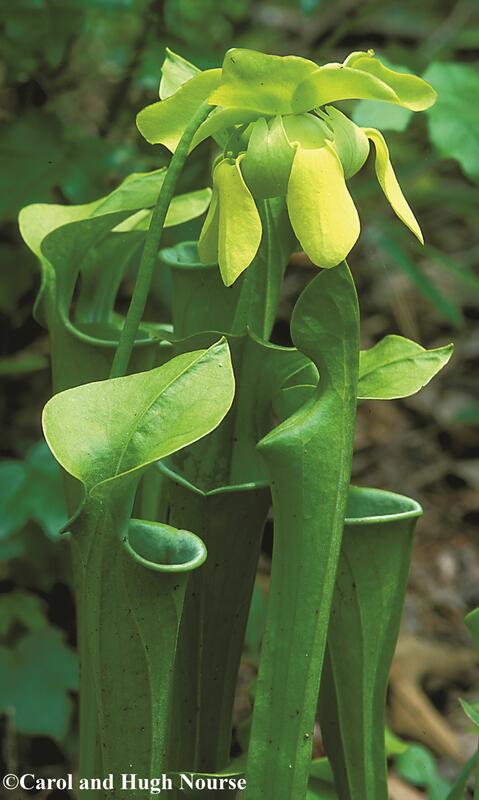
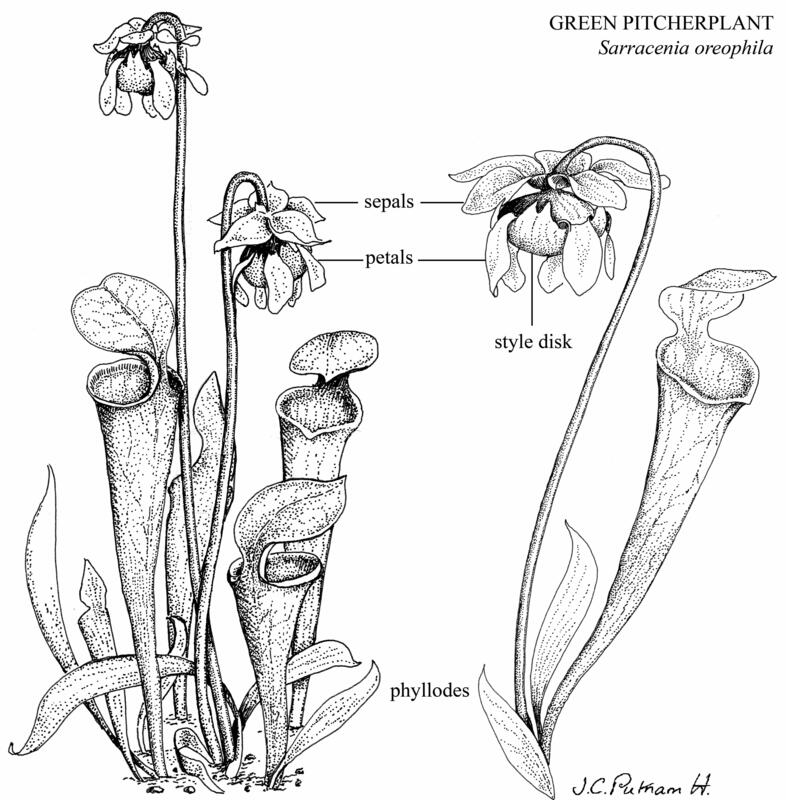
Perennial herb with leaves modified into erect, tubular pitchers. The pitchers are 8 - 30 inches (20 - 75 cm) tall, green, narrow at the base and widening to an opening partially covered by a hood. Many flat, curved, erect, non-pitcher leaves (phyllodes), 2 - 7 inches (5 - 18 cm) tall, are produced in late summer, persist through the winter, and may be more numerous than pitchers when plants are shaded or stressed. The flower stalk is 18 - 28 inches (45 - 70 cm) tall and leafless, generally taller than the pitchers. The flower is solitary with 5 drooping, yellow petals 1.5 - 2 inches (4 - 5.5 cm) long, 5 yellow-green sepals, and a yellow-green, umbrella-shaped style disk in the center of the flower. The sepals and style disk persist long after the petals fall, and the fruit – a small, round, warty capsule – develops.
Green Pitcherplant most closely resembles Sarracenia flava (Yellow Flytrap) which occurs only in the Coastal Plain. Its pitchers are yellowish-green, the phyllodes are few in number, and the flower stalk is generally shorter than the pitchers.
Eleven types of Pitcherplant occur in Georgia, including 8 species, 4 varieties, and 2 subspecies. All are considered rare, vulnerable, threatened or endangered.
Sarracenia flava (Yellow Flytrap), https://www.georgiabiodiversity.org/portal/profile?group=plants&es_id=18445
Sarracenia leucophylla (Whitetop Pitcherplant), https://www.georgiabiodiversity.org/portal/profile?group=plants&es_id=18829
Sarracenia minor var. minor (Hooded Pitcherplant), https://www.georgiabiodiversity.org/portal/profile?group=plants&es_id=33691
Sarracenia minor var. okefenokeensis (Okefenokee Giant Pitcherplant), https://www.georgiabiodiversity.org/portal/profile?group=plants&es_id=33687
Sarracenia oreophila (Green Pitcherplant), https://www.georgiabiodiversity.org/portal/profile?group=plants&es_id=16880
Sarracenia psittacina (Parrot Pitcherplant), https://www.georgiabiodiversity.org/portal/profile?group=plants&es_id=15362
Sarracenia purpurea var. montana (Mountain Purple Pitcherplant), https://www.georgiabiodiversity.org/portal/profile?group=plants&es_id=34032
Sarracenia purpurea var. venosa (Southern Purple Pitcherplant), https://www.georgiabiodiversity.org/portal/profile?group=plants&es_id=21623
Sarracenia rosea (Rose Pitcherplant), https://www.georgiabiodiversity.org/portal/profile?group=plants&es_id=34058
Sarracenia rubra ssp. gulfensis (Gulf Sweet Pitcherplant), https://www.georgiabiodiversity.org/portal/profile?group=plants&es_id=18435
Sarracenia rubra ssp. rubra (Sweet Pitcherplant), https://www.georgiabiodiversity.org/portal/profile?group=plants&es_id=19129
Throughout its range, it occurs in Piedmont or montane wet meadows, wet flatwoods, swamps, seepage slopes, sandy stream banks. In Georgia, it is known from a wet meadow in the mountains.
Pitcherplants capture and digest insects and other small animals in their pitchers. Nectar is produced by glands around the top of the pitcher, luring animals to the opening with its sweet smell. Stiff, down-pointing hairs line the pitcher, encouraging the animals to slide in and impeding their escape. Enzymes dissolved in water in the base of the pitcher digest the animals, making nutrients, particularly nitrogen, available for absorption by the plant. (Soils of bogs and other permanently saturated wetlands are typically low in nitrogen.) Sarracenia oreophylla pitchers are inhabited by a nitrogen-fixing bacteria, Burkholderia sp., and may benefit from the association.
Pitcherplants reproduce sexually and also vegetatively by the spread of underground stems (rhizomes). Pitcherplants are usually 4 - 5 years old before they flower and may live to be 20 - 30 years old. The unusual shape of their flowers, with drooping petals and umbrella-like style disk, promotes cross-pollination by insects. When an insect, usually a bee, pushes its way past the petals to reach nectar on the interior of the flower, it brushes against one of the stigmas, which are at the pointed tips of the “umbrella,” and deposits pollen gathered from a previously visited flower. Once inside the petals, it picks up pollen from the anthers and from the inner surface of the umbrella and then carries it to the next visited flower, usually avoiding the stigmas as it leaves the flower.
Since it would be a disadvantage to the plant to “eat” its pollinators, most pitcherplants produce flowers before their pitchers are well developed. However, green pitcherplants flower at the same time their pitchers are fully expanded; no studies have been done to determine how this effects pollination or seed set.
Green Pitcherplant blooms May–early June, but pitchers may be identified throughout the growing season.
Thirty-five populations are known in Georgia, northeast Alabama, and southwest North Carolina; historically, plants also occurred in eastern Tennessee.
Destruction of habitat by clearing, ditching, and draining. Fire suppression, canopy closure, and encroachment by woody plants. Poaching. Off-road vehicle traffic. Digging by feral hogs.
| Threat 1 | Threat 2 | Threat 3 | |
|---|---|---|---|
| General Threat | Natural system modifications | Climate change & severe weather | Residential & commercial development |
| Specific Threat | None | None | None |
Sarracenia oreophila is ranked S1 by the Georgia Department of Natural Resources, indicating that it is critically imperiled in the state. It is listed as Endangered by the State of Georgia and by the U.S. Fish and Wildlife Service. It has been documented four times in Georgia as early as 1840. However, only one population has survived; it is on private conservation land.
Avoid ditching and draining wetlands. Apply prescribed fire or hand-clear to control competing vegetation and prevent canopy closure. Limit access to sites to prevent poaching and off-road vehicle traffic. Prosecute plant poachers. Eradicate feral hogs.
Botanical Society of America. 2008. Sarracenia - the pitcher plants. https://botany.org/Carnivorous_Plants/Sarracenia.php
Boyer, T. and R. Carter. 2011. Community analysis of Green Pitcher Plant (Sarracenia oreophila) Bogs in Alabama. Castanea 76(4): 364-376. https://doi.org/10.2179/10-048.1
Carter, R., T. Boyer, H. McCoy, and A. Londo. 2006. Classification of Green Pitcher Plant (Sarracenia oreophila (Kearney) Wherry) communities in the Little River Canyon National Preserve, Alabama. Natural Areas Journal 26(1):84-93. https://tinyurl.com/ydgqdlhm
Catalani, M. 2004. A field study of Sarracenia oreophila. Carnivorous Plant Newsletter 33: 6-12.
Chafin, L.G. 2007. Field guide to the rare plants of Georgia. State Botanical Garden of Georgia and University of Georgia Press, Athens.
Dennis, W.M. 1980. Sarracenia oreophila (Kearny) Wherry in the Blue Ridge Province of northeastern Georgia. Castanea 45(2): 101-103. https://www.jstor.org/stable/4033194?seq=1#metadata_info_tab_contents
GADNR. 2020. Element occurrence records for Sarracenia oreophila. Georgia Department of Natural Resources, Wildlife Resources Division, Social Circle, Georgia.
Godfrey, R.K. and J.W. Wooten. 1981. Aquatic and wetland plants of southeastern United States, Vol. 2, dicotyledons. University of Georgia Press, Athens.
Godt, M.J.W. and J.L. Hamrick. 1996b. Genetic structure of two endangered pitcher plants, Sarracenia jonesii and Sarracenia oreophila (Sarraceniaceae). American Journal of Botany 83(8): 1016-1023. https://bsapubs.onlinelibrary.wiley.com/doi/abs/10.1002/j.1537-2197.1996.tb12798.x
Govus, T.E. 1987. The occurrence of Sarracenia oreophila (Kearney) Wherry in the Blue Ridge Province of southwestern North Carolina. Castanea 52: 310-311. https://www.jstor.org/stable/4033410?seq=1#metadata_info_tab_contents
Kral, R. 1983. A report on some rare, threatened, or endangered forest-related vascular plants of the South. Technical Publication R8-TP2. United States Forest Service, Atlanta.
Kuntz, V.L. 2011. The relationship between Sarracenia oreophila and an endophytic Burkholderia. M.S. Thesis, Georgia Institute of Technology, Atlanta. https://smartech.gatech.edu/bitstream/handle/1853/41094/kuntz_veronica_l_201108_mast.pdf?sequence=1&isAllowed=y
McDaniel, S. 1971. The genus Sarracenia. Bulletin 9, Tall Timbers Research Station, Tallahassee, Florida.
NatureServe. 2020. Species account for Sarracenia oreophila. NatureServe Explorer. NatureServe, Arlington, Virginia. https://explorer.natureserve.org/Taxon/ELEMENT_GLOBAL.2.141421/Sarracenia_oreophila
Patrick, T.S., J.R. Allison, and G.A. Krakow. 1995. Protected plants of Georgia. Georgia Department of Natural Resources, Natural Heritage Program, Social Circle.
Schnell, D.E. 1980. Notes on the biology of Sarracenia oreophila (Kearney) Wherry in the Blue Ridge Province of southwestern North Carolina. Castanea 45(3): 166-170.
Schnell, D.E. 2002. Carnivorous plants of the United States and Canada, 2nd edition. Timber Press, Inc. Portland, Oregon.
USFWS. 2019. Green pitcherplant (Sarracenia oreophila) species profile and related documents. U.S. Fish and Wildlife Service, Washington D.C. https://ecos.fws.gov/ecp0/profile/speciesProfile?sId=2896
Weakley, A.S. 2015. Flora of the southern and mid-Atlantic States. University of North Carolina Herbarium, University of North Carolina, Chapel Hill. http://www.herbarium.unc.edu/flora.htm
Linda G. Chafin
L.Chafin, Aug. 2008: original account
D.Weiler, Feb. 2010: added pictures
L. Chafin, May 2020: updated original account.