


Loading profile. Please wait . . .
Penstemon smallii Heller
Small's Beardtongue




Federal Protection: No US federal protection
State Protection: No Georgia state protection
Global Rank: G3
State Rank: S1?
Element Locations Tracked in Biotics: Yes
SWAP 2015 Species of Greatest Conservation Need (SGCN): No
SWAP 2025 Species of Greatest Conservation Need (SGCN): Yes
2025 SGCN Priority Tier: High Conservation Concern
Element Occurrences (EOs) in Georgia: 7
Habitat Summary for element in Georgia: Open woods on rocky slopes and bluffs in circumneutral soil
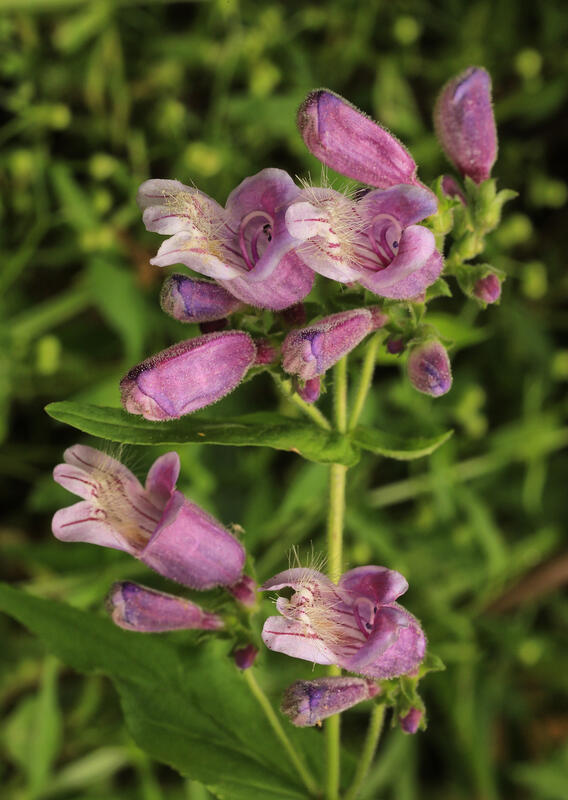
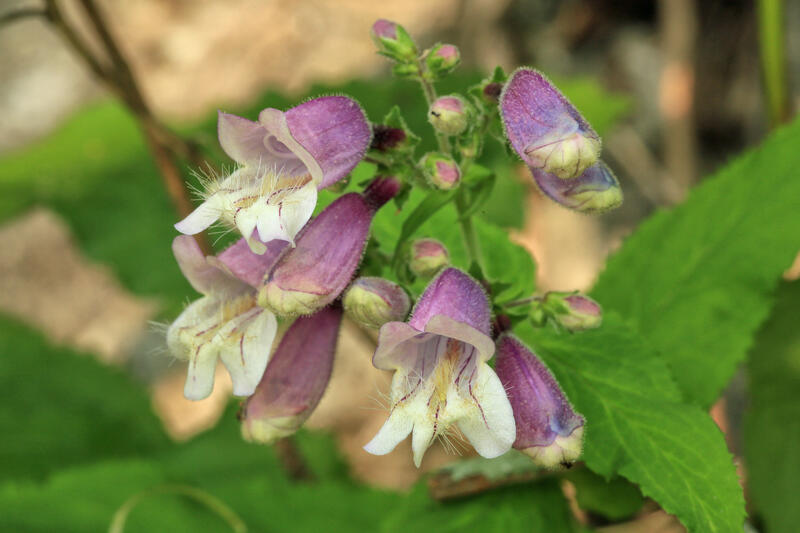
Perennial herb with a bushy appearance and mostly hairless stems 16 - 28 inches (40 - 70 cm) tall. Basal leaves up to 8 inches (20 cm) long and 3 inches (8 cm) wide, oval, hairless, toothed, usually absent at flowering. Stem leaves are 1.8 - 6 inches (4.5 - 15 cm) long and 0.8 - 1 inch (2-2.5 cm) wide, opposite with the pairs set at 90 degrees from the adjacent pairs, broadly lance-shaped, hairless; the base of the leaf is wide, heart-shaped, and clasping the stem. The leafy flower clusters are held at the top of the stems, with up to 50 flowers each. The flower is 1 - 1.4 inch (2.5 - 3.5 cm) long and 0.3 - 0.7 inch (0.9 - 1.8 cm) wide, tubular with two spreading lips; the upper lip is 2-lobed, and the lower lip is 3-lobed and conspicuously projects out beyond the upper lip. The floor of the flower throat is strongly 2-ridged. The flower tube is inflated, dark pink or purple on the outside, white on the inside, with purple lines on the floor. There are 4 fertile stamens curled against the roof of the tube, and 1 sterile stamen (staminode) on the floor of the tube that is bearded for more than half its length. The fruit is a conical capsule about 0.5 inch (0.6 - 0.9 cm) long.
Three common and similar species of Penstemon occur in north Georgia plus two that are rare (see below).
Penstemon australis, Southern Beardtongue, occurs in dry, sandy woodlands and disturbed areas throughout Georgia; its stems are stiffly erect and uniformly hairy with a mixture of long glandular hairs and short non-glandular hairs.
Penstemon canescens, Appalachian Beardtongue, occurs throughout north Georgia in woodlands and forest edges; its stems are not stiffly erect and are uniformly hairy with a mixture of long glandular hairs and short non-glandular hairs.
Penstemon laevigatus, Eastern Beardtongue, occurs in moist meadows, bottomlands, and forest edges. Its stems are hairless but its flowers differ from Small’s Beardtongue – they are pale pink and white, the lower lip is about the same length as the upper lip, and floor of the flower throat is not strongly 2-ridged. Its leaves have entire or only remotely toothed margins.
Penstemon calycosus (Long-sepal Beardtongue) occurred on limestone ledges in Dade County. For more information, see: https://www.illinoiswildflowers.info/savanna/plants/ls_penstemon.htm
Penstemon dissectus (Cutleaf Beardtongue) occurs on Altamaha Grit outcrops and in adjacent pine woodlands in the Coastal Plain. For more information, see: https://www.georgiabiodiversity.org/portal/profile?group=plants&es_id=20605
Penstemon pallidus (Eastern White Beardtongue) occurs on limestone and shale barrens in northwest Georgia and the Atlanta area. For more information, see: https://www.illinoiswildflowers.info/prairie/plantx/pale_penstemon.htm
Penstemon smallii occurs in rocky woodlands and forest openings, and on cliffs, rocky slopes, and bluffs with circumneutral soils.
Penstemon smallii is a perennial herb that reproduces sexually by seed. While this species has not been studied, other Penstemons have mixed breeding systems, setting fruits after both self- and cross-pollination. Penstemon species with large flower openings and inflated tubes such as Penstemon smallii, are pollinated by bumblebees and wasps that probe the nectary at the base of the stamens for nectar. The genus Penstemon (meaning “almost stamen”) is named for the staminode, the hairy, sterile, fifth stamen or “beard tongue” lying on the floor of each flower. The beard tongue, which is usually exserted and showy, attracts insects and also increases contact between fertile flower parts and visiting insect pollinators – the weight of the pollinator pressing down on the staminode brings the anthers and stigmas into contact with the insect. The long hairs on the beard tongue may also function to exclude small insects that would take nectar without serving as pollinators. Small’s Beardtongue seeds are probably dispersed by wind, gravity, and small animals.
Surveys must be conducted during flowering, May–June.
Penstemon smallii is endemic to the Southern Appalachians of Georgia, Alabama, South Carolina, North Carolina, and Tennessee. It is rare throughout its range.
Recreational use of outcrops and cliffs, logging, clearing.
| Threat 1 | Threat 2 | Threat 3 | |
|---|---|---|---|
| General Threat | Pollution | Climate change & severe weather | None |
| Specific Threat | None | None | None |
Penstemon smallii is ranked S1? by the Georgia Department of Natural Resources, indicating that it is probably critically imperiled in Georgia but that additional survey is needed to make a definitive ranking. Six populations have been documented in Georgia, all on National Forest land.
Protect Penstemon smallii habitat from recreational overuse and other human disturbances.
Clinebell, R.R. and Peter Bernhardt. 1998. The pollination ecology of five species of Penstemon (Scrophulariaceae) in the tallgrass prairie. Annals of the Missouri Botanical Garden 85(1): 126-136.
Estes, D. 2012. Penstemon kralii (Plantaginaceae), a new species from Alabama and Tennessee, with an updated key to the southeastern U.S. taxa. Journal of the Botanical Research Institute of Texas 6(1): 1-8. https://www.jstor.org/stable/41972352?seq=1#metadata_info_tab_contents
GADNR. 2019. Element occurrence records for Penstemon smallii. Georgia Department of Natural Resources, Wildlife Resources Division. Social Circle, Georgia.
Hilty, J. 2019. Species account for Pale Penstemon, Penstemon pallidus. Illinois Wildflowers. https://www.illinoiswildflowers.info/prairie/plantx/pale_penstemon.htm
Kampny, C.M. 1995. Pollination and flower diversity in Scrophulariaceae. Botanical Review 61(4): 50-366.
NatureServe. 2019. Species account for Penstemon smallii. NatureServe Explorer: an online encyclopedia of life, Version 7.1. NatureServe, Arlington, Virginia. http://explorer.natureserve.org/servlet/NatureServe?searchName=Penstemon+smallii
Walker-Larsen J. and L.D. Harder. 2001. Vestigial organs as opportunities for functional innovation: the example of the Penstemon staminode. Evolution 55: 477-487. https://onlinelibrary.wiley.com/doi/abs/10.1111/j.0014-3820.2001.tb00782.x
Weakley, A.S. 2015. Flora of the southern and mid-Atlantic States. University of North Carolina Herbarium, University of North Carolina, Chapel Hill. http://www.herbarium.unc.edu/flora.htm
Wilson, P., MC. Castellanos, J.N. Hogue, J.D. Thomson, W.S. Armbruster. 2004. A multivariate search for pollination syndromes among penstemons. Oikos 104(2): 345-361. https://onlinelibrary.wiley.com/doi/full/10.1111/j.0030-1299.2004.12819.x
Linda G. Chafin
Linda G. Chafin, 16 April 2020: original account