


Loading profile. Please wait . . .
Desmognathus marmoratus (Moore, 1899)
Shovel-nosed Salamander




Federal Protection: No US federal protection
State Protection: No Georgia state protection
Global Rank: G3
State Rank: S3
Element Locations Tracked in Biotics: Yes
SWAP 2015 Species of Greatest Conservation Need (SGCN): No
SWAP 2025 Species of Greatest Conservation Need (SGCN): Yes
2025 SGCN Priority Tier: Moderate Conservation Concern
Element Occurrences (EOs) in Georgia: 34
Habitat Summary for element in Georgia: Mountain streams
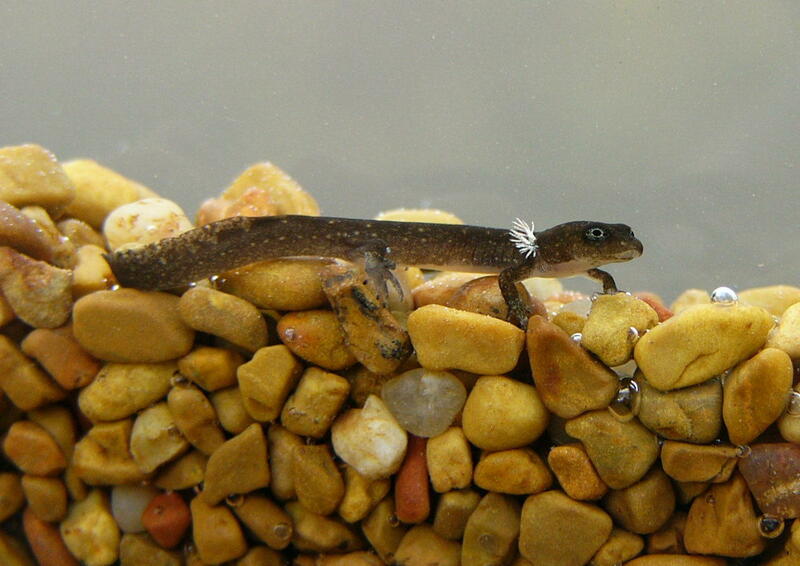
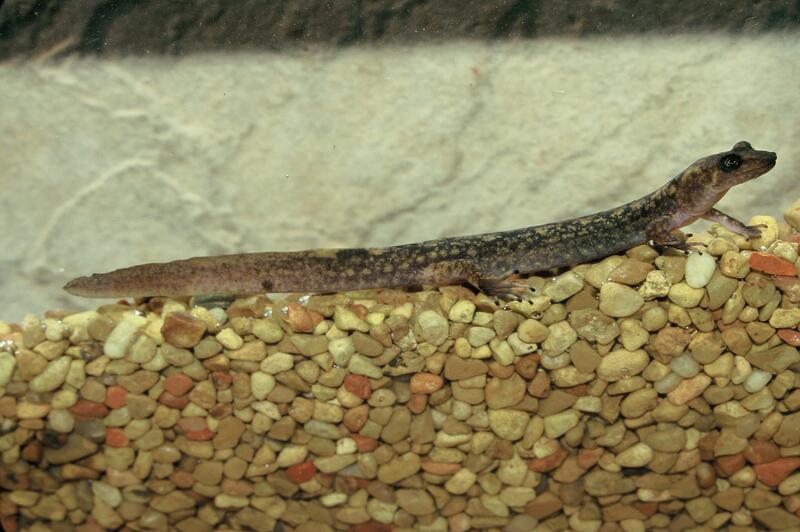
Three separate shovel-nosed salamander species are currently recognized: the northern shovel-nosed salamander (Desmognathus marmoratus), the western shovel-nosed salamander (D. intermedius), and the southern shovel-nosed salamander (D. aureatus) – only the latter occurring in Georgia. Despite being the smallest of the three shovel-nosed species, the southern shovel-nosed salamander is a moderately large, heavy bodied (11.3-14.8 cm or 4.5-5.8 inches total length) dusky salamander (genus Desmognathus). Its back has a background color of dark brown to black and lighter color pattern of paired, golden, marbled or lichen-shaped blotches; although less distinct within populations inhabiting the Chattooga River drainage (formerly classified as Leurognathus marmorta roborata) the prominent color of this blotched pattern was the conspicuous trait that was chosen in the naming of this species – the specific epithet, “aureatus” translates from Latin meaning “adorned with gold.” The pale-colored (dark gray or smoky black) belly may or may not have a mottled pattern. This species has 14 costal grooves (i.e., deep, vertical groove on the side of a salamander’s body indicating the position of a rib). Two rows of lateral white specks correspond and flank the pores of the lateral line organ along each side of the body and the base of the tail; each row of spots average one per costal space (i.e., the space between costal grooves). The body is somewhat (dorsoventrally) flattened, head is distinctly flattened (sloping down toward snout from behind the eyes), and the snout is U-shaped (dorsally); these salamanders are commonly referred to as “shovel-nosed” as their heads are more flattened and wedge-shaped than those of other dusky salamanders. The eyes are prominent, but relatively small. The pale diagonal line from the eye to the angle of the jaw, diagnostic for all dusky salamanders, is generally not as white as in other dusky salamanders but is clearly evident if present. The internal nares located on the roof of the mouth are distinctive, slit-like openings in shovel-nosed salamanders, but are conspicuous, rounded openings in the other dusky salamanders (a trait that is difficult to discern unless the specimen is dead and was preserved with its mouth open). The tail is flattened dorsoventrally at the base, gradually becomes laterally compressed, rounded, and spatulate toward the tip; the tail is rounded below, without a free fin except at the posterior fourth. There is a prominent dorsal fin on the posterior 2/3 of the tail (often notched or ragged through abrasion while swimming among rocks within the stream substrate), but the tip is somewhat rounded in profile. The soles of the feet are blackish to dark brown, and the tips of the digits are black. Larvae resemble black-bellied salamander larvae, but are darker, have conspicuous light flecks laterally, white gills, have longer legs, more spatulate tails and are more slender generally.
Shovel-nosed salamanders are often confused with members of the black-bellied salamander “complex.” This is not surprising since genetics research has demonstrated that the species of the shovel-nosed salamander “complex” are more genetically similar to species in the black-bellied salamander “complex” than to other shovel-nosed salamander species (e.g., D. aureatus is most closely related to the D. folkertsi (dwarf black-bellied salamander) and D. amphileucus (southern black-bellied salamander) than to either of the other shovel-nosed salamander species). In Georgia, portions of the ranges of D. amphileucus and D. folkertsi are sympatric (overlapping geographic distribution) with D. aureatus, thus the identification of phenotypical differences is desirable for species identification and differentiation.
The southern black-bellied salamander exhibits a much larger body size than any other species of dusky salamander (9-21 cm or 3.5-8.25 inches total length), lacks a discernible pattern on its back, and its sides are sometimes a vibrant chocolate-brown. Subadults have a reddish dorsal tail stripe. The belly color that is white at metamorphosis, becomes mottled in juveniles, and attains a color of solid jet-black without any pattern or secondary coloration at a snout to vent length (SVL) of > 6 cm (2.4 inches). The dwarf black-bellied salamander (11.5-12 cm or 4.5-4.7 inches total length) has either a vermiculate pattern of brown and black or brown irregular alternating blotches that are similar to the dorsal pattern typical of shovel-nosed salamander species. The belly color is white at metamorphosis, becomes mottled with gray and white in juveniles, and becomes black at a SVL of > 4 cm (1.6 inches). The underside of adult dwarf black-bellied salamanders is black except for the lighter gray posterior third of the tail. The tail of both of these species is squarish in cross section at the base and becomes laterally compressed with a thin dorsal keel starting immediately posterior to the vent and a narrow ventral keel is limited to the posterior third of the tail. In contrast to the general head shape of shovel-nosed salamanders, the head of both these species is not distinctly flattened (slope down to the snout begins in front of the eyes).
Suitable shovel-nosed salamander habitat consists of cool, well-oxygenated, second- and third-order streams as well low gradient first-order streams. This species inhabits shallow waters within stream stretches characterized by a moderate- to fast-flowing current over streambed substrates consisting of loose gravel and flat rocks (with open interstitial spaces necessary for use as refugia, foraging, and nesting) rather than stretches with deeper water, water-worn (rounded) cobbles, large amounts of sand or silt, or bedrock. A greater density of shovel-nosed salamanders is found in rapids and riffles rather than within pools or deeper areas with less rapid flow.
Larvae and adults are primarily insectivorous, preying opportunistically almost exclusively on the larval or nymphal forms of aquatic insects and also on aquatic invertebrates found within the streambed, including mayflies, caddisflies, true flies, stone flies, beetles, crayfish, as well as small salamanders.
Although mating behavior has not been observed for this species, courtship, spermatophore deposition by the male, and spermatophore reception by the female presumably all occur within aquatic habitat that is favored by southern shovel-nosed salamanders for other activities (i.e., riffle areas of streams). Females deposit 20-65 eggs (~4.1 mm [5/32 inches] in diameter) by attaching them singly or in tight clusters (2-4 eggs) on the underside of large rocks found in the fast-flowing portion of the main stream current at a depth of 8-36 cm (3-14 inches) in the late spring and summer; females attend the nest until hatching of the eggs. Eggs typical hatch from mid-August to mid-September, hatchlings measuring 11 mm (0.4 inches) SVL. The larval period of this species is typically 10-20 months; however, three distinct larval size classes have been observed in Georgia populations indicating that the larval period may sometimes span three years. Metamorphosis occurs at a SVL of 25-38 mm (~1-1.5 inches).
For all dusky salamanders (genus Desmognathus), the degree of terrestrial or aquatic affinity of a given species is directly related to that species’ relative size (i.e., length and weight) – in general, the larger the species, the more aquatic, whereas, the smaller the species, the more terrestrial. This pattern holds true for all but the shovel-nosed salamanders, for which this pattern is reversed relative to black-bellied salamander species. Despite their relative sizes, the larger, black-bellied salamanders are inhabitants of the edge of streams (thus, being more terrestrial) and smaller, shovel-nosed salamanders are inhabitants of the stream proper (thus being more aquatic). Although often characterized as completely aquatic, shovel-nosed salamanders have been observed out of water (having climbed onto vegetation a short distance above a flowing stream) during daylight hours and are likely able to climb onto land during rainy weather. Typically, however, shovel-nosed salamanders are found under submerged cover objects of the streambed during the day, emerging only at night to feed. Feeding in shovel-nosed salamanders is accomplished either by leaving their cover objects to forage along the stream bottom, or by lying in wait with just their head protruding to ambush passing insect prey.
Individual shovel-nosed salamanders are reliably captured from within suitable, occupied habitat (i.e., stretches of moderately swift current in riffles and small cascades) by use of a seine. Though this species is primarily nocturnal, surveys during daylight hours are generally more successful. The proper technique involves stretching the seine across the target stream at a right angle to the current just downstream of rocks and loose gravel with the weighted line of the seine seated directly on the stream bottom; since these salamanders are bottom dwellers, assuring minimal gapping between the seine and the stream bottom will avoid unnecessary evasion of capture. Use of a fine-meshed (2 mm) nylon seine is desirable as shovel-nosed salamanders are adept at getting through surprisingly small openings. Once the placement of the seine is secured directly downstream of a given riffle, larger rocks upstream of the seine should be quickly lifted by hand, and gravel and smaller rocks vigorously agitated by foot. Individual shovel-nosed salamanders are dislodged from the stream substrate by this method and swept into the seine by the current. The use of a backpack shocker as used in fisheries sampling can augment this aforementioned methodology. However, it should be noted that small larvae can be under collected in samples obtained through various survey methods because of their secretive nature of inhabiting interstitial spaces of streambed gravel.
The shovel-nosed salamander was first recognized as occurring in Georgia in 1946. Historically, the shovel-nosed salamander (as originally described in 1899) was documented to occur from southwestern Virginia through eastern Tennessee, western North Carolina, extreme northwestern South Carolina, and into northern Georgia from elevations 985-5,500 ft (300-1,680 m). However, recent genetics research has determined that what was formerly considered a single species, is in fact, three separate allopatric (ranges do not overlap) species: the northern shovel-nosed salamander (D. marmoratus), the western shovel-nosed salamander (D. intermedius), and the southern shovel-nosed salamander (D. aureatus). The geographic distribution currently recognized for southern shovel-nosed salamander, includes Blue Ridge populations of northeastern Georgia, northwestern South Carolina, and small portions of the nearby border regions of North Carolina, in headwater streams of the Chattahoochee, Chattooga, and Tallulah river drainages ~1,315-3,600 ft (~400-1,100 m) of elevation.
The present distribution of the southern shovel-nosed salamander species in Georgia is undoubtedly attributable to chance events involving stream course changes, dispersal and speciation, as well as drainage capture events and associated faunal exchanges between river basins. One such capture event involved the Tallulah River, which once flowed into the ancestral Chattahoochee River (Gulf drainage) was captured by the Tugaloo River (Savannah River – Atlantic drainage). Following this capture event, shovel-nosed salamanders dispersed into the Chattooga River drainage (shovel-nosed salamanders of this drainage formerly classified as Leurognathus marmorta roborata). The current range of D. aureatus reflects distributional retractions into headwater streams as habitat suitability changed with shifts in climate over geologic time. However, since the ranges of two most closely related species (i.e., D. folkertsi and D. amphileucus) span the continental divide, it remains unclear how the southern shovel-nosed salamander of the Georgia Blue Ridge occurs east of the Continental Divide, is restricted to the headwaters of both Atlantic slope and Gulf slope drainages, yet is absent from suitable habitat within drainages west of the Continental Divide (Hiawassee, Nottely, and Toccoa rivers and the upper stretches of the Little Tennessee River).
Because shovel-nosed salamanders are heavily dependent on flowing streams possessing rocky substrates (containing plentiful interstitial spaces), they are particularly vulnerable to habitat degradation resulting from siltation and impoundment. Shovel-nosed salamanders have been eliminated from stream stretches that have been dammed and are largely absent from streams that have been subjected to heavy siltation as such sedimentation input covers the stream’s rocky substrate and fills in the interstitial spaces within. Because shovel-nosed salamanders are dependent on aquatic insects as a food source, water pollution or other degrading factors that affect the insect population would undoubtedly negatively affect shovel-nosed salamander populations as well.
Though not yet reported from the wilds of North America, salamander chytrid fungus (Batrachochytrium salamandrivorans) [or Bsal] has caused a 90% reduction in some salamander populations in Europe. While different species and groups of salamanders show differences in susceptibility to the disease and in the severity of resulting chytridiomycosis, this emergent disease for some plethodontid salamanders has been shown to be lethal in laboratory experiments. Although D. aureatus has not undergone such testing, it is likely resistant to Bsal, as the closely related northern dusky salamander (D. fuscus) has been shown to present resistance to the disease in a laboratory setting.
| Threat 1 | Threat 2 | Threat 3 | |
|---|---|---|---|
| General Threat | Human intrusions & disturbance | Invasive & other problematic species, genes & diseases | Pollution |
| Specific Threat | None | None | None |
Largely because of the species’ restricted geographic range, lack of comprehensive survey data, and near Georgia endemism, this salamander is a species of conservation concern in Georgia and documented occurrences are consequently tracked within the Georgia Department of Natural Resources’ (DNR) conservation database. Populations of D. aureatus found in Georgia, South Carolina, and North Carolina occur largely on federal lands (National Forest), which conveys some level of protection, and the species is thought to be secure.
Adherence to forestry best management practices (BMPs) in maintaining stream management zones (SMZs) during upland forest harvest as well as maintaining vegetated stream buffers or establishing vegetated buffers along streams in agricultural areas where currently lacking, would improve or help maintain suitability of preferred stream habitats for this species. This is particularly true for those lower elevation, lower gradient streams within the southern shovel-nosed salamander’s range in Georgia that tend to be within private ownership. Known occurrences (populations) of the southern shovel-nosed salamander in Georgia should be monitored periodically to confirm the species’ continued presence and to determine possible changes in abundance over time at each site. Additionally, a concerted survey effort across the predicted range in Georgia is suggested to determine current species occupancy, abundance, conservation status, and needed management actions for specific populations.
Jones, M. T., S. R. Voss, M. B. Ptacek, D. W. Weisrock, and D. W. Tonkyn. 2006. River drainages and phylogeography: An evolutionary significant lineage of shovel-nosed salamander (Desmognathus marmoratus) in the southern Appalachians. Molecular Phylogenetics and Evolution 38: 280–287.
Martof, B. S. 1956. Three new subspecies of Leurognathus marmorata from the southern Appalachian Mountains. Occasional Papers of the Museum of Zoology, University of Michigan, 575, 1-14.
Martof, B. S. 1962. Some aspects of the life history and ecology of the salamander Leurognathus. American Midland Naturalist 67(1): 1-35.
Pope, C. H. and N. G. Hairston. 1947. The distribution of Leurognathus, a southern Appalachian genus of salamanders. Fieldiana Zoology 31(20): 155-162.
Pyron, R. A., and D. A. Beamer. 2023. A systematic revision of the shovel-nosed salamander (Plethodontidae: Desmognathus marmoratus), with re-description of the related D. aureatus and D. intermedius. Zootaxa 5270(2):262-280.
Pyron, R. A. and D. A. Beamer. 2022. Nomenclatural solutions for diagnosing ‘cryptic’ species using molecular and morphological data facilitate a taxonomic revision of the black-bellied salamanders (Urodela, Desmognathus ‘quadramaculatus’) from the southern Appalachian Mountains. Bionomina 27(1): 1-43.
Titus, T. A. and A. Larson. 1996. Molecular phylogenetics of desmognathine salamanders (Caudata: Plethodontidae): a reevaluation of evolution in ecology, life history, and morphology. Systematic Biology 45(4): 451-472.
Thomas M. Floyd
T. M. Floyd, January 2024: original account