

Loading profile. Please wait . . .
Thermopsis villosa (Walt.) Fern. & Schub.
Blue Ridge Golden-banner




Federal Protection: No US federal protection
State Protection: No Georgia state protection
Global Rank: G3?
State Rank: S1?
Element Locations Tracked in Biotics: Yes
SWAP 2015 Species of Greatest Conservation Need (SGCN): Yes
SWAP 2025 Species of Greatest Conservation Need (SGCN): Yes
2025 SGCN Priority Tier: High Conservation Concern
Element Occurrences (EOs) in Georgia: 11
Habitat Summary for element in Georgia: Mesic forests, floodplains and roadsides; mostly in sandy soils
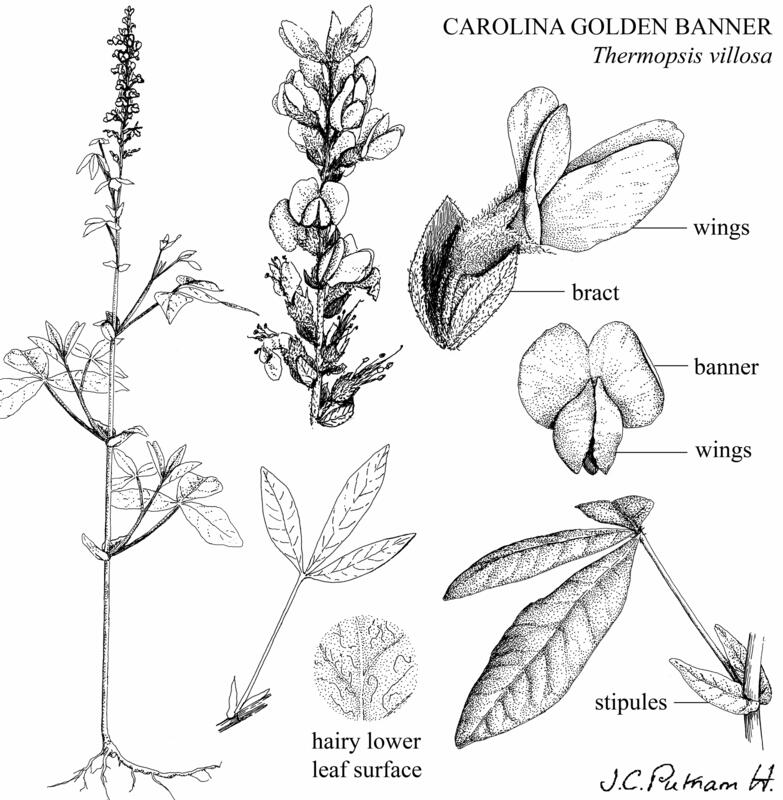
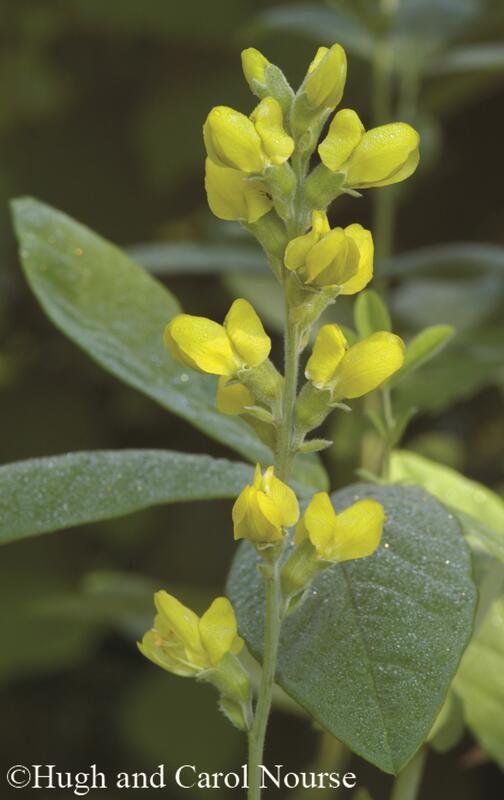
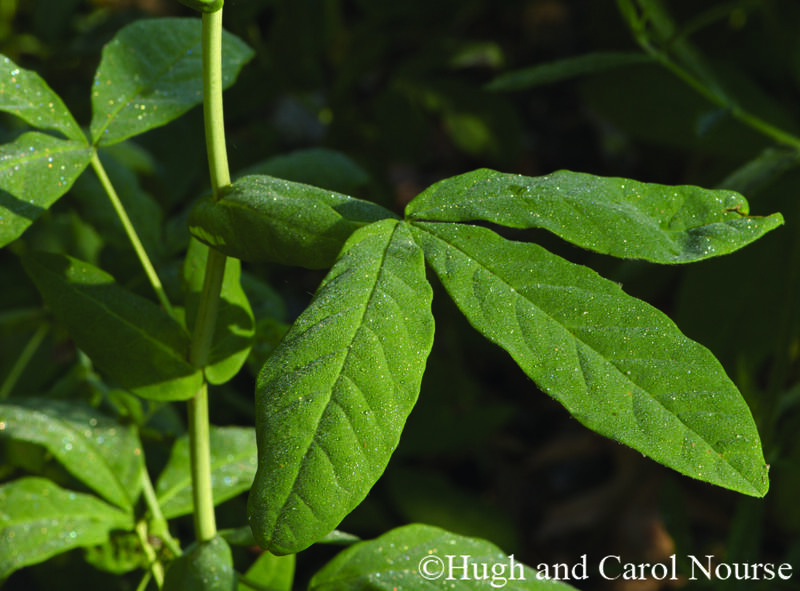
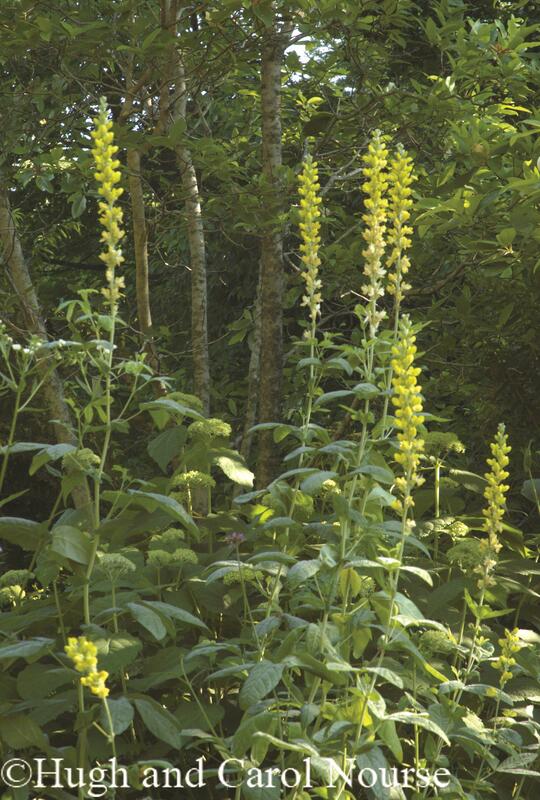
Perennial herb up to 6.5 feet (2 meters) tall, with several unbranched stems rising from a rootstock. The leaves are large, alternate, and compound with 3 oval, softly green leaflets that are 2.4 - 3.5 inches long (6 - 9 cm) and 1.6 inches (4 cm) wide with hairy lower surfaces. The leaf stalks are 1.2 - 2.4 inches (3 - 6 cm) long, with a pair of oval, leafy stipules at least 1.6 inches (4 cm) long and 0.4 - 2 inches (1 - 2.5 cm) wide, clasping the stem at the base of the stalk. The flower cluster is a large, elongated cylinder with a densely hairy stalk held erect at the top of the stem, with the lowest flowers opening first. The flowers are 0.8 inch (2 cm) long, bright yellow, and typically pea-flower-shaped with an erect, rounded, notched banner petal and 2 wing petals enclosing 2 fused keel petals; the banner petal is shorter than the wings; the calyx is green and densely hairy. Each flower has a stalk about 0.1 inch (3 mm) long with a pair of hairy, oval bracts, about 0.4 inch (1 cm) long, at the base of the stalk. The fruit is an oblong, flattened pod about 2 inches (4 - 5 cm) long and densely hairy, held upright and pressed against the stem.
Rattlebox (Crotalaria spp.) plants are typically much-branched and its flowers have banner petals larger than the wings, and its pods are inflated. See below for information on other Thermopsis species in Georgia.
Ash-leaved Bush-pea (Thermopsis fraxinifolia) and Downy Bush-pea (Thermopsis mollis), both Special Concern, occur in dry to moist, oak-pine forests in north Georgia. Their stipules are less than 1.4 inch (4 cm) long and do not clasp the stem. Their pods usually spread away from the stem. For more information, see: https://www.georgiabiodiversity.org/portal/profile?group=plants&es_id=21945
Edges and sunny openings in floodplains, woodland edges, and moist disturbed areas, often in sandy soil, and in roadsides and utility rights-of-way through these habitats.
Thermopsis villosa, also known as Thermopsis caroliniana, is a perennial herb that reproduces sexually and probably also vegetatively by the spread of rhizomes. Although no studies have been published on the biology of this species, other Thermopsis species are pollinated primarily by large bees. Seeds are dispersed by gravity and small animals.
Surveys are best conducted during flowering (mid-May–mid-June) and fruiting (July–September).
Mountains of Georgia, Tennessee, and North Carolina. It has escaped from cultivation and naturalized in Virginia, Maryland, and West Virginia.
Clearcutting of forests; conversion of habitat to pine plantations, pastures, and developments; use of herbicides in right-of-way maintenance.
| Threat 1 | Threat 2 | Threat 3 | |
|---|---|---|---|
| General Threat | Invasive & other problematic species, genes & diseases | Pollution | None |
| Specific Threat | None | None | None |
Thermopsis villosa is ranked S1? by the Georgia Department of Natural Resources, indicating that the species is imperiled in Georgia, but that more information is needed to make a definitive ranking. Nine populations have been documented in Georgia, most in the Chattahoochee National Forest; only four populations have been confirmed since 2000.
Avoid herbicide use in roadside right-of-way maintenance; time mowing to avoid flowering and fruiting period. Avoid clearcutting in upland and floodplain forests. Use fire and hand-clearing to maintain sunny openings and edges.
Chafin, L.G. 2007. Field guide to the rare plants of Georgia. State Botanical Garden of Georgia and University of Georgia Press, Athens.
Chen, C.J., M.G. Mendenhall, and B.L. Turner. 1994. Taxonomy of Thermopsis (Fabaceae) in North America. 81(4): 714-742. https://www.jstor.org/stable/2399917?seq=1#metadata_info_tab_contents
GADNR. 2020. Element occurrence records for Thermopsis villosa. Georgia Department of Natural Resources, Wildlife Resources Division, Social Circle, Georgia.
Horn, D., T. Cathcart, T.E. Hemmerly, and D. Duhl. 2005. Wildflowers of Tennessee, the Ohio Valley, and the southern Appalachians. Lone Pine Publishing, Auburn, Washington.
Isely, D. 1990. Vascular flora of the southeastern United States, Vol. 3, Part 2, Leguminosae (Fabaceae). University of North Carolina Press, Chapel Hill.
NatureServe. 2020. Thermopsis villosa species account. NatureServe Explorer. Arlington, Virginia. https://explorer.natureserve.org/Taxon/ELEMENT_GLOBAL.2.153229/Thermopsis_villosa
Radford, A.E., H.E. Ahles, and C.R. Bell. 1968. Manual of the vascular flora of the Carolinas. University of North Carolina Press, Chapel Hill.
Weakley, A.S. 2015. Flora of the southern and mid-Atlantic States. University of North Carolina Herbarium, University of North Carolina, Chapel Hill. http://www.herbarium.unc.edu/flora.htm
Linda G. Chafin
L. Chafin, Jan. 2009: original account.
K. Owers, Feb. 2010: added pictures.
L. Chafin, Jun. 2020: updated original account.