

Loading profile. Please wait . . .
Clematis fremontii S. Wats.
Fremont's Leatherflower




Federal Protection: No US federal protection
State Protection: Endangered
Global Rank: G5
State Rank: S1
Element Locations Tracked in Biotics: Yes
SWAP 2015 Species of Greatest Conservation Need (SGCN): Yes
SWAP 2025 Species of Greatest Conservation Need (SGCN): Yes
2025 SGCN Priority Tier: High Conservation Concern
Element Occurrences (EOs) in Georgia: 1
Habitat Summary for element in Georgia: Grassy openings in flatwoods of mostly lowland oaks and red maple
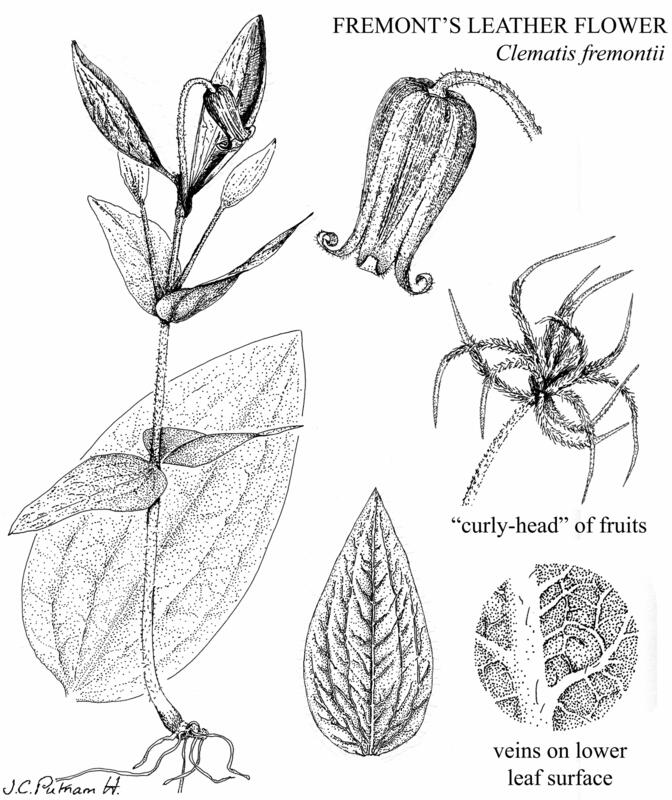
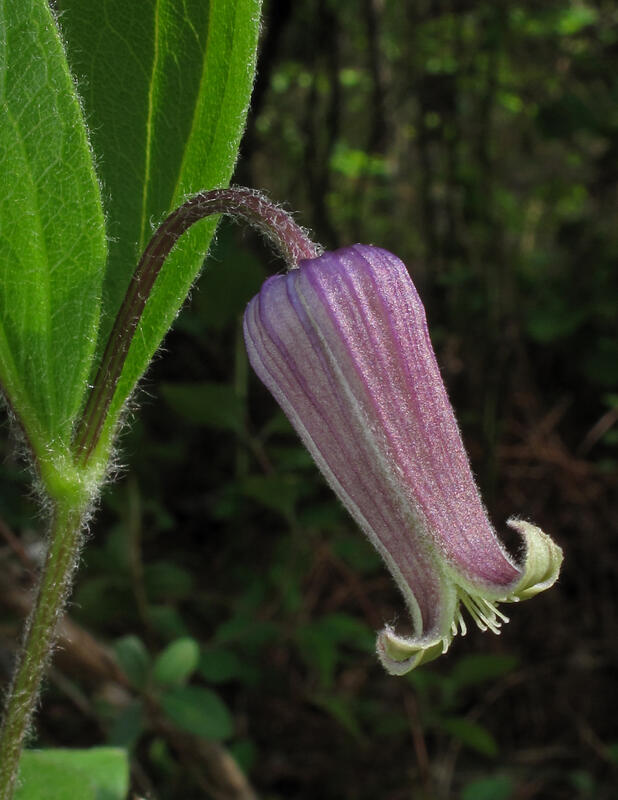
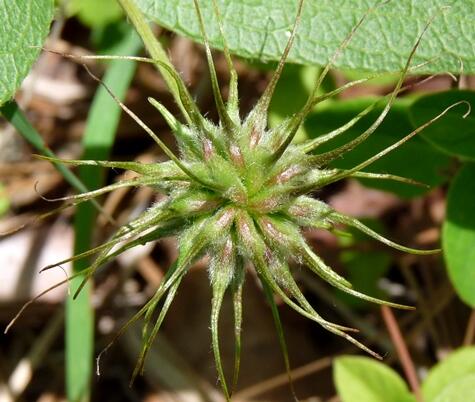
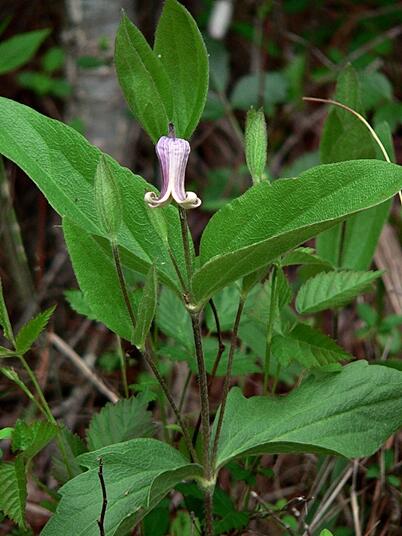
Perennial herb with an erect, hairy stem 6 - 28 inches (15 - 70 cm) tall. Leaves are 2 - 5.5 inches (5 - 14 cm) long and 1.4 - 3.4 inches (3.5 - 11 cm) wide, simple, opposite, leathery, oval, with conspicuously netted, occasionally hairy veins, and pointed or blunt leaf tips; the leaf margin sometimes has 2 - 4 teeth; there is no leaf stalk. The flower is 0.8 - 1.5 inches (2 - 4 cm) long, bell-shaped, solitary at the tips of branches, with 4 - 5 showy sepals and no petals; mature sepals are purple on the outside (sepals are yellow on immature flowers), green on the tips, and white on the inside, and hairy only on the margins; the tips of the sepals curve upwards. Individual fruits are about 1 inch (2.5 cm) long, hairy, each with an elongated beak that is nearly hairless on the outer ½ of its length; several fruits are grouped together into a “curly-head.”
Four common Leather Flower species (Clematis crispa, C. glaucophylla, C. reticulata, and C. viorna) occur in Georgia. They have similar flowers but are climbing or sprawling vines with 3 - 9 leaflets per leaf. None of these common species form colonies of low, erect plants with single- or few-flowered stems and simple leaves.
Three other rare species of Clematis occur in Georgia:
Morefield's Leatherflower (Clematis morefieldii) occurs in limestone woodlands in Walker County. For more information, see: https://georgiabiodiversity.org/portal/profile?group=plants&es_id=34963
Curlyheads (Clematis ochroleuca) occurs in dry woods with basic soils in Columbia, Elbert, Franklin, and Stephens Counties. The entire plant, including the erect non-vining stem, is covered with long, white hairs; its flowers are pale purple with yellowish tips.
Alabama Leather Flower (Clematis socialis) occurs in sunny, grassy openings in Coosa Valley flatwoods in Floyd County. For more informatin, see: https://georgiabiodiversity.org/portal/profile?group=plants&es_id=16148
Coosa Valley flatwoods (Shortleaf Pine-Blackjack Oak-Post Oak woodlands with clayey soils over limestone or calcareous shale) and pine plantations and utility and highway rights-of-way in this habitat.
Little is known about the life history of Fremont’s Leather Flower except that it is a perennial herb that reproduces sexually. Its flowers depend on insect pollinators, such as bees and butterflies, to effect cross-pollination in order to produce abundant seeds. The plume-like seed heads are dispersed by wind.
Surveys are best conducted during flowering (April–May) and fruiting (May–July).
Georgia, Kansas, Missouri, and Nebraska. It is rare throughout most of this range.
Logging, clearing, or other mechanical soil disturbance. Overbrowsing by deer. Invasion by exotic pest plants. Encroachment by woody plants in the absence of fire or other natural disturbance.
| Threat 1 | Threat 2 | Threat 3 | |
|---|---|---|---|
| General Threat | Natural system modifications | Agriculture & aquaculture | None |
| Specific Threat | None | None | None |
Clematis fremontii is ranked S1 by the Georgia Department of Natural Resources, indicating that is critically imperiled in the state. It is listed as Endangered by the State of Georgia. Only one population, with about 25 plants, is known; it occurs on lands owned by Berry College.
Avoid logging and other mechanical disturbances. Use prescribed fire or hand-clearing to reduce competition from woody species. Protect plants from browsing by deer and reduce the size of Georgia's deer herd. Eradicate exotic pest plants. Develop a conservation management plan for this species.
Chafin, L.G. 2007. Field guide to the rare plants of Georgia. State Botanical Garden of Georgia and University of Georgia Press, Athens.
Pringle, J.S. 1997. Clematis fremontii species account. Flora of North America. Vol. 3. Oxford University Press, New York. http://www.efloras.org/florataxon.aspx?flora_id=1&taxon_id=233500392
GADNR. 2019. Element occurrence record for Clematis fremontii. Georgia Department of Natural Resources, Wildlife Resources Division, Social Circle, Georgia.
Kansas Wildflowers and Grasses. 2005. Fremont's clematis. https://www.kswildflower.org/flower_details.php? flowerID=204https://www.kswildflower.org/flower_details.php?flowerID=204http://www.lib.ksu.edu/wildflower/fremont.html
NatureServe. 2019. Clematis fremontii comprehensive report. NatureServe Explorer. Arlington, Virginia. http://explorer.natureserve.org/servlet/NatureServe?searchName= Clematis%20fremontii
Ware, R.T., Sr. 2003. Rare plant re-located after 64 years. Georgia Botanical Society, BotSoc News 77(6): 1,3.
Weakley, A.S. 2015. Flora of the southern and mid-Atlantic States. University of North Carolina Herbarium, University of North Carolina, Chapel Hill. http://www.herbarium.unc.edu/flora.htm
Linda G. Chafin
L. Chafin, June 2007: original account.
K. Owers, Jan. 2010: updated status and ranks, added pictures.
L. Chafin, Jan 2020: updated original account..