Loading profile. Please wait . . .
Hamiota subangulata (I. Lea, 1840)
Shinyrayed Pocketbook




Federal Protection: Listed Endangered
State Protection: Endangered
Global Rank: G2
State Rank: S2
Element Locations Tracked in Biotics: Yes
SWAP 2015 Species of Greatest Conservation Need (SGCN): Yes
SWAP 2025 Species of Greatest Conservation Need (SGCN): Yes
2025 SGCN Priority Tier: High Conservation Concern
Element Occurrences (EOs) in Georgia: 48
Habitat Summary for element in Georgia: Medium sized creeks to large rivers in sand substrates in slow to swift flowing water
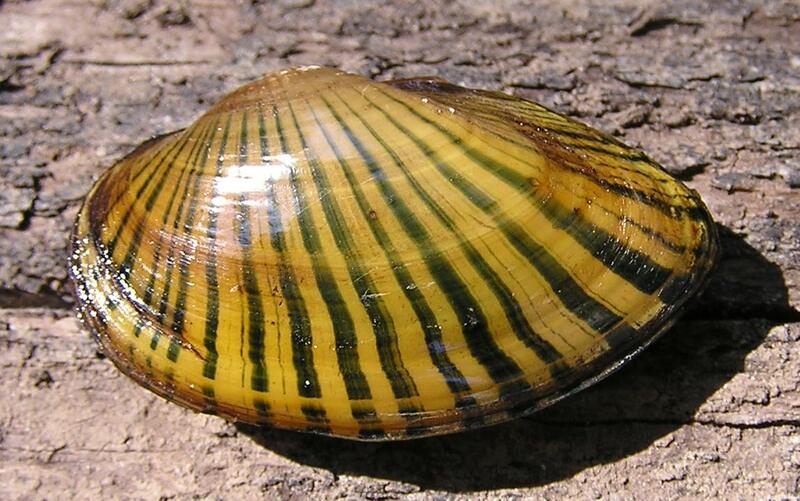
Shell profile is subelliptical with a maximum length of approximately 85 mm (3⅜ inches). The umbo is positioned anteriorly of middle of valves and is elevated above the hingeline. Rounded anteriorly and broadly rounded to pointed posteriorly. Posterior ridge prominent dorsally but broadly rounded posterioventrally. Ventral margin typically broadly rounded and terminating near midline of shell. The periostracum is glossy and yellow to dark brown often with prominent dark rays radiating from the umbo to the margin of the shell. Left valve with two triangular, slightly compressed pseudocardinal teeth and two long, straight lateral teeth. Right valve with one stout pseudocardinal tooth. Nacre typically white or salmon-colored.
Florida Sandshell (Lampsilis floridensis) and Southern Rainbow (Villosa vibex). The Shinyrayed Pocketbook can be distinguished from the Florida Sandshell by the raying pattern, which tends to only appear posteriorly in the Florida Sandshell whereas the Shinyrayed Pocketbook tends to have more prominent rays located on both the anterior and posterior portions of the shell. The Shinyrayed Pocketbook tends to have a relatively heavier shell than that of Southern Rainbow and heavier pseudocardinal teeth. The Southern Rainbow also tends to have a bluish-white periostracum as opposed to the white to salmon periostracum observed in the Shinyrayed Pocketbook.
Typically occupies medium sized streams to large rivers in sandy to muddy substrates with variable current.
The diets of unionids are poorly understood but are believed to consist of algae and/or bacteria. Some studies suggest that diets may change throughout the life of a unionid with juveniles collecting organic materials from the substrate though pedal feeding and then developing the ability to filter feed during adulthood (Vaughn and Hakenkamp 2001).
Gravid females have been collected year round with superconglutinates observed during April thought September. The superconglutinate is comprised of a long gelatinous string with several glochidial packages attached. The superconglutinate floats in water currents in order to resemble a small fish. Females also exhibit a display in which they flutter their mantle while positioned with their posterior margin exposed. This display may be used alone or in conjunction with the superconglutinate and may be an evolutionary strategy that this species uses to attract host fishes during periods of extreme low flow periods. The purpose of this display and the superconglutinate is to attract predatory glochidial host fishes. Glochidia of this mussel have successfully transformed on Largemouth Bass (Micropterus salmoides), Spotted Bass (M. punctatus), Redeye Bass (M. coosae), and Shoal Bass (M. cataractae) with transformation rates exceeding 78% (Fritts and Bringolf 2014).
Surveyors should consider sampling during periods when female individuals are spawning or brooding as this species may have higher detection rates during this period. However, since basic life history information for many of Georgia’s unionids is lacking, sampling during periods when closely related species are spawning or brooding may increase probability of detection. Long-term capture-mark-recapture sampling has been ongoing since 2008 at all of the best remaining populations.
This species is endemic to the eastern Gulf Slope of Alabama, Florida, and Georgia, and was historically known from the Apalachicola and Ochlockonee river basins. In Georgia, this species occurred in the Chattahoochee River Basin up to Atlanta and to the headwaters of the Flint River, as well as the Ochlockonee River. Currently, the Chattahoochee population appears to be restricted to Sawhatchee and Kirkland creeks whereas the species appears to occur widely throughout the Flint River and its tributaries upstream to Whitewater Creek (Fayette County). There have also been several recent collections this species from the Ochlockonee River.
Water withdrawals in the Lower Flint River Basin coupled with severe drought may cause this species to become extirpated from Georgia. Habitat fragmentation may isolate populations and prevent fish movement, limiting the distribution of host fishes carrying glochidia. Additionally, construction of impoundments may further fragment populations and inundate suitable habitat. Excess sedimentation due to inadequate riparian buffer zones also covers suitable habitat and potentially bury individuals.
| Threat 1 | Threat 2 | Threat 3 | |
|---|---|---|---|
| General Threat | Natural system modifications | Pollution | Natural system modifications |
| Specific Threat | Dams & water management/use | None | Dams & water management/use |
The Shinyrayed Pocketbook is known from Chickasawhatchee Creek in the vicinity of Chickasawhatchee and Elmodel Wildlife Management Areas in Georgia. However, unlike terrestrial species, the occurrence of an aquatic species on state or federal lands may not eliminate habitat degradation due to the influences of upstream and downstream disturbances.
Development of environmental flow criteria and investigation of dissolved oxygen concentration and thermal tolerance of this species were identified as high priority conservation actions in the 2015 Georgia State Wildlife Action Plan. In addition, technical teams recommended a comprehensive survey of the Ochlockonee River to assess the current status and distribution of the species in this basin.
Fritts, A.K., and R.B. Bringolf. 2014. Host fishes for four federally endangered freshwater mussels (Unionidae) in the Apalachicola-Chattahoochee-Flint Basin. Walkerana 17:51-59.
O’Brien, C.A., J. Brim Box, and A. Daniels. 1995. Host fish attraction strategy and host fish identification for Lampsilis subangulata. Poster presented to the Conservation and Management of Freshwater Mussels Conference II: Initiatives for the Future, October 16-18, 1995. St. Louis, Missouri.
Shea, C.P., J.T. Peterson, M.J. Conroy, and J.M. Wisniewski. 2013. Evaluating the influence of land use, drought, and reach isolation on the occurrence of freshwater mussel species in the lower Flint River Basin, Georgia (U.S.A.). Freshwater Biology 58:382-395.
Vaughn C.C. and C.C. Hakenkamp. 2001. The functional role of burrowing bivalves in freshwater ecosystems. Freshwater Biology 46: 1431-1446.
Williams, J.D., A.E. Bogan, and J.T. Garner. 2008. Freshwater mussels of Alabama and the Mobile Basin in Georgia, Mississippi, and Tennessee. The University of Alabama Press, Tuscaloosa.
Williams, J.D., R.S. Butler, G.L. Warren, and N.A. Johnson. 2014. Freshwater Mussels of Florida. University of Alabama Press, Tuscaloosa, Alabama.
Wisniewski, J.M., N.M. Rankin, D.A. Weiler, B.A. Strickland, and H.C. Chandler. 2013. Occupancy and detection of benthic macroinvertebrates: a case study of unionids in the lower Flint River, Georgia, USA. Freshwater Science 32:1122-1135.
Wisniewski, J.M., C.P. Shea, S. Abbott, and R.C. Stringfellow. 2013. Imperfect recapture: a potential sources of bias in freshwater mussel studies. The American Midland Naturalist 170:229-247.
Wisniewski, J.M., N.M. Rankin, D.A. Weiler, B.A. Strickland, and H.C. Chandler. 2014. Use of occupancy modeling to assess the status and habitat relationships of freshwater mussels in the lower Flint River, Georgia, USA. Walkerana 17:24-40.
Jason Wisniewski
2018-03-19