


Loading profile. Please wait . . .
Jamesianthus alabamensis Blake & Sherff
Alabama Warbonnet




Federal Protection: No US federal protection
State Protection: Endangered
Global Rank: G3
State Rank: S1
Element Locations Tracked in Biotics: Yes
SWAP 2015 Species of Greatest Conservation Need (SGCN): Yes
SWAP 2025 Species of Greatest Conservation Need (SGCN): Yes
2025 SGCN Priority Tier: High Conservation Concern
Element Occurrences (EOs) in Georgia: 3
Habitat Summary for element in Georgia: Streambanks, in circumneutral soil
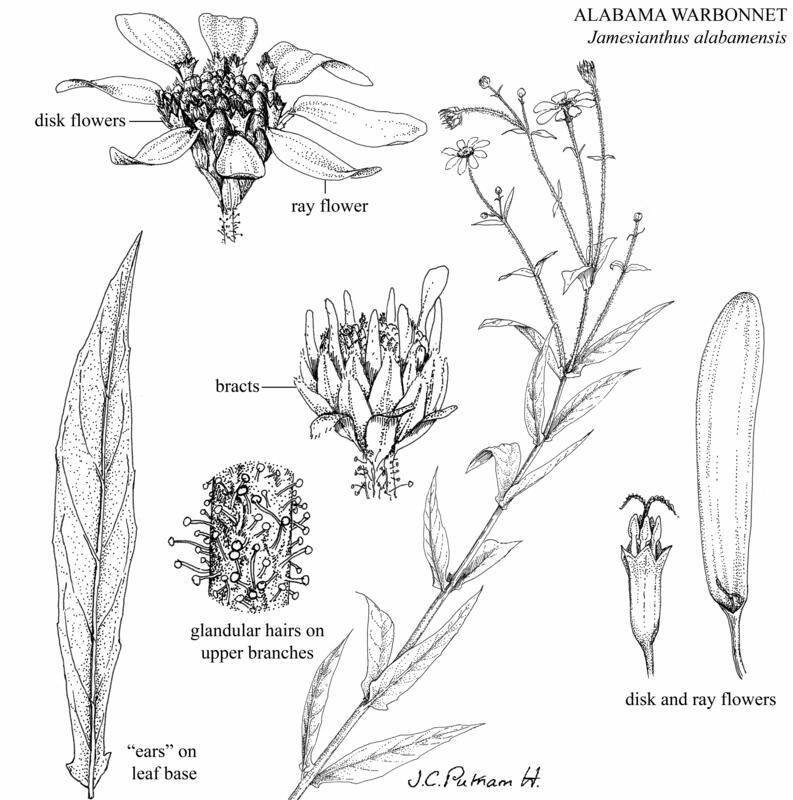
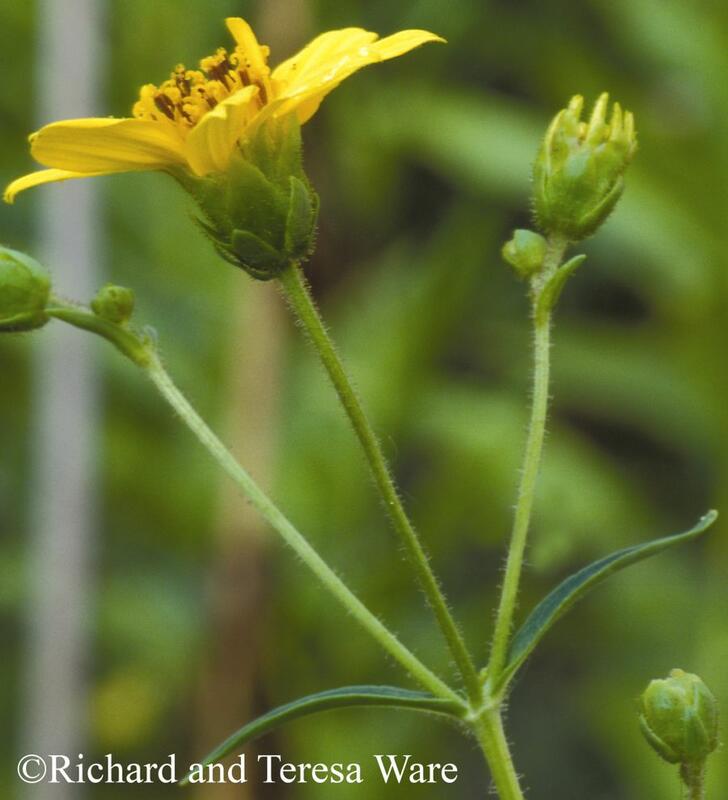
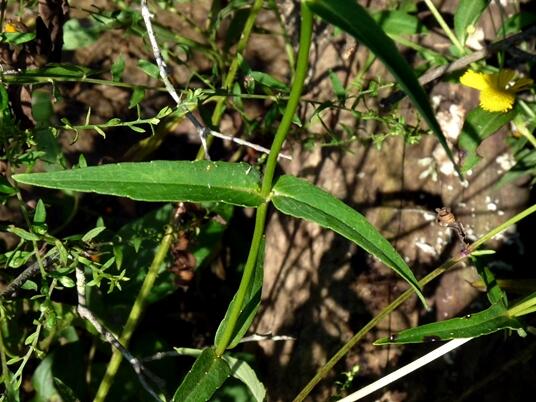
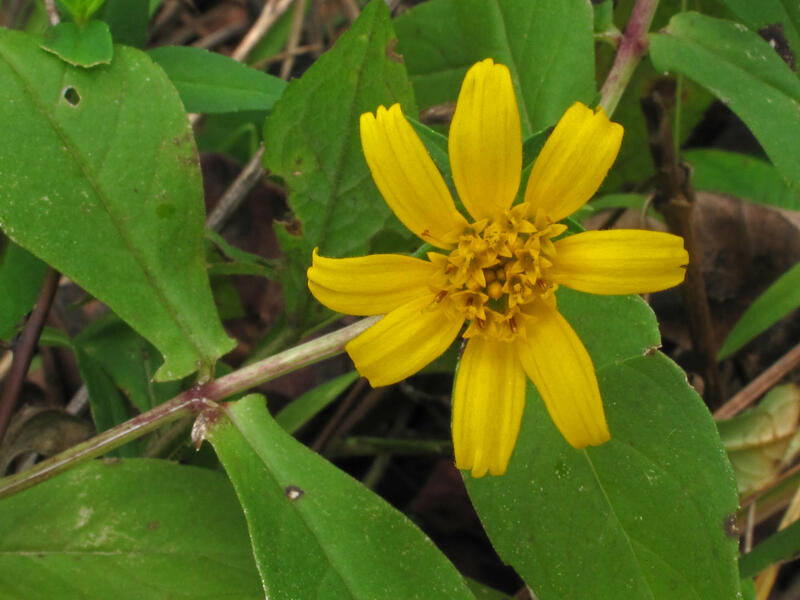
Perennial herb with a leafy stem 2 - 5 feet (60 - 150 cm) tall; the lower stem is slightly 4-sided and hairless, and the upper branches have gland-tipped hairs. Leaves are 2 - 3.5 inches long and 0.4 - 1 inch wide (5 - 9 cm long and 1 - 2.5 cm wide), opposite, deciduous, lance-shaped with pointed tips, small “ears” at the base, and no (or very short) leaf stalks; the leaf margins have a few low, widely spaced teeth; the upper leaf surface may have short, rough hairs. The flower head is about 1 inch (2.5 cm) broad, with a central disk of small, yellow disk flowers, 4 - 9 yellow ray flowers surrounding the disk, and 3 whorls of green, glandular bracts that form a cup around the base of the head. Fruits are achenes that are about 0.1 inch (3 - 4 mm) long, dry and seed-like, oblong, purple-red, and tipped with bristles less than 0.2 inch (4 - 5 mm) long.
Alabama Warbonnet resembles sunflowers (Helianthus spp.) and tick-seeds (Coreopsis spp.), and other tall, yellow-flowered composites. It is most easily distinguished by a combination of slightly 4-sided lower stems and opposite leaves with the small “ears” that give the leaf bases a squared-off look.
Alabama Warbonnet is the only species in the genus Jamesianthus.
Coosa Valley flatwoods, shaded stream banks over shale or limestone in the Coosa River valley; also moist creek banks under a hardwood canopy in the Piedmont.
Alabama Warbonnet is a perennial that dies back to the ground in late fall, developing small, overwintering buds on the root crown; in the spring, the buds produce leafy rosettes and a stem that lengthens throughout the summer. Flower buds appear in July and open in August; there are no reports of pollinators, but it is likely that Alabama Warbonnet is pollinated primarily by bees. Fruits are produced in the late summer and fall and probably dispersed by animals, gravity, and water.
Surveys are best conducted during flowering (August–October).
Alabama Warbonnet is narrowly endemic to northwest Georgia (Ridge and Valley and upper Piedmont) and northern Alabama, where it is also rare.
Conversion of habitat to pine plantations, pasture, and residential and commercial developments; ditching and draining wetlands, clearcutting and other mechanical disturbances, cattle grazing and trampling, stream impoundment and channelization, and invasion by exotic pest plants.
| Threat 1 | Threat 2 | Threat 3 | |
|---|---|---|---|
| General Threat | Natural system modifications | Invasive & other problematic species, genes & diseases | Pollution |
| Specific Threat | None | None | None |
Alabama Warbonnet is ranked S1 by the Georgia Department of Natural Resources, indicating that it is critically imperiled in the state. It is listed as Endangered by the State of Georgia. Two populations occur on private land that is protected by a conservation easement; one population in the Piedmont occurs on state conservation land.
Protect streamside forests from clearcutting, development, cattle grazing and trampling. Avoid impounding streams. Eradicate invasive pest plants.
Chafin, L.G. 2007. Field guide to the rare plants of Georgia. State Botanical Garden of Georgia and University of Georgia Press, Athens.
Cronquist, A. 1980. Vascular flora of the southeastern United States, Vol. 1, Asteraceae. University of North Carolina Press, Chapel Hill.
Dennis, W.M. 1982. Ecological notes on Jamesianthus alabamensis Blake and Sherff (Asteraceae) and an hypothesis on its endemism. Sida 9(3): 210-214. https://www.jstor.org/stable/41967396?seq=1
GADNR. 2020. Element occurrence records for Jamesianthus alabamensis. Georgia Department of Natural Resources, Wildlife Resources Division, Social Circle, Georgia.
Gunn, S.C. 1994. Report on the status of Jamesianthus alabamensis Blake and Sherff. Alabama Natural Heritage Program, Auburn University, Auburn, Alabama.
Kral, R. 1983. A report on some rare, threatened, or endangered forest-related vascular plants of the South. Technical Publication R8-TP2. United States Forest Service, Atlanta.
NatureServe. 2019. Jamesianthus alabamensis. NatureServe Explorer. Arlington, Virginia. http://explorer.natureserve.org/servlet/NatureServe?searchName=Jamesianthus+alabamensis
Sherff, E.E. 1940. A new genus of Compositae from northwestern Alabama. Botanical Series 483, Field Museum of Natural History 22(6): 399-403. https://www.biodiversitylibrary.org/item/19754#page/7/mode/1up
Strother, J.L. 2006. Flora of North America. Vol. 21, Magnoliophyta: Asteridae, Part 8: Asteraceae, Part 3. Oxford University Press, New York. http://www.efloras.org/florataxon.aspx?flora_id=1&taxon_id=116740
Weakley, A.S. 2015. Flora of the southern and mid-Atlantic States. University of North Carolina Herbarium, University of North Carolina, Chapel Hill. http://www.herbarium.unc.edu/flora.htm
Linda G. Chafin
L. Chafin, Dec. 2008: original account
K. Owers, Feb. 2010: added pictures
L. Chafin, March 2020: updated original account.