Loading profile. Please wait . . .
Telegonus cellus (Boisduval and Le Conte, [1837])
Golden-banded Skipper




Federal Protection: No US federal protection
State Protection: No Georgia state protection
Global Rank: G5
State Rank: S2
Element Locations Tracked in Biotics: Yes
SWAP 2015 Species of Greatest Conservation Need (SGCN): Yes
SWAP 2025 Species of Greatest Conservation Need (SGCN): Yes
2025 SGCN Priority Tier: High Conservation Concern
Element Occurrences (EOs) in Georgia: 14
Habitat Summary for element in Georgia: Thicket bean/ wild kidney bean (Phaseolus polystachios), areas of intact groundcover
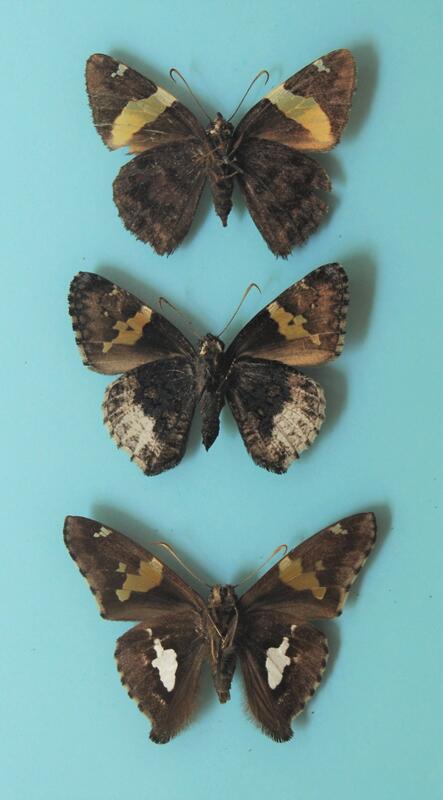
This is a large skipper butterfly, 4 to 5 cm (up to 2 inches) in wingspan. The ground color is brown, with a diagnostic golden band across the forewing, visible from both upperside (see photo above) and underside (see photo below).
There are two other large skipper species, likely sympatric in most of the Golden-banded Skippers range, that might briefly be confused with the Golden-banded Skipper -- the Hoary-edge Skipper (Cecropterus lyciades) and the Silver-spotted Skipper (Epargyreus clarus). Both have a golden band across the forewing, but in both of these species, the band is broken into separate sections by dark lines along the veins on the upperside, and the band is irregularly shaped (see comparison photo, below). But the EASY way to tell the species apart is the underside of the hindwing. The Golden-banded Skipper has a brown underside of the hindwing, with two slightly darker brown bands on a lighter brown background. The hindwing underside of the Hoary-edge Skipper has a white subterminal area, and the Silver-spotted Skipper has a large, irregular shaped silvery white patch in the median area. Since all three species often sit with wings at least partially closed, the undersides are often visible, and diagnostic for all three species.
This species is a forest/forest edge dwelling insect, and could potentially occur, particularly in the northern part of the state, wherever the Thicket Bean vine foodplant (Phaseolus polystachios) occurs. The plant and the skipper do prefer openings in the forest, both natural and artificial, which can include streamsides and roadsides, and can be found on occassion on drier, oak-forested ridgelines (Schweitzer, et al., 2011).
The larval foodplant in the eastern U.S. has been commonly reported (Schweitzer, et al., 2011) as American Hog Peanut (Amphicarpaea bracteata). Early instar larvae of A. cellus and the Silver-spotted Skipper (Epargyreus clarus; see photo below) are hard to tell apart and E. clarus larvae feed on a variety of legumes, including A. bracteata, so there is some question about correct identification of skipper larvae on this foodplant. Clark (1936) and Harris (1972) reported feeding/oviposition on Falcata pitcheri, which, as it turns out, is a misidentification of Thicket Bean (Phaseolus polystachios). In 2011, Jue et al. observed oviposition by A. cellus on P. polystachios in Phipps park in the Tallahasee, Florida area. At the same time, they observed larval A. cellus feeding on the Thicket Bean and no activity on Hog Peanut (A. bracteata). Minno and Friedman (2012) futher reported similar findings in terms of larval activity on the two plants in Florida. In 2015, Boscoe, et al. reported on a more detailed study on female oviposition choices and larval food plant choices with A. cellus in West Virginia. In this study, females in captivity did NOT lay eggs on A. bracteata, and newly hatched larvae placed on A. bracteata walked off the plant and starved instead of eating the plant (Epargyreus clarus adults and larvae were observed ovipositing and feeding respectively on A. bracteata in nature at the West Virginia locations, however). In the locations from which the female A. cellus were obtained no larvae of A. cellus were found on any A. bracteata plants. However, P. polystachios was found growing abundantly, and many A. cellus larval shelters were discovered on this plant. Several of the larvae were reared to adults, confirming their identity as A. cellus. A. bracteata and P. polystachios grow in similar habitats over a large part of the eastern U.S., and, as such, the occurrence of A. cellus in a given location is likely due to local occurrence of P. polystachios and not A. bracteata. The two plants are similar in appearance, but P. polystachios vines are more robust, with broader leaflets that are minutely hirsute on the leaf surfaces (compared to the smooth leaf surfaces of A. bracteata). As such, it seems that the main foodplant in the eastern U.S. for the Golden-banded Skipper is Thicket Bean (Phaseolus polystachios (L.)) and NOT American Hog Peanut (Amphicarpaea bracteata). Further west, a number of different legumes (Fabaceae) are used as hostplants, including a number of Phaseolus species (Minno and Friedman, 2012; Boscoe, et al., 2015).
It should be noted that there may be several locations where the foodplant Thicket Bean may occur in abundance, and yet the skipper does not occur there. This may mean that the skipper has other very specific ecological requirements that we are unaware of, or that the skipper just never made it to that location.
This species is double brooded over much of its range. In Georgia, the first brood flies in April/May (earlier in the southern parts of the state; note the late May date on the photo below) and the second in July/August. The adults feed on a variety of nectar sources, including flowers of the larval foodplant (Thicket Bean) when available (Jue, et al., 2011), and males can be found getting water and minerals from the soil. Eggs are laid sparsely distributed on the foodplant (Schweitzer, et al., 2011). The larvae are typical skipper larvae with an enlarged dark head capsule and a green body. The larvae build typical skipper tents (folded over edges of leaves anchored with silk), and should be looked for as evidence of presence of the species. As the larvae enter later instars, it develops prominent lateral yellow stripes on the green background, and the head capsule develops obvious orange "eye" spots (Schweitzer, et al., 2011; Minno and Friedman, 2012; Boscoe, et al., 2015). For photos of the entire developmental sequence, including the pupa, see Boscoe, et al., 2015.
The species overwinters in the leaf litter in the pupal stage.
Searches for the Golden-banded Skippers should be concentrated around known locations of the foodplant Thicket Bean (Phaseolus polystachios). The best evidence to look for to establish occurrence of the skipper is the presence of larval tents along the edges of the leaves, which are maintained as shelters when not feeding throughout the larval stages. Searches for adults can be made at times when the adults should be flying, which would be mainly May and July/August in the northern part of the state.
There are apparently many locations where the foodplant can be abundant, but the skipper will be absent or in very low numbers, so some significant diligence may be required to find populations of the species.
In the eastern U.S., the historical range of the Golden-banded Skipper extends from New Jersey and Delaware southwestward across the Ohio Valley to Missouri, and then southward into central Georgia and eastern Texas, with outlying colonies in northern Florida and central Texas. There are also western populations in western Texas and southeastern Arizona (Schweitzer, et al., 2011). The range of the primary foodplant, thicket bean (Phaseolus polystachios), very much mirrors the historic range of the skipper (USDA PLANTS database).
In Georgia, the vast majority of historical and recent occurrences of the skipper are in the northern parts of the state (see map). There was a sight record in 2020 at Oaky Woods WMA in Houston County in April by Phil Delestrez (Anna Yellin, pers. comm.). Anna has since searched the abundant foodplant at the location and has not had success locating larvae. There are historical records from Grady Co. in extreme SW Georgia (Harris, 1972), but there are no recent records from there.
As with any species that requires healthy forest, this species is threatened by development (deforestation or forest fragmentation). Having said that, forest management that can open up the habitat to some extent without disturbing much of the understory with the foodplants could actually improve the status of skipper in some locations (Schweitzer, et al., 2011). This set of circumstances is similar to the threats for Erynnis martialis. Also similar to that species, in places where deer populations are high, deer could be an issue because Phaseolus polystachios is a plant (similar to the Ceanothus americana foodplant of Erynnis martialis) that is a favored browse species of deer (Schweitzer, et al., 2011).
Since this species is largely a mesic forest species, fire should not be much of an issue for northern Georgia populations. Spraying to control for Gypsy moths, if such would ever be applied, should also not be much of an issue, as that involves application of control measures in early spring for the larval stages of Gypsy moths. Since Autochton cellus overwinters as pupae and do not emerge typically until late April/May in north Georgia, the skipper should not be exposed.
| Threat 1 | Threat 2 | Threat 3 | |
|---|---|---|---|
| General Threat | Natural system modifications | Pollution | Natural system modifications |
| Specific Threat | Fire & fire suppression | Air-borne pollutants | Other ecosystem modifications |
The species has not been sighted frequently in Georgia in recent years, and yet the species could occur across a large portion of the state. S2S3 seems the appropriate ranking for this species. Recent evaluation has recommended this species to be S2.
It is important to maintain already protected habitat with the foodplant Thicket Bean (Phaseolus polystachios). This requires that the habitat becomes neither too heavily forested, nor too open, and it is especially important to maintain the understory where the foodplant occurs. As such, periodic thinning of the forest and maintenance of paths and roads will likely help this skipper maintain itself where it still exists.
All life stages of the skipper are above ground and therefore are susceptible to fire, so large forest fires will decimate local populations of the skipper. But the habitat that the skipper requires would not largely be managed by prescribed burns for the most part in Georgia, so fire prevention is more important for this skipper.
In the few sandhills populations, prescribed burns may need to be done in a small patchwork fashion to allow for refugia from which the skippers can recolonize the prescribed burn areas. In the panhandle of Florida, Dean and Sally Jue (2011) worked with the land managers at Elinor Klapp-Phipps Park near Tallahassee to develop an appropriate burn plan for the Golden-banded Skipper and its foodplant. The success of the management was remarkable, as post-burn daily counts as high as 83 were recorded for the species.
If deer herds are persistently large in an area where the foodplant for the skipper occurs, especially if direct browsing of the Thicket Bean is observed, culling herds of deer may be warranted to maintain the hostplants.
Boscoe, R. W., M. C. Minno, and D. M. Wright. 2015. A case of mistaken identity: the true host of the Golden-banded Skipper Autochton cellus (Hesperiidae: Eudaminae) in the eastern U.S. News of the Lepidopterists' Society 57(2): 56-59.Harris, L., Jr. 1972. Butterflies of Georgia, pages 102-105. University of Oklahoma Press, Norman.
Clark, A. H. 1936. The Golden-banded Skipper (Rhabdoides cellus). Smithsonian Miscellaneous Collections 95(7): 1-50.
Harris, L., Jr. 1972. Butterflies of Georgia, pages 102-105. University of Oklahoma Press, Norman.
Jue, D., S. Jue, and D. Harder. 2011. Elinor Klapp-Phipps Park Update: A success story for Golden Banded-Skippers and land managers. American Butterflies 19(1): 30-38.
Minno, M. C. and M. A. Friedman. 2012. A new larval host for the Golden-banded Skipper (Autochton cellus: Hesperiidae: Eudaminae) in Florida. News of the Lepidopterists' Society 54(1): 3-5.
Schweitzer, D. F., M. C. Minno, and D. L. Wagner. 2011. Rare, declining and poorly known butterfly and moths (Lepidoptera) of forests and woodlands in the eastern United States, pages 83-86. Forest Health Technology Enterprise Team.
US Department of Agriculture website. PLANTS database. Online at https://plants.usda.gov/java/
James K. Adams, Professor of Biology, Dalton State College, Dalton, GA
July 10, 2020