

Loading profile. Please wait . . .
Helenium brevifolium (Nutt.) Wood
Shortleaf Sneezeweed




Federal Protection: No US federal protection
State Protection: No Georgia state protection
Global Rank: G4
State Rank: S1
Element Locations Tracked in Biotics: Yes
SWAP 2015 Species of Greatest Conservation Need (SGCN): Yes
SWAP 2025 Species of Greatest Conservation Need (SGCN): Yes
2025 SGCN Priority Tier: High Conservation Concern
Element Occurrences (EOs) in Georgia: 9
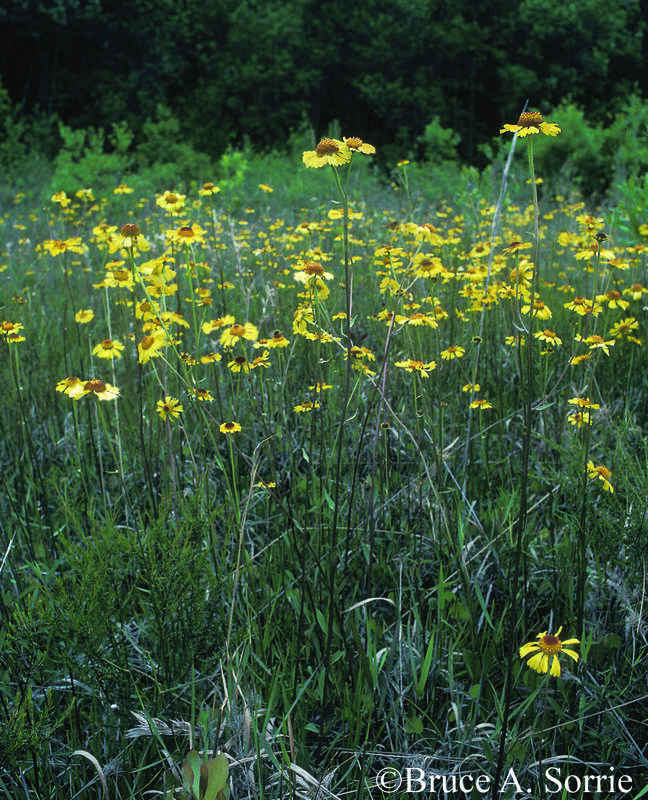
Habitat Summary for element in Georgia: Seepage bogs, sometimes with Sarracenia rubra near the Fall Line
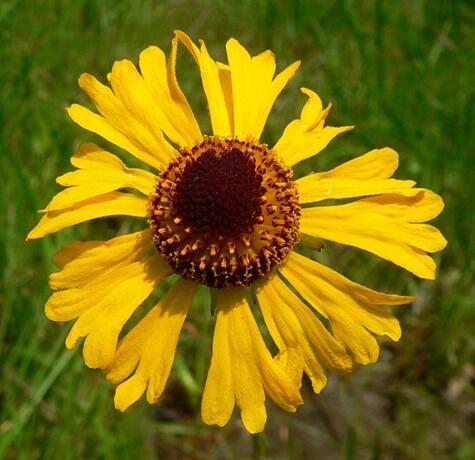
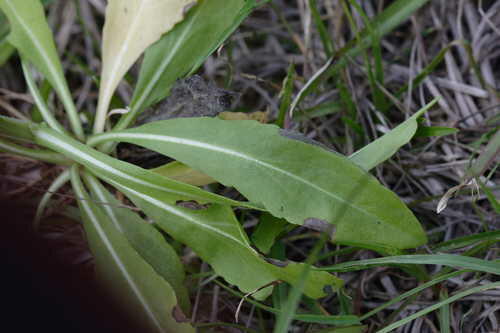
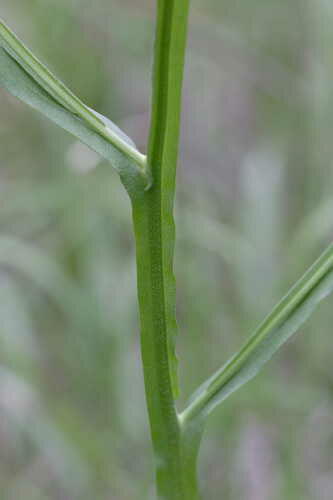
Perennial herb with winged, purple stems, 1 - 2.6 feet (30 - 80 cm) tall, hairless except the top of the stem, which is covered with cottony hairs. Basal leaves are 0.8 - 6.7 inches (2 - 17 cm) long and ¼ - 1 inch (0.6 - 3 cm) wide, purple-tinged, spatula-shaped, mostly hairless, present during flowering. Stem leaves smaller, few and widely spaced, alternate, with cottony hairs on both surfaces; leaf bases extend well down along the stem, forming narrow wings. Flower heads 1 - 10 per plant, with 8 - 24 yellow ray flowers, each ray with 3 or 5 teeth, and many reddish-brown disk flowers. Fruit dry and seed-like, with bristles.
Spring Sneezeweed (Helenium vernale) has one flower head per plant and yellow disk flowers; its stems and leaves are hairless; its basal leaves are up to 10 inches long and much longer than wide.
Southeastern Sneezeweed (Helenium pinnatifidum) leaves barely extend down along the stem; flower stalks are rough-hairy; and it has 13 - 40 ray flowers crowded around a yellow disk.
Southern Sneezeweed (Helenium flexuosum) usually has many heads in a branched cluster; its disk flowers are purple with 4 lobes.
None in Georgia.
Pine- or Cypress-dominated wet savannas, seepage slopes, bogs, boggy stream banks, Atlantic White Cedar swamps, and powerlines or other clearings through these habitats.
Although the life history of Bog Sneezeweed has not been studied, it is likely that it germinates in the fall as do other members of this genus, forming a rosette during the first year of growth and sending up a flowering stem in the second year. Like most species in the Aster family, Bog Sneezeweed flowers are probably self-incompatible, requiring visits by a variety of insect pollinators to effect cross-pollination.
Surveys are best conducted during flowering (late April–June) and fruiting (June–July).
Georgia, Florida, Alabama, Mississippi, Louisiana, Tennessee, South Carolina, North Carolina, and Virginia
Conversion of habitat to pine plantations, pastures, and developments; ditching and draining of wetlands; fire suppression; clearcutting and other mechanical clearing.
| Threat 1 | Threat 2 | Threat 3 | |
|---|---|---|---|
| General Threat | Invasive & other problematic species, genes & diseases | Pollution | None |
| Specific Threat | None | None | None |
Helenium brevifolium is ranked S1 by the Georgia Department of Natural Resources, indicating that it is critically imperiled in the state. Nine populations are known, none on conservation lands.
Apply prescribed fire every 2 - 3 years. Avoid plowing firebreaks in wetlands. Avoid clearcutting and other mechanical disturbances.
Bierner, M.W. 2006. Helenium brevifolium species account. Flora of North America, Vol. 21. Oxford University Press, New York. http://www.efloras.org/florataxon.aspx?flora_id=1&taxon_id=250066850
Chafin, L.G. 2007. Field guide to the rare plants of Georgia. State Botanical Garden of Georgia and University of Georgia Press, Athens.
Cronquist, A. 1980. Vascular flora of the southeastern United States, Vol. 1, Asteraceae. University of North Carolina Press, Chapel Hill.
GADNR. 2020. Element occurrence records for Helenium brevifolium. Georgia Department of Natural Resources, Wildlife Resources Division, Social Circle, Georgia.
Godfrey, R.K. and J.W. Wooten. 1981. Aquatic and wetland plants of southeastern United States, Vol. 2, dicotyledons. University of Georgia Press, Athens.
NatureServe. 2019. Helenium brevifolium comprehensive report. NatureServe Explorer. Arlington, Virginia. http://explorer.natureserve.org/servlet/NatureServe?searchName=Helenium+brevifolium
Weakley, A.S. 2015. Flora of the southern and mid-Atlantic States. University of North Carolina Herbarium, University of North Carolina, Chapel Hill. http://www.herbarium.unc.edu/flora.htm
Linda G. Chafin
L. Chafin, Mar. 2007: original account
K. Owers, Jan. 2010: added pictures
L. Chafin, Feb 2020: updated original account.