

Loading profile. Please wait . . .
Spiranthes floridana (Wherry) Cory
Florida Ladies'-tresses




Federal Protection: No US federal protection
State Protection: No Georgia state protection
Global Rank: G1
State Rank: S1?
Element Locations Tracked in Biotics: Yes
SWAP 2015 Species of Greatest Conservation Need (SGCN): Yes
SWAP 2025 Species of Greatest Conservation Need (SGCN): Yes
2025 SGCN Priority Tier: Highest Conservation Concern
Element Occurrences (EOs) in Georgia: 3
Habitat Summary for element in Georgia: Wet savannas; mowed grassy openings in Okefenokee area
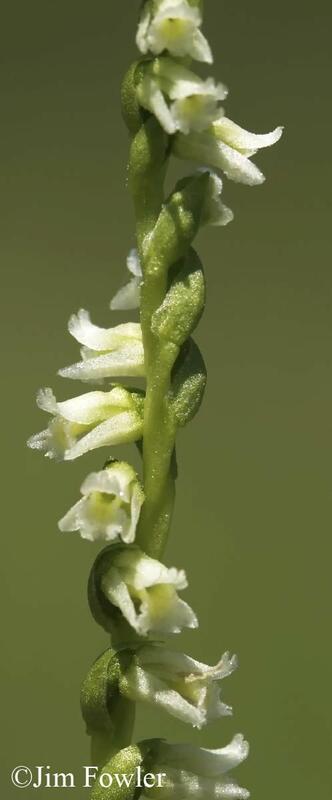
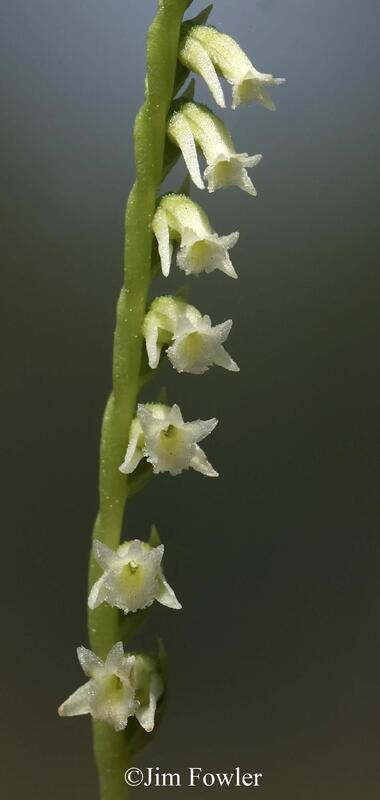
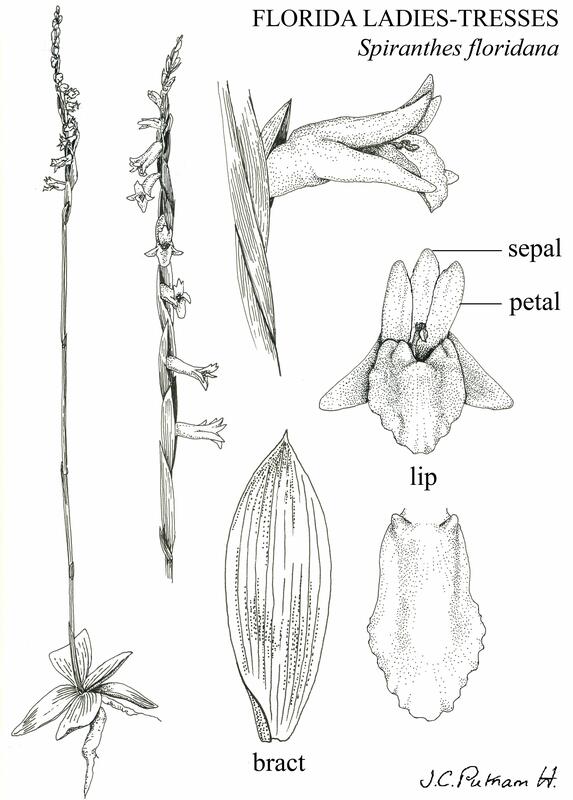
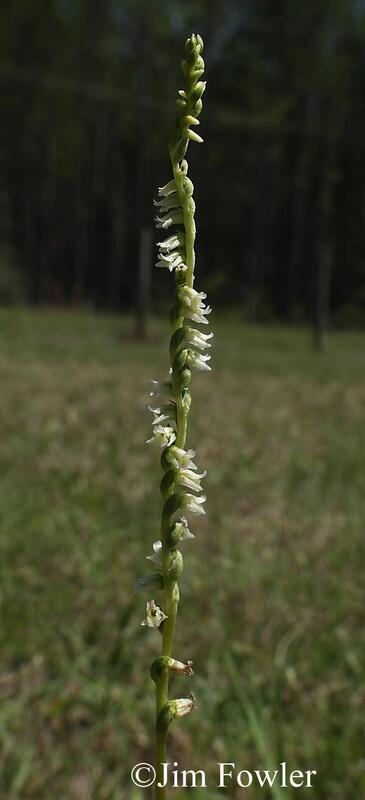
Perennial herb with an erect stem 8 - 16 inches (20 - 40 cm) tall, with several small bracts sheathing the stem. Basal leaves are 0.8 - 2.4 inches (2 - 6 cm) long and up to 0.8 inch (2 cm) wide, 3 - 5 in number, in a rosette at the base of the stem, oval, yellowish-green, overwintering and present during flowering in the spring, but withering soon after. The flower spike has a single row of 35 or fewer, yellowish flowers loosely spiraled around the stem, with 8 - 10 flowers per cycle of the spiral (flowers are occasionally in a single row on one side of the spike); the flower stalk has few or no hairs. The flowers are less than 0.2 inch (4 - 5 mm) long; 2 petals and 3 sepals are similar in size and shape and curve forward; the lip petal curves slightly downward, with a yellow center and a wavy or fringed edge. Fruits are oval capsules less than 0.2 inch (4 - 5 mm) long, with many tiny seeds.
Several ladies-tresses species produce overwintering leaf rosettes and bloom in late winter or early spring in south Georgia. Florida Ladies-tresses is distinguished by its hairless, yellow-lipped flowers and hairless flower stalks.
Seven species of Ladies-tresses are rare in Georgia:
Downy Slender Ladies-tresses (Spiranthes brevilabris) occurs in frequently burned wet, pine savannas and flatwoods, cemeteries, and on roadsides through these habitats in the Coastal Plain. For more information, see: https://www.georgiabiodiversity.org/portal/profile?group=plants&es_id=18671
Eaton’s Ladies-tresses (Spiranthes eatonii) occurs in frequently burned pine savannas and dry flatwoods, cemeteries, and on roadsides through these habitats in the Coastal Plain. For more information, see: http://beta.floranorthamerica.org/Spiranthes_eatonii
Florida Ladies-tresses (Spiranthes floridana) occurs in wet savannas, mowed grassy openings in the Okefenokee area, and on roadsides through these habitats in the Coastal Plain. For more information, see: https://www.georgiabiodiversity.org/portal/profile?group=plants&es_id=17359
Long-lipped Ladies-tresses (Spiranthes longilabris) occurs in low hammocks with saw palmetto, seasonally wet depressions in pine flatwoods and savannas, fields, and wet roadside ditches in the Coastal Plain. For more information, see: https://www.georgiabiodiversity.org/portal/profile?group=plants&es_id=19007
Great Plains Ladies-tresses (Spiranthes magnicamporum) occurs in northwest Georgia in grassy areas on limestone cedar glades and in prairie openings in the Coosa River valley. For more information, see: https://www.georgiabiodiversity.org/portal/profile?group=plants&es_id=15517
Northern Oval Ladies-tresses (Spiranthes ovalis var. erostellata) occurs in seepy margins of small streams and floodplain forests throughout Georgia except the southeast corner. For more information, see: http://beta.floranorthamerica.org/Spiranthes_ovalis_var._erostellata
Pale Green Ladies-tresses (Spiranthes sylvatica, synonym S. praecox) occurs in Live Oak hammocks and other open woodlands in the Coastal Plain. For more information, see: http://beta.floranorthamerica.org/Spiranthes_praecox
Frequently burned wet savannas and pine flatwoods; grassy, wet roadsides and cemeteries in these habitats.
Florida Ladies-tresses produce rosettes of leaves during the winter; the leaves are still visible when flowers open early in the spring, but wither soon after. Ladies-tresses’ flowers are pollinated by bumblebees and halictid bees. Self-pollination is discouraged by two sequences of events.
First, when a flower opens, a tiny structure at the center of the flower (the column) is pressed against the flower’s lip, covering the stigma and leaving only a narrow space into which a bee can insert its tongue in search of nectar. While the stigma is covered, the flower can’t be pollinated. As the bee sips nectar, two pollen packets stick to its proboscis. Once the bee exits the flower, carrying with it that flower’s pollen packets, the column lifts up, exposing the stigma. The next bee that comes along to sip nectar – possibly carrying pollen packets from another plant – may brush against the exposed stigma and deposit the pollen.
Second, in order to discourage the movement of pollen between flowers on the same plant, the flowers in a spike open from the bottom to the top of the spike. Bees always work their way from the bottom to the top of a flower spike as they gather nectar. If they pick up pollen from flowers at the bottom of the spike, flowers on the same spike nearer the top will not yet be open and receiving pollen. Instead, the bee flies to an open flower on another plant, gathers nectar and deposits its pollen load, thus cross-pollinating the flower. If pollinated, the flowers produce small capsules containing many dust-like seeds that are dispersed by the wind.
As with all species of orchid, the minute seeds of Florida Ladies-tresses lack endosperm and require the presence of certain species of fungi to germinate and support seedlings.
Surveys are best conducted during flowering (April–May).
Georgia, Florida, Alabama, Mississippi, Louisiana, Texas, South Carolina, and North Carolina. Plants have been seen recently only in Mississippi and Florida.
Fire suppression, destruction of habitat by clearing or conversion to pine plantations, pastures, and fields. Use of herbicides in roadside maintenance.
| Threat 1 | Threat 2 | Threat 3 | |
|---|---|---|---|
| General Threat | Natural system modifications | Natural system modifications | Agriculture & aquaculture |
| Specific Threat | None | None | None |
Florida Ladies-tresses is ranked S1? by the Georgia Department of Natural Resources, indicating that the species is critically imperiled in Georgia, but that more information is needed to make a definitive ranking. Three populations were documented in Georgia between 1939 and1997, all on private land, and have not been observed since.
Prevent ditching, draining, filling, and conversion to pine plantations of wet savannas and flatwoods. Apply prescribed fires every 2 - 3 years during the growing season; avoid use of herbicides on roadsides and in cemeteries.
Brown, P.M. and S.N. Folsom. 2004. Wild orchids of the southeastern United States. University Press of Florida, Gainesville.
Catling, P.M. 1983. Pollination of northeastern North American Spiranthes (Orchidaceae). Canadian Journal of Botany 61(4): 1080–1093. https://www.nrcresearchpress.com/doi/abs/10.1139/b83-116
GADNR. 2020. Element occurrence records for Spiranthes floridana. Georgia Department of Natural Resources, Wildlife Resources Division, Social Circle, Georgia.
Luer, C.A. 1975. The native orchids of the United States and Canada, excluding Florida. New York Botanical Garden, New York.
NatureServe. 2020. Spiranthes floridana species account. NatureServe Explorer. NatureServe, Arlington, Virginia. https://explorer.natureserve.org/Taxon/ELEMENT_GLOBAL.2.130391/Spiranthes_floridana
Proctor, M. and P. Yeo. 1972. Pollination of flowers. Taplinger Publishing Company, New York.
Sheviak, C.J. and P.M. Brown. 2003. Spiranthes floridana species account. Flora of North America, Vol. 26, Magnoliophyta: Liliidae: Liliales and Orchidales. Oxford University Press, New York. http://beta.floranorthamerica.org/Spiranthes_floridana
Stewart, S.L. 2007. Integrated conservation of Florida Orchidaceae in the genera Habenaria and Spiranthes: model orchid conservation systems for the Americas. Ph.D. Dissertation, University of Florida, Gainesville. etd.fcla.edu › UFE0021367 › stewart_s
Stewart, S.L. and M.E. Kane. 2007. Symbiotic seed germination and evidence for mycobiont specificity between two closely-related Florida terrestrial orchids, Spiranthes brevilabris and Spiranthes floridana (Orchidaceae). In Vitro Cellular & Developmental Biology - Plant. https://link.springer.com/article/10.1007/s11627-006-9023-4
Weakley, A.S. 2015. Flora of the southern and mid-Atlantic States. University of North Carolina Herbarium, University of North Carolina, Chapel Hill. http://www.herbarium.unc.edu/flora.htm
Linda G. Chafin
L. Chafin, Aug. 2008: original account
K. Owers, Feb. 2010: added pictures
L. Chafin, May 2020: updated original account