Loading profile. Please wait . . .
Tridens carolinianus (Steud.) Henr.
Carolina Fluffgrass




Federal Protection: No US federal protection
State Protection: No Georgia state protection
Global Rank: G3G4
State Rank: S2?
Element Locations Tracked in Biotics: Yes
SWAP 2015 Species of Greatest Conservation Need (SGCN): Yes
SWAP 2025 Species of Greatest Conservation Need (SGCN): Yes
2025 SGCN Priority Tier: High Conservation Concern
Element Occurrences (EOs) in Georgia: 9
Habitat Summary for element in Georgia: Dry, open mixed oak-pine forests of the Fall Line Sandhills
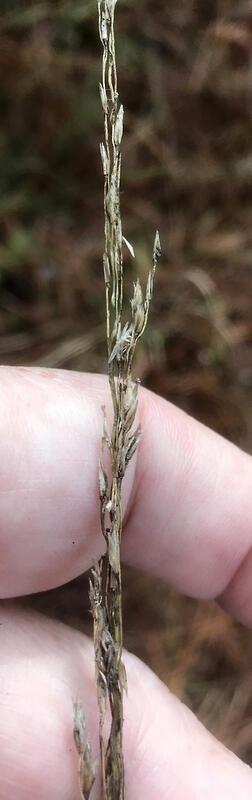
Perennial grass with erect, hairless stems 2.5 - 4 feet (80 - 120 cm) tall; stems arise in a line from long, scaly rhizomes. Most leaf sheaths are hairy with ligules of long hairs or membranes about 0.5 mm high. Most leaf blades are up to 14 inches long and 0.27 inch wide (up to 35 cm long and 2 - 7 mm wide), flat, hairy only at the base, margins smooth or slightly roughened; upper leaves and sheaths are hairless. Flower clusters 3.5 - 6 inches long and 0.4 - 1.6 inches wide (9 - 15 cm long and 1 - 4 cm wide) , purplish, nodding at the top of the stem, densely flowered, spike-like, the short branches nearly erect and overlapping. The uppermost flowers in the cluster are sterile. Spikelets 0.27 - 0.54 inches (7 - 10 mm) long, compressed, with two hairless, one-veined glumes that are shorter than the lowest lemma, and 3 - 5 flowers. Each flower consists of one lemma, 4 - 5 mm long, with three hairy veins that extend into short points at the tip; a delicate, hairless palea, 3 - 3.5 mm; a pistil with three brushy stigmas; and three stamens with reddish anthers. Fruits are somewhat flattened, yellowish to dark brown, seed-like achenes, 2 - 2.5 mm long.
Long-spike Fluff-grass (Tridens strictus) occurs in sandhills, moist pine savannas, and roadsides through these habitats. It is a bunch grass, with several stems arising from a large clump of leaves. Its glumes are obviously longer than the adjacent lemmas, and are usually longer than the uppermost flower in the spikelet.
The narrow flower clusters and leaves and short glumes are similar to the widespread and common Smut Grass (Sporobolus indicus). Smut Grass is not rhizomatous and its leaves are completely hairless. Most of its leaves are shorter than the flower clusters, which are either green or brown and usually coated with a black smut fungus. Smut Grass is usually confined to disturbed areas such as roadsides.
At least 30 grass species are rare in Georgia. For detailed information on some of these, see on this website: Calamagrostis porteri (Porter's Reed-grass), Ctenium floridanum (Florida Orange-grass), Danthonia epilis (Bog Oat Grass), Dichanthelium hirstii (Hirst Brothers Panic Grass), Eriochloa michauxii var. michauxii (Michaux's Longleaf Cupgrass), Eustachys floridana (Florida Finger Grass), and Sporobolus teretifolius (Wire-leaf Dropseed).
Longleaf Pine–Wire Grass woodlands and oak-dominated sandhills
Carolina Redtop Grass is a perennial, warm-season, bunch grass that germinates in the spring, grows actively in the summer, and flowers and sets seed in the late summer and early fall. Its seeds are dispersed by gravity and by small animals whose fur and feather pick up the awned fruits. Carolina Redtop Grass also reproduces vegetatively by sending up stems from buds scattered along elongated rhizomes. No life history or ecological studies of this species have been published, but the similar species Tridens strictus is known to be moderately fire-tolerant, very drought-tolerant, and tolerant of low-nutrient soils, with no known pests or disease problems.
Surveys must be conducted during August–October when the plants are in flower and fruit.
Carolina Redtop Grass occurs from Georgia north to North Carolina and west to Louisiana. It is rare throughout its range, except in Florida.
Sandhills and Longleaf Pine-dominated woodlands have been extensively converted to pastures, pine plantations, and other agricultural, commercial, and residential uses, directly destroying this habitat and indirectly leading to habitat fragmentation and fire suppression. Fire suppression is a major threat to this species which is easily outcompeted by woody plants.
| Threat 1 | Threat 2 | Threat 3 | |
|---|---|---|---|
| General Threat | Residential & commercial development | Climate change & severe weather | None |
| Specific Threat | None | None | None |
Tridens carolinianus is ranked S2 by the Georgia Department of Natural Resources, indicating that it is imperiled in the state. Only seven populations have been documented in Georgia, and only two of these have been observed since 1998. Four occurred on lands managed at least in part by fire.
Protect Longleaf Pine–Wire Grass and sandhill communities from human disturbance. Apply prescribed fire every 2-3 years, preferably in the growing season.
GADNR. 2019. Element occurrence records for Tridens carolinianus. Georgia Department of Natural Resources, Wildlife Resources Division. Social Circle, Georgia.
NatureServe. 2019. Species account for Tridens carolinianus. NatureServe Explorer. NatureServe, Arlington, Virginia. https://explorer.natureserve.org/Taxon/ELEMENT_GLOBAL.2.153669/Tridens_carolinianus
Radford, A.E., H.E. Ahles, and C.R. Bell. 1968. Manual of the vascular vlora of the Carolinas. University of North Carolina Press, Chapel Hill.
Shadow, A. USDA/NRCS Plant fact sheet: Longspike Tridens, Tridens strictus (Nutt.) Nash. USDA, Natural Resources Conservation Service, East Texas Plant Materials Center, Nacogdoches, Texas. Accessed 28 December 2019. https://plants.usda.gov › plantguide › pdf › pg_trst2
Valdes-Reyna, J. 2004. Species account for Tridens carolinianus. Flora of North America North of Mexico, vol. 25. http://beta.floranorthamerica.org/Tridens_carolinianus
Weakley, A.S. 2015. Flora of the southern and mid-Atlantic States. University of North Carolina Herbarium, University of North Carolina, Chapel Hill. http://www.herbarium.unc.edu/flora.htm
Linda G. Chafin
Linda G. Chafin, 28 December 2019: original account