


Loading profile. Please wait . . .
Trillium reliquum J.D. Freeman
Relict Trillium




Federal Protection: Listed Endangered
State Protection: Endangered
Global Rank: G3
State Rank: S3
Element Locations Tracked in Biotics: Yes
SWAP 2015 Species of Greatest Conservation Need (SGCN): Yes
SWAP 2025 Species of Greatest Conservation Need (SGCN): Yes
2025 SGCN Priority Tier: Highest Conservation Concern
Element Occurrences (EOs) in Georgia: 53
Habitat Summary for element in Georgia: Mesic hardwood forests; limesink forests; usually with Fagus and Tilia
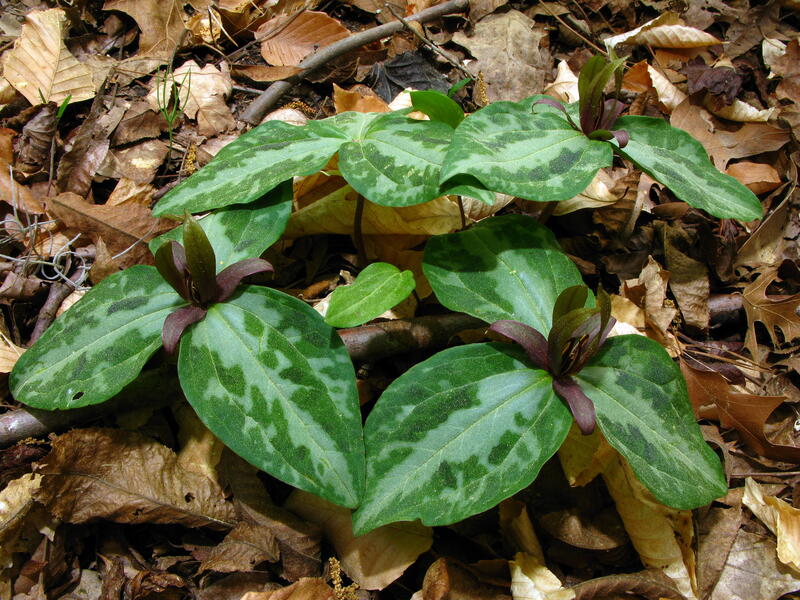
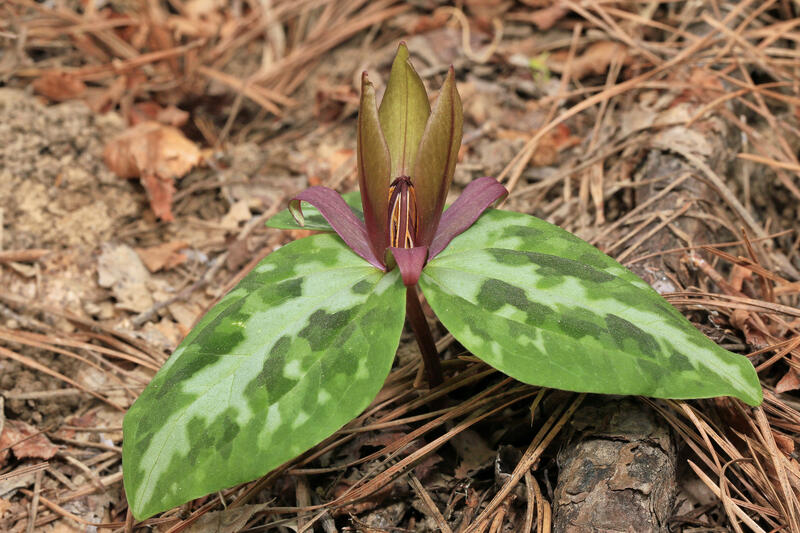
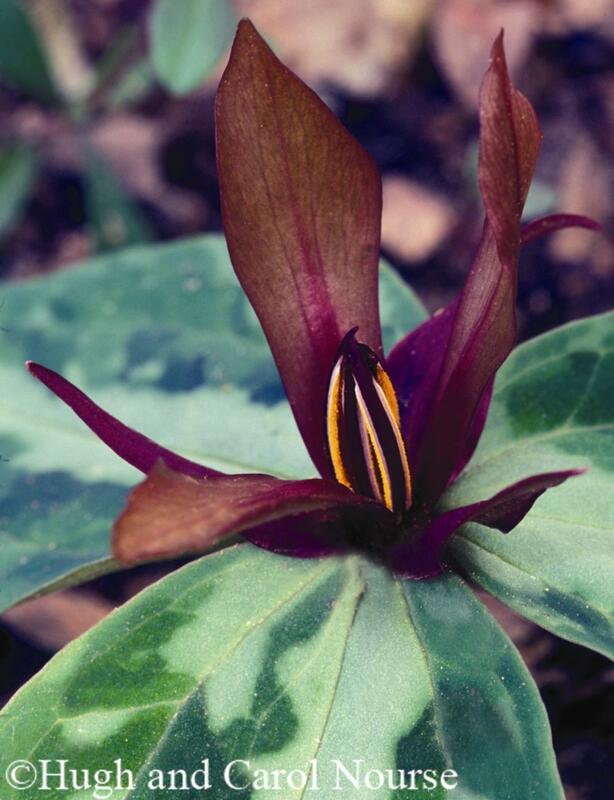
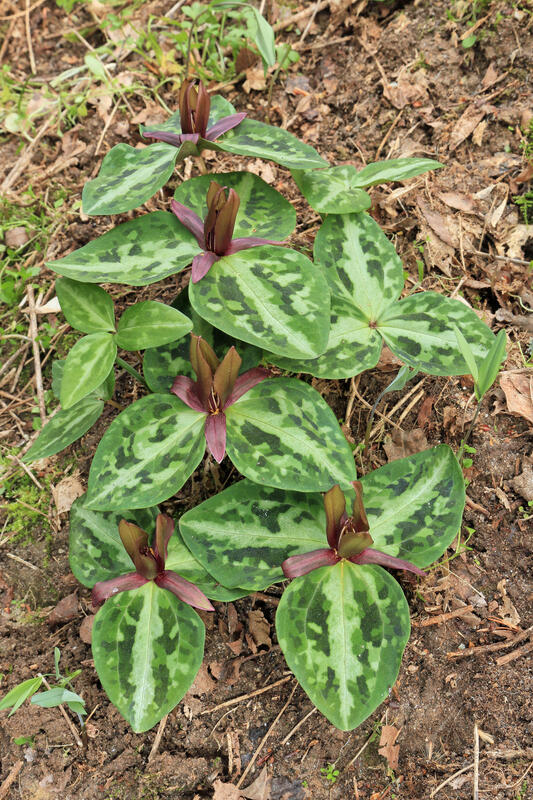
Perennial herb with 1 or 2 hairless stems that are 2.4 - 7 inches (6 - 18 cm) long, and curving, leaning, or resting on the ground. Leaves are 3 in number, 2 - 4.7 inches (5 - 12 cm) long and 2.4 - 4 inches (6 - 10 cm) wide, in a whorl at the top of the stem, and mottled with 3 - 5 shades of green; a silvery streak runs along the midvein; leaves of older plants are nearly as wide as long and overlap at the base (note: trillium leaves are called bracts in some treatments). The single, erect flower arising at the center of the whorl of leaves has no flower stalk and reportedly smells of rotten meat. Sepals are 3 in number and green to maroon. Petals are 3 in number, 1 - 2 inches (2.5 - 5.5 cm) long, erect, overlapping at the base, and maroon, green, or bronzy-yellow. Stamens are 6 in number, dark purple, with vertical anthers that open inwardly to release the yellow pollen; the maroon connective tissue between the anthers has a pointed tip. The ovary is greenish-purple, oval, 6-angled, and develops into a fleshy capsule up to 0.4 inch (1 cm) long.
Decumbent Trillium (T. decumbens) leaves also rest on the ground and its flower also smells like rotten meat, but its leaves have blunt tips and are mottled only with silver and one shade of green; its anthers open outwardly and its stem is hairy. It occurs only in northwest Georgia.
Ocmulgee Trillium (T. delicatum) leaves also rest on the ground, its anthers also open inwardly, and its leaves are mottled similarly; its stem is short but straight and erect, and its flower smells of animal manure; it occurs in patches of several plants. For more information, see: https://www.georgiabiodiversity.a2hosted.com/portal/profile?group=plants&es_id=34971
Underwood’s Trillium (T. underwoodii) has an erect stem holding its leaves above the ground, although early in the season the leaf tips may just touch the ground. Also see Mimic Trillium (T. decipiens): https://www.georgiabiodiversity.a2hosted.com/portal/profile?group=plants&es_id=20231
There are at least 22 named species of Trillium in Georgia, 12 of which are rare:
Trillium decipiens (Mimic Trillium) occurs in moist hardwood forests and limesink forests in southwest Georgia. For more information, see: https://www.georgiabiodiversity.org/portal/profile?group=plants&es_id=20231
Trillium delicatum (Ocmulgee Trillium) occurs in central Georgia in moist to wet floodplain forests with high pH soils. For more information, see: https://www.georgiabiodiversity.org/portal/profile?group=plants&es_id=34971
Trillium discolor (Pale Yellow Trillium) occurs in moist hardwood forests only in the Savannah River watershed. For more information, see: https://www.georgiabiodiversity.org/portal/profile?group=plants&es_id=18320
Trillium flexipes (Bent Trillium) occurs in moist hardwood forests over limestone in northwest Georgia. For more information, see: http://beta.floranorthamerica.org/Trillium_flexipes
Trillium lancifolium (Lanceleaf Trillium) occurs in floodplain forests and lower slopes over basic soils in widely scattered locations in Georgia. For more information, see: http://beta.floranorthamerica.org/Trillium_lancifolium
Trillium persistens (Persistent Trillium, Edna's Trillium) occurs in mixed Pine-Hemlock-hardwood forests in ravines or along streams in northeast Georgia, often with rhododendrons or in lowbush blueberry thickets. For more information, see: https://www.georgiabiodiversity.org/portal/profile?group=plants&es_id=19927
Trillium pusillum (Dwarf Trillium) occurs in seasonally wet, red maple-blackgum-oak woods in calcium-rich, clay soils in northwest Georgia. For more information, see: https://www.georgiabiodiversity.org/portal/profile?group=plants&es_id=18756
Trillium reliquum (Relict Trillium) occurs in mature hardwood forests in rich ravines and on stream terraces, over calcium-rich bedrock such as amphibolite or limestone. For more information, see: https://www.georgiabiodiversity.org/portal/profile?group=plants&es_id=17442
Trillium simile (Sweet White Trillium) occurs in Georgia's Blue Ridge mountains in rich coves or slopes over mafic rocks, often in or near seepage. For more information, see: http://beta.floranorthamerica.org/Trillium_simile
Trillium sp. [newly recognized, unnamed species] (Lookout Mountain Toadshade) occurs in rich forests in northwest Georgia, southeast Tennessee, and northeast Alabama; it resembles Trillium ludovicianum.
Trillium sp. [newly recognized, unnamed species] (Amicalola Trillium) occurs in Blue Ridge cove forests in Georgia and South Carolina; it resembles Trillium simile.
Trillium sulcatum (Barksdale Trillium) occurs in rich, moist hardwood forests in northwest Georgia. For more information, see: http://beta.floranorthamerica.org/Trillium_sulcatum
Mature hardwood forests in rich ravines and on stream terraces; over calcium-rich bedrock such as amphibolite or limestone.
Trilliums are perennial herbs that send up stems, leaves, and flowers in early spring, after temperatures have risen but before the forest canopy has leafed out. After flowering and fruiting, the aboveground plant disappears, persisting through the late summer, fall, and winter as an underground rhizome. Seeds shed in the summer germinate the following spring and, within a year or two, send up a single, spatula-shaped seed leaf (cotyledon) for one year’s growing season. The next year, a true leaf is produced and, in subsequent years, three-leaved plants appear. After 5 - 7 years (possibly fewer in the Coastal Plain), the plant produces a flowering stalk.
Trillium seeds have small, fat-rich appendages called elaiosomes that are appealing to ants, yellow jackets, and other wasps, which carry the seed back to their nests, inadvertently dispersing the trillium seeds. Seeds are dispersed longer distances when the fruits are eaten by other animals such as deer and woodchucks.
Mature trillium plants are very long-lived, perhaps living hundreds of years, since the rhizome continues to lengthen and produce shoots on one end, while the other end decays.
Surveys are best conducted during flowering (mid-March–April) when the plants are most conspicuous, but the low, curved stem and heavily mottled leaves are diagnostic both earlier and later in the growing season.
Georgia, Alabama, and South Carolina.
Logging and clearing of hardwood slope forests, competition from exotic pest plants especially Japanese Honeysuckle (Lonicera japonica) and Kudzu (Pueraria montana), browsing by deer, feral hog rooting, and habitat destruction for residential and commercial development.
| Threat 1 | Threat 2 | Threat 3 | |
|---|---|---|---|
| General Threat | Residential & commercial development | Agriculture & aquaculture | None |
| Specific Threat | None | None | None |
Trillium reliquum is ranked S3 by the Georgia Department of Natural Resources, indicating that it is vulnerable to extirpation in Georgia. It is listed as Endangered by both the State of Georgia and the U.S. Fish and Wildlife Service. About 60 populations have been documented in Georgia, 26 of these confirmed since 2000. Only seven occur on conservation lands.
Protect mature hardwood slope forests from logging, clearing, and developments. Eradicate exotic pest plants, especially Japanese Honeysuckle and Kudzu. Reduce the size of Georgia’s deer population. Eradicate feral hogs.
Broyles, B.B., S.M. Smith, T.R. Smith, and J.R. Kindt. 2013. A reevaluation of the use of rhizome scars to age plants of Trillium erectum (Melanthiaceae). American Journal of Botany 100(6): 1155-1161.
Case, F.W., Jr. 2003. Trillium reliquum species account. Flora of North America, Vol. 26. Oxford University Press, New York. http://beta.floranorthamerica.org/Trillium_reliquum
Caspary, M. 2016. Assessing conserved populations of the rare Relict Trillium (Trillium reliquum). Natural Areas Journal 36(1): 59-67. https://www.researchgate.net/publication/291357569_Assessing_Conserved_Populations_of_the_Rare_Relict_Trillium_Trillium_reliquum
Chafin, L.G. 2007. Field guide to the rare plants of Georgia. State Botanical Garden of Georgia and University of Georgia Press, Athens.
Farmer, S.B. 2006. Trillium and the Trillium family (Trilliaceae). http://www.goldsword.com/sfarmer/Trillium
Farmer, S.B. and E.E. Schilling. 2002. Phylogenetic analyses of Trilliaceae based on morphological and molecular data. Systematic Botany 27: 674-692. https://bioone.org/journals/Systematic-Botany/volume-27/issue-4/0363-6445-27.4.674/Phylogenetic-Analyses-of-Trilliaceae-based-on-Morphological-and-Molecular-Data/10.1043/0363-6445-27.4.674.full
Folkerts, D.R., J.D. Freeman, and G.W. Folkerts. 1987. Insect visitors to the flowers of the rare plant Trillium reliquum Freeman (Liliaceae). Journal of the Alabama Academy of Science 58(3): 84.
Freeman, John D. 1975. Revision of Trillium subgenus Phyllantherum (Liliaceae). Brittonia 27(1): 1-26. https://www.jstor.org/stable/2805646?seq=1#metadata_info_tab_contents
GADNR. 2020. Element occurrence records for Trillium reliquum. Georgia Department of Natural Resources, Wildlife Resources Division, Social Circle, Georgia.
Gonzales, E. and J.L. Hamrick. 2005. Distribution of genetic diversity among disjunct populations of the rare forest understory herb, Trillium reliquum. Heredity 95: 306-314. https://www.nature.com/articles/6800719
Heckel, C.D. 2004. Impacts of exotic invasive vines on the ecology and reproduction of the endangered Trillium reliquum. M.S. Thesis, Georgia Southern University, Statesboro. https://digitalcommons.georgiasouthern.edu/etd/692/
Leege, L. M., J. S. Thompson, and D.J. Parris. 2010. The responses of rare and common trilliums (Trillium reliquum, T. cuneatum, and T. maculatum) to deer herbivory and invasive honeysuckle removal. Castanea 75(4): 433-443. https://bioone.org/journals/Castanea/volume-75/issue-4/09-048.1/The-Responses-of-Rare-and-Common-Trilliums-span-classgenus-speciesTrillium/10.2179/09-048.1.short
NatureServe. 2020. Trillium reliquum species account. NatureServe Explorer. Arlington, Virginia. https://explorer.natureserve.org/Taxon/ELEMENT_GLOBAL.2.159345/Trillium_reliquum
Ohara, M. 1989. Life history evolution in the genus Trillium. Plant Species Biology 4:1-28. https://esj-journals.onlinelibrary.wiley.com/doi/epdf/10.1111/j.1442-1984.1989.tb00044.x
Patrick, T.S. 2007. Trilliums of Georgia. Tipularia, Journal of the Georgia Botanical Society 22: 3 - 22.
Patrick, T.S., J.R. Allison, and G.A. Krakow. 1995. Protected plants of Georgia. Georgia Department of Natural Resources, Wildlife Resources Division, Social Circle, Georgia.
Thompson, J. 2007. Impacts of white-tailed deer and honeysuckle on the endangered Trillium reliquum and its associated plant community. M.S. Thesis, Georgia Southern University, Statesboro. https://digitalcommons.georgiasouthern.edu/etd/695/
USFWS. 2020. Relict Trillium (Trillium reliquum) species profile and related documents. U.S. Fish and Wildlife Service, Atlanta, Georgia. https://ecos.fws.gov/ecp0/profile/speciesProfile?spcode=Q2RG
Waddell, M. 2006. Reproductive biology of Relict Trillium (Trillium reliquum). M.S. Thesis, Auburn University, Auburn, Alabama. http://etd.auburn.edu/handle/10415/331
Vellend, M., J. Myers, S. Gardescu, and P. Marks. 2003. Dispersal of Trillium seeds by deer: implications for long-distance migration of forest herbs. Ecology 84(4):1067-1072. https://esajournals.onlinelibrary.wiley.com/doi/full/10.1890/0012-9658%282003%29084%5B1067%3ADOTSBD%5D2.0.CO%3B2
Weakley, A.S. 2015. Flora of the southern and mid-Atlantic States. University of North Carolina Herbarium, University of North Carolina, Chapel Hill. http://www.herbarium.unc.edu/flora.htm
Zettler, J. A., T. P. Spira, and A. A. Craig. 2001. Yellow Jackets (Vespula spp.) disperse Trillium spp. seeds in Eastern North America. American Midland Naturalist 146(2): 444-446. https://bioone.org/journals/The-American-Midland-Naturalist/volume-146/issue-2/0003-0031(2001)146[0444: YJVSDT]2.0.CO;2/Yellow-Jackets-Vespula-spp-Disperse-Trillium-spp-Seeds-in-Eastern/10.1674/0003-0031(2001)146[0444:YJVSDT]2.0.CO;2.full
Linda G. Chafin
L. Chafin, Jan. 2009: original account
K. Owers, Feb. 2010: added pictures
L. Chafin, Jun. 2020: updated original account.