

Loading profile. Please wait . . .
Hypericum erythreae (Spach) Steudel
Georgia St. John's-wort




Federal Protection: No US federal protection
State Protection: No Georgia state protection
Global Rank: G2
State Rank: S2
Element Locations Tracked in Biotics: Yes
SWAP 2015 Species of Greatest Conservation Need (SGCN): Yes
SWAP 2025 Species of Greatest Conservation Need (SGCN): Yes
2025 SGCN Priority Tier: Highest Conservation Concern
Element Occurrences (EOs) in Georgia: 14
Habitat Summary for element in Georgia: Pitcherplant bogs
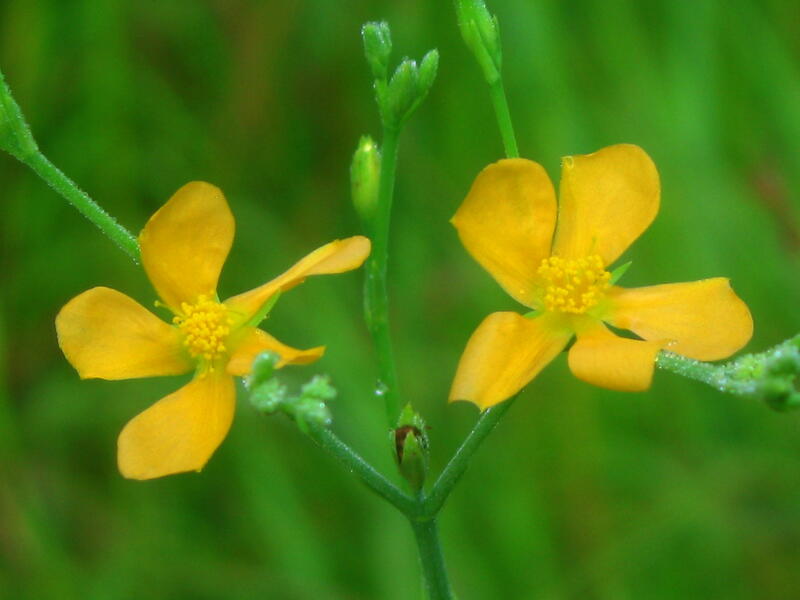
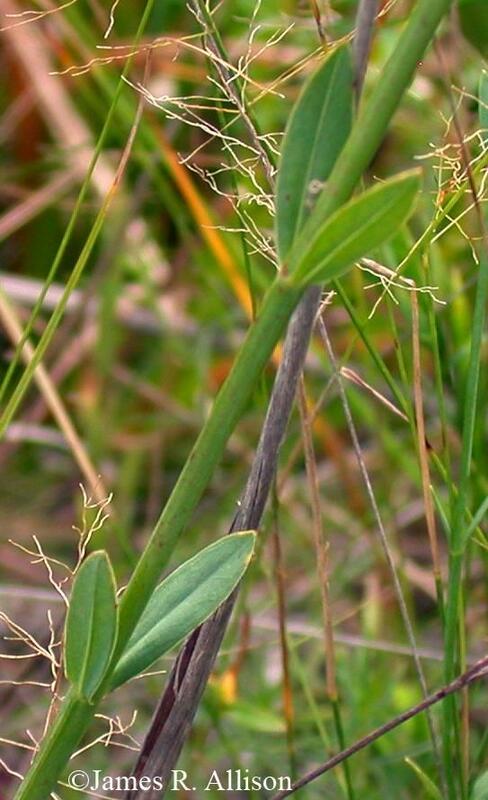
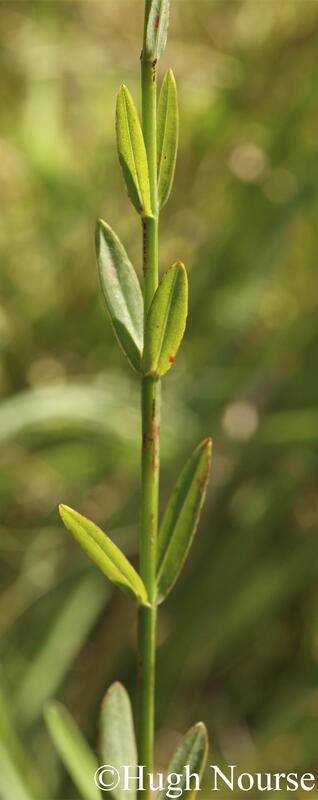
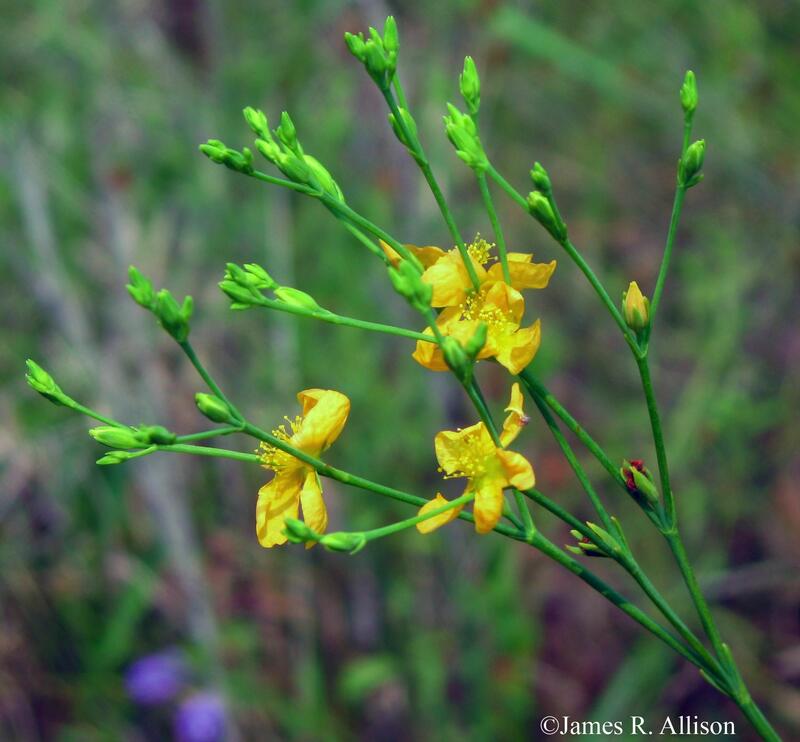
Perennial herb 15 - 46 inches (38 - 116 cm) tall. Stems one to several, erect, winged, four-sided, bluish green, with shredding reddish-brown bark near the base and spongy tissue at the base, usually unbranched except in the flower cluster. Leaves are about 0.2 - 0.8 inch (0.5 - 2 cm) long and 0.2 - 0.6 inch (0.5 - 1.5 cm) wide, mostly 4 - 6 times longer than wide, becoming smaller upward along the stem, opposite, bluish green, oval to lance-shaped, with pointed tips, a conspicuous midvein and no leaf stalk, angled upwards and held closely to the stem; the leaf margins are not inrolled, and glandular dots are few and inconspicuous (except when dried, when they are conspicuous on the lower leaf surfaces). The flower cluster, held at the top of the stem, has numerous forking branches with few or no leaves. Flowers are 0.4 - 0.8 inch (1 - 2 cm) wide with 5 dark yellow, asymmetrical petals, each with wavy margins and a single large tooth near the tip; there are 50 - 80 yellow stamens, a yellow ovary with 3 separate styles, and 5 green, lance-shaped sepals about 0.2 inch (3.5 - 4.5 mm) long that surround the underside of the flower. Fruits are oval, dark brown capsules about 0.1 inch (3 - 4.5 mm) long (not including the persistent styles that form a short beak on the fruit).
Georgia St. John’s-wort resembles several other herbaceous species of St. John’s-wort that occur in Georgia's Coastal Plain wetlands; it is distinguished by the combination of these traits: height (usually 2 - 3 feet tall), spongy tissue at the base of the stem, leaves held close to the stem, pointed leaf tips, few and inconspicuous translucent glands on the leaves, and by the large number of stamens per flower.
Hypericum adpressum (Bog St. John's-wort ) occurs in open, shallow depression ponds, marshes, bogs, and sunny edges of cypress ponds in the Coastal Plain. For more information, see: https://www.georgiabiodiversity.org/portal/profile?group=plants&es_id=18837
Hypericum buckleii (Blue Ridge St. John’s-wort) occurs in rocky crevices on high elevation rock outcrops in Georgia’s Blue Ridge. For more information, see: https://www.georgiabiodiversity.org/portal/profile?group=plants&es_id=21435
Hypericum denticulatum (St. John’s-wort) occurs in bogs, seeps, and moist pine savannas in Georgia’s southeast Coastal Plain. For more information, see: http://www.efloras.org/florataxon.aspx?flora_id=1&taxon_id=250100871
Hypericum dolabriforme (Glade St. John’s-wort) occurs in limestone glades and woodlands in northwest Georgia. For more information, see: http://www.efloras.org/florataxon.aspx?flora_id=1&taxon_id=250100863
Hypericum sphaerocarpum (Barrens St. John’s-wort) occurs in limestone glades and Coosa Valley prairies in northwest Georgia. For more information, see: https://www.illinoiswildflowers.info/prairie/plantx/rf_stjohnwortx.htm
Pitcherplant bogs, wet savannas, open roadside ditches and powerline rights-of-way through these habitats, and other poorly drained but not continuously inundated habitats in the Coastal Plain.
Georgia St. John’s-wort is a perennial herb that reproduces sexually. No studies of its reproductive biology have been published, but its flowers are likely pollinated by bees that are attracted to its showy flowers and abundant pollen since, like most members of this genus, bog St. John’s-wort probably does not produce nectar. It is self-incompatible and depends on insect visitors to effect cross-pollination in order to produce fruit.
Surveys are best conducted during flowering, July–September.
Georgia St. John’s-wort is nearly endemic to Georgia; it occurs in the Coastal Plain of southeastern Georgia and, historically, the southern Coastal Plain of South Carolina.
Conversion of habitat to pine plantations, pastures, and developments. Ditching and draining of bogs and savannas. Fire suppression and competition from trees and shrubs.
| Threat 1 | Threat 2 | Threat 3 | |
|---|---|---|---|
| General Threat | Transportation & Service Corridors | Agriculture & aquaculture | Natural system modifications |
| Specific Threat | None | None | None |
Hypericum erythraeae is ranked S2 by the Georgia Department of Natural Resources, indicating that the species is imperiled in Georgia. Seventeen populations of Georgia St. John’s-wort have been documented in Georgia, eleven since 2000, none on conservation land.
Protect bogs and savannas from clearcutting, development, and ditching, draining, and filling. Apply prescribed fire every 2 - 3 years during the growing season.
Allison, J.R. 2011. Synopsis of the Hypericum denticulatum complex (Hypericaceae). Castanea 76(1): 99-115. https://www.jstor.org/stable/pdf/41301584.pdf?ab_segments=0%252Fbasic_SYC-5055%252Ftest&refreqid=excelsior%3A5c13dd4075bbc3e8d6afa25099ee93c4
Allison, J.R. 2011. The Hypericum denticulatum complex: images. http://www.jimbotany.com/Hypericum/
Chafin, L.G. 2007. Field guide to the rare plants of Georgia. State Botanical Garden of Georgia and University of Georgia Press, Athens.
NatureServe. 2019. Hypericum erythraeae comprehensive report. NatureServe Explorer. Arlington, Virginia. http://explorer.natureserve.org/servlet/NatureServe?searchName=Hypericum+erythraeae
Robson, N.K.B. 2015. Hypericum erythraeae species account. Flora of North America, Vol. 6. Oxford University Press. http://www.efloras.org/florataxon.aspx?flora_id=1&taxon_id=242416675
Weakley, A.S. 2015. Flora of the southern and mid-Atlantic States. University of North Carolina Herbarium, University of North Carolina, Chapel Hill. http://www.herbarium.unc.edu/flora.htm
Linda G. Chafin
L. Chafin, Jan. 2009: original account
K. Owers, Feb. 2010: added pictures
L. Chafin, Feb 2020: updated original account.