Loading profile. Please wait . . .
Sapindus marginatus Willd.
Florida Soapberry




Federal Protection: No US federal protection
State Protection: Rare
Global Rank: G5
State Rank: S1S2
Element Locations Tracked in Biotics: Yes
SWAP 2015 Species of Greatest Conservation Need (SGCN): Yes
SWAP 2025 Species of Greatest Conservation Need (SGCN): Yes
2025 SGCN Priority Tier: High Conservation Concern
Element Occurrences (EOs) in Georgia: 8
Habitat Summary for element in Georgia: Coastal shell mounds
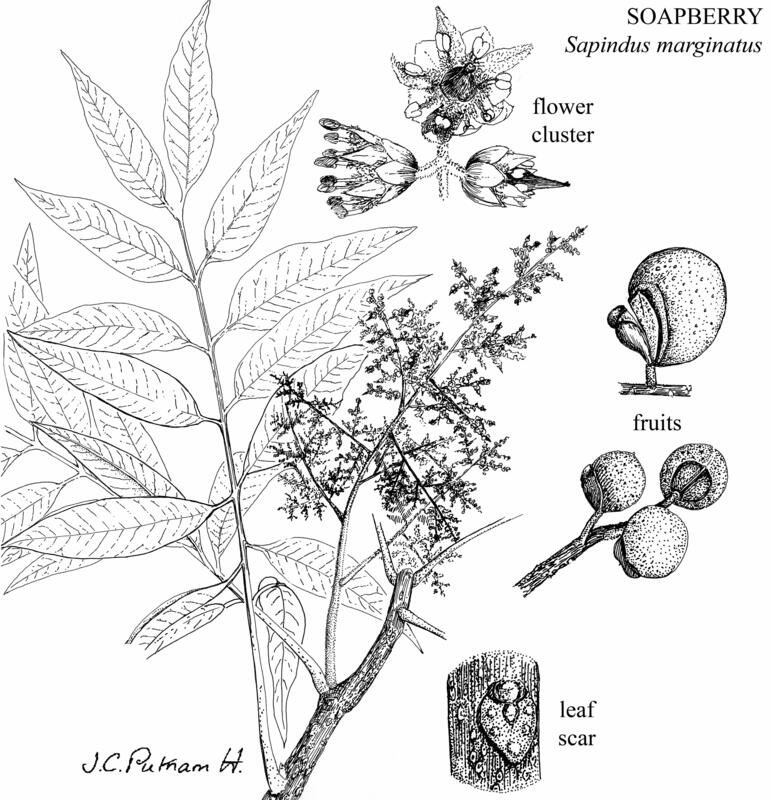
Small tree or large shrub usually less than 30 feet (10 meters) tall. Twigs of the season are green and hairless and marked with long, narrow lenticels; older twigs are brown with corky brown lenticels. The bark on mature branches is pale gray or brown, warty, and sloughing off in large scales. Leaves are deciduous, compound, up to 1 foot (32 cm) long (including the leaf stalk), alternate, with 6 - 13 leaflets; the leaf stalk between the leaflets (i.e. the rachis) lacks wings. Leaflets are 2 - 6 inches (5 - 15 cm) long and 0.8 - 2.8 inches (2 - 7 cm) wide, lance-shaped with pointed tips, with entire margins; the leaflets may be opposite or alternate along the stalk; the leaves fall in the early spring. Flower clusters are up to 7 inches (18 cm) long, with both female and male flowers in the same cluster, with the male flowers opening first. Flowers are tiny, bell-shaped, with 5 pale yellow petals. Fruits are about 0.8 inches (2 cm) long, oval but lopsided, golden-brown, leathery, wrinkled, and hard, with a large, black, poisonous seed.
The closely related Tropical Soapberry (Sapindus saponaria) is not native to Georgia, but may escape from cultivation. It has narrow wings on the rachis between the leaflets; the leaflets have blunt or rounded tips, and its fruits are round. Some botanists consider Sapindus marginatus and Sapindus saponaria be the same species.
None in Georgia.
Coastal shell mounds and maritime hardwood hammocks, often near the edge of salt marshes, with Live Oak, Red Cedar, Red Bay, Pignut Hickory, and Yaupon.
Sapindus marginatus reproduces sexually by seed. Its flowers are usually unisexual, though some may be bisexual. Individual trees usually produce both female and male flowers, but there is a tendency for flowers of one sex to dominate, making the tree functionally female or male. Although nothing is reported about pollination for Soapberry, most species of Sapindus are heavy nectar producers and are frequently visited by butterflies and bees. The common name “soapberry” refers to the fruits, which contain a natural detergent called saponin and produce lather when crushed; however, the lather is a skin-irritant for some people.
Surveys are best conducted during flowering (summer–early fall) but leaves are distinctive throughout the year except for a brief time in early spring.
Georgia, Florida, and possibly South Carolina. Frequently planted in gardens and yards along the southeastern coast and possibly escaped.
Clearing and development of coastal hammocks and maritime forests.
| Threat 1 | Threat 2 | Threat 3 | |
|---|---|---|---|
| General Threat | Natural system modifications | None | None |
| Specific Threat | Other ecosystem modifications | None | None |
Sapindus marginatus is ranked S1S2 by the Georgia Department of Natural Resources, indicating that it is imperiled in Georgia, and possibly critically imperiled. Eight populations have been documented in Georgia, three since 2000, all on conservation lands.
Protect coastal hammocks and forests from clearcutting and development. Soapberry is probably killed by fire.
Chafin, L.G. 2007. Field guide to the rare plants of Georgia. State Botanical Garden of Georgia and University of Georgia Press, Athens.
GADNR. 2020. Element occurrence records for Sapindus marginatus. Georgia Department of Natural Resources, Wildlife Resources Division, Social Circle, Georgia.
Gilman, E. F. and D. G. Watson. 2011. Sapindus saponaria: Florida Soapberry. Publication ENH-740. University of Florida Cooperative Extension Service, I.F.A.S. Gainesville. https://edis.ifas.ufl.edu/st582
Godfrey, R.K. 1988. Trees, shrubs, and woody vines of northern Florida and adjacent Georgia and Alabama. University of Georgia Press, Athens.
Hodel, D.R. 2012. Trees in the landscape, Part 6: Sapindus saponaria. Western Arborist, Winter 2012: 38-47. University of California, Division of Agriculture and Natural Resources. https://ucanr.edu/sites/HodelPalmsTrees/files/186125.pdf
Kirkman, L.K., C.L. Brown, and D.J. Leopold. 2007. Native trees of the southeast. Timber Press, Portland, Oregon.
Lance, R. 2004. Woody plants of the southeastern United States: a winter guide. University of Georgia Press, Athens.
NatureServe. 2020. Species account for Sapindus marginatus. NatureServe Explorer. NatureServe, Arlington, Virginia.
Nelson, G. 1996. Shrubs and woody vines of Florida. Pineapple Press, Sarasota, Florida.
Tomlinson, P.B. 1980. Biology of trees native to tropical Florida. Harvard University Printing Office, Allston, Massachusetts.
Weakley, A.S. 2015. Flora of the southern and mid-Atlantic States. University of North Carolina Herbarium, University of North Carolina, Chapel Hill. http://www.herbarium.unc.edu/flora.htm
Linda G. Chafin
L.Chafin, Aug. 2008: original account
D.Weiler, Feb. 2010: added pictures
L. Chafin, May 2020: updated original account.