


Loading profile. Please wait . . .
Egretta tricolor (Müller, 1776)
Tricolored Heron




Federal Protection: No US federal protection
State Protection: No Georgia state protection
Global Rank: G5
State Rank: S3
Element Locations Tracked in Biotics: Yes
SWAP 2015 Species of Greatest Conservation Need (SGCN): Yes
SWAP 2025 Species of Greatest Conservation Need (SGCN): Yes
2025 SGCN Priority Tier: High Conservation Concern
Element Occurrences (EOs) in Georgia: 0
Habitat Summary for element in Georgia: Nests in colonies (often with other wading bird species) in wetlands and on isolated islands. Feeds in shallow wetlands, creeks and rivers.
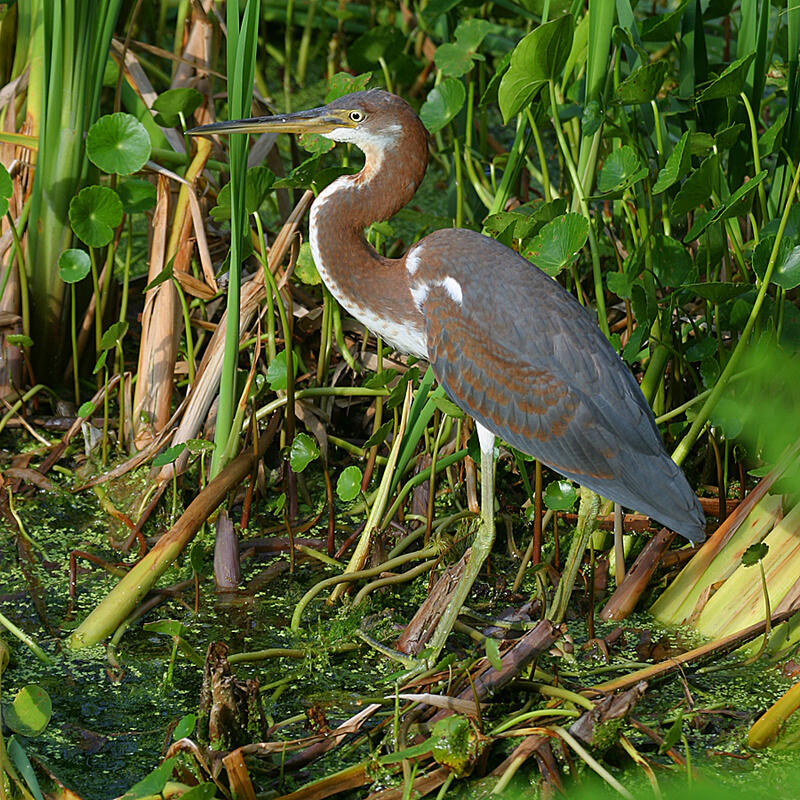
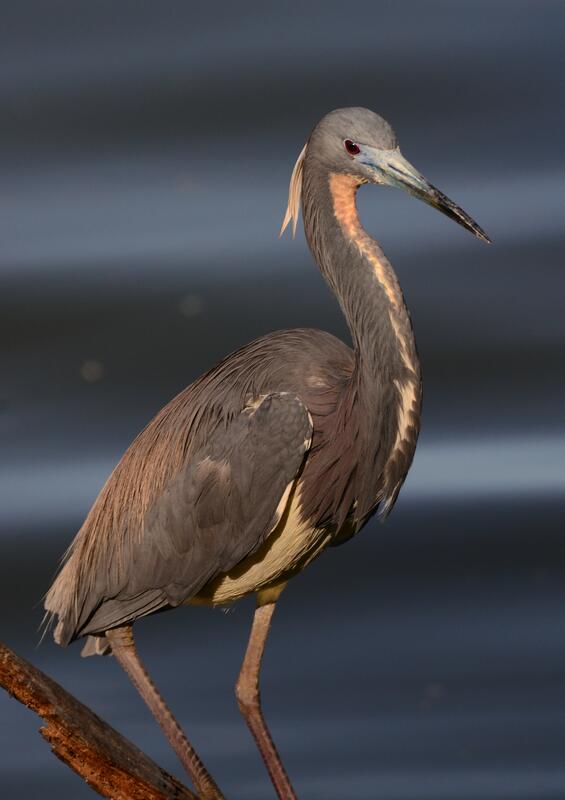
Previously known as the Louisiana heron, this species is a medium-sized day heron with distinct three-colored plumage. Adults are mostly blue-gray above with a white belly. The front of the neck is white with some rusty striping and the sides are blue-gray to lavender. Breeding plumage features small white plumes extending from the back of the head, bright blue bill and facial skin, and pinkish legs. Immatures have a chestnut hindneck and wing coverts giving them a rusty appearance. Overall shape is very slender and long-necked with a long bill. Tricolors are 60-70 cm (24-28 in) in length with a 95 cm (37 in) wingspan and weigh about 415 g (15 oz).
The little blue heron (Egretta caerulea), which is blue to bluish purple on both upper and underparts is the most similar in size and color. However, the tricolored heron can easily be distinguished from this bird and all other dark-backed herons and egrets found in North America by its white underside. The tricolored heron is also longer in all dimensions than the little blue heron, with longer legs, and very long neck and bill, giving it a distinctly lankier appearance. It is typically a much more active feeder than the little blue heron as well, who spends most of its time standing still in a hunched over position with neck extended.
Utilizes mostly brackish to saltwater coastal estuaries, saltmarshes, mangroves, and lagoons for feeding, but will also use freshwater wetlands. Nesting habitat usually consists of shrubby vegetation on islands surrounded by estuarine wetland complexes, but it also nests in inland freshwater wetlands.
The main prey items of the tricolored heron are small fishes, particularly killifishes in saltwater environments and topminnows in freshwater habitats. In fact, fish make up about 90% of their diet in the Southeastern United States. Grasshoppers, cutworms, spiders, weevils, beetles, dragonflies, giant water bugs, crayfish, frogs, and lizards are also occasionally eaten.
The tricolored heron typically breeds with other wading birds in large multi-species colonies, generally near the edge of the colony. The nest is constructed out of sticks and built in shrubs or small trees such as buttonbush, willows, or live oaks. Clutch size is three to five eggs. Eggs are pale bluish green and hatch in 22-23 days. Both sexes engage in incubation. Chicks may climb out of the nest at 21 days and achieve independence at 51-56 days. Only one clutch per year is attempted, except in cases where the first clutch is destroyed a renesting attempt is often made. This species is more solitary than other day herons and egrets and to a great extent dependent on coastal environments with its main prey being small estuarine fishes that it captures in shallow brackish and salt water. A variety of hunting methods are used including stand-and-wait, walking slowly, running pursuit, loping chases with flapping wings and lunging strikes, and pirouetting. Generally foraging techniques used by this species are more active than those of most other egrets and herons.
This bird is difficult to survey from the air due to its dark plumage, which makes it less visible, and the placement of its nest low in vegetation. Wading bird surveys, particularly for wood storks (Mycteria americana), have been used to monitor tricolored numbers when encountered, but these surveys are likely missing several colonies due to their limited scope. Colony counts from the ground are needed to accurately determine population numbers, trends, nest success and productivity.
The tricolored heron is an uncommon breeder in coastal New England, a regular breeder in the mid-Atlantic, and a year-round resident along the Southeastern Atlantic Coast, in peninsular Florida, along the Gulf Coast to northeastern Mexico, and sporadically in the Yucatan peninsula. Resident populations also occur along much of the Pacific Coast of Mexico and Central America, along the northern coast of South America, and in the Caribbean.
Historically this bird was a common nesting species along the Georgia coast primarily on the islands and coastal rivers. It had never been found nesting inland until 1981 when an active nest was recorded in Turner County in a colony of cattle egrets and white ibis. During the Breeding Bird Atlas (1994-2001), the tricolored was recorded nesting at 17 sites in Chatham, Liberty, McIntosh, Glynn, and Camden counties along the coast and at one inland site in Brooks County, where only a single nest was mixed in with several hundred nests of other wading bird species.
Primary conservation concerns for tricolored herons are similar to those of other wading birds. Habitat loss and degradation are the two greatest threats, particularly from coastal development. Environmental contaminants, mainly mercury, PCBs, and toxaphene are possible threats. Given their primarily coastal distribution and extensive use of salt marsh for foraging, they may be particularly susceptible to rising sea levels which could reduce foraging and breeding habitat. Human disturbance at colony sites is also an issue, especially where colonies occur near areas used for recreational activities such as boating. Predation at colonies can be high and mammalian predators such as raccoons may cause complete colony failure and subsequent abandonment of the colony site. Exotic fire ants may kill young birds as they emerge from the egg, particularly in areas where nests are near the ground.
| Threat 1 | Threat 2 | Threat 3 | |
|---|---|---|---|
| General Threat | Climate change & severe weather | Residential & commercial development | Human intrusions & disturbance |
| Specific Threat | Habitat shifting & alteration | Housing & urban areas | Recreational activities |
May be viewed at most protected sites with extensive wetlands along the coast. Harris Neck is likely the best publically accessible colony to observe this species, but this bird can typically be found easily in coastal saltmarshes.
Breeding Bird Survey (BBS) data suggest that tricolored heron numbers declined by 0.4% per year from 1966-2015 across its U. S. breeding range. However, it appears that more recently (2005-2015) there was a slight resurgence in numbers with a 0.5% annual increase. Unfortunately, the BBS does not adequately track this species in Georgia due to its very localized distribution and life history. Due to historic population losses, a significant long-term declining trend, and continued loss and degradation of wetland habitat this species has been categorized as a Regional Stewardship species in the Southeast U. S. Waterbird Conservation Plan. Protecting and maintaining wetland nesting and feeding habitats and preventing human disturbance of colony sites are the most important conservation actions. Control of raccoons might become necessary at some sites if high predation rates lead to colony failure.
Frederick, P. C. 2013. Tricolored Heron (Egretta tricolor), version 2.0. In The Birds of North America (A. F. Poole, Editor). Cornell Lab of Ornithology, Ithaca, NY, USA.
Hopkins, M., Jr. 1981. Louisiana Heron breeding in Turner County. Oriole 46:15-16.
https://www.allaboutbirds.org/guide/Tricolored_Heron
https://www.audubon.org/field-guide/bird/tricolored-heron
Melvin, S. L. 2010. Tricolored Heron (Egretta tricolor). Pp. 100-101 in T. M. Schneider, G. Beaton, T. S. Keyes, and N. A. Klaus, eds. The Breeding Bird Atlas of Georgia. University of Georgia Press, Athens.
Sauer, J. R., D. K. Niven, J. E. Hines, D. J. Ziolkowski, Jr., K. L. Pardieck, J. E. Fallon, and W. A. Link (2017). The North American Breeding Bird Survey, Results and Analysis 1966–2015. Version 2.07.2017. U.S.G.S. Patuxent Wildlife Research Center, Laurel, MD, USA.
Sibley, D. A. 2003. The Sibley Guide to Birds. A. A. Knopf, New York, NY
Schulenberg, T. S. (ed.). 2019. Tricolored Heron (Egretta tricolor) In Neotropical Birds Online. Cornell Lab of Ornithology, Ithaca, NY, USA. https://neotropical.birds.cornell.edu/Species-Account/nb/species/triher
Stefani L. Melvin and Andy Day
S. Melvin, 2010: Breeding Bird Atlas species account
A. Day, November 2019: Modified and edited text.