


Loading profile. Please wait . . .
Plantago sparsiflora Michx.
Pineland Plantain




Federal Protection: No US federal protection
State Protection: No Georgia state protection
Global Rank: G3
State Rank: S2
Element Locations Tracked in Biotics: Yes
SWAP 2015 Species of Greatest Conservation Need (SGCN): Yes
SWAP 2025 Species of Greatest Conservation Need (SGCN): Yes
2025 SGCN Priority Tier: High Conservation Concern
Element Occurrences (EOs) in Georgia: 23
Habitat Summary for element in Georgia: Open, wet pine savannas; shallow ditches and seeps, especially in mowed rights-of-way
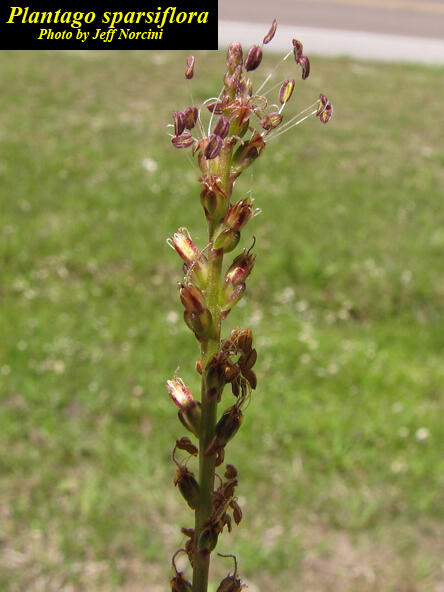
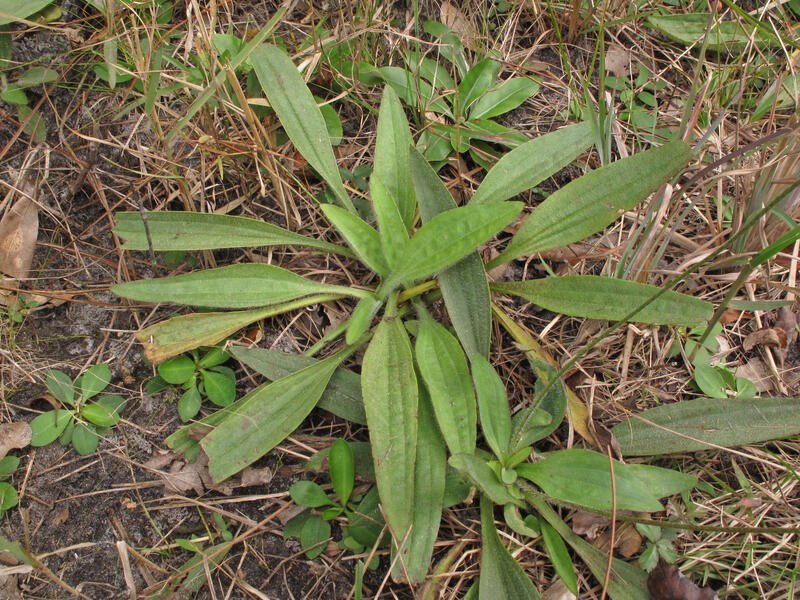
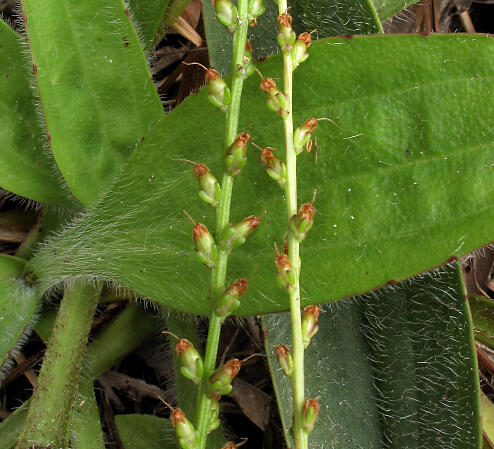
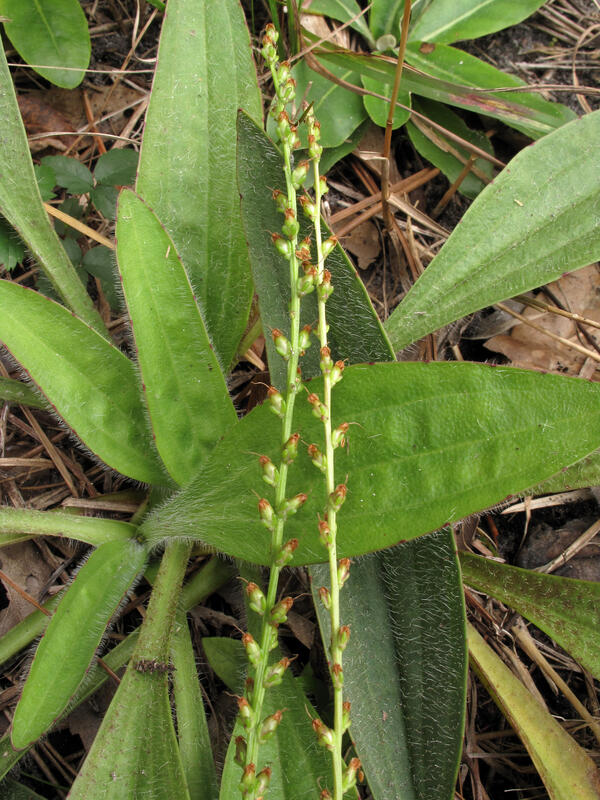
Perennial herb with a basal rosette of elongated, lance-shaped leaves, 3 - 8 inches (8 - 20 cm) long and 0.4 - 1.5 inches (1 - 4 cm) wide, the blade with parallel veins, entire margins, and many scattered hairs on both surfaces, and tapering to winged leaf stalks. One to several flower spikes 8 - 16 inches (20 - 40 cm) tall rise from the center of the leaf rosette, bearing many small, widely spaced flowers; the flowering stem is visible between the flowers. The corolla is 4-lobed, reddish-green, and attached to the top of an oval, green ovary that is surrounded at the base by a fleshy, green, hairless, 4-lobed calyx and 2 tiny, triangular bracts; the feathery stigma and 4 long stamens extend well beyond the corolla in mature flowers. Fruits are oval capsules about 0.1 inch (3-3.8 mm) long, each with two purplish-black seeds.
There are nine other species of Plantago in Georgia. Plantago sparsiflora is distinguished by the combination of hairy, elongated, parallel-veined, lance-shaped leaves; a hairless flowering stem with widely scattered flowers; and hairless sepals and bracts.
Plantago cordata (Heart-leaf Plantain) is an aquatic plant that occurs in shallow streams over limestone or slate in northwest Georgia; it is ranked S3, vulnerable. For more information, see: http://beta.floranorthamerica.org/Plantago_cordata AND https://explorer.natureserve.org/Taxon/ELEMENT_GLOBAL.2.155726/Plantago_cordata
In Georgia, Pineland Plantain is known from wet roadside ditches and shoulders, moist pine flatwoods and pine plantations, peaty margins of Pond Cypress ponds, and natural gas line rights-of-way. Elsewhere in its range, it occurs in wet pine savannahs over limestone and disturbed areas in savannas.
Pineland Plantain is a perennial, bisexual herb that reproduces sexually by seed. Although no studies have been conducted on the breeding system of this species, other Plantago species with open (chasmogamous) flowers and strongly exserted long stamens, like Pineland Plantain, have flowers that are cross-pollinated mainly by wind and possibly to a lesser degree by insects. Self-pollination is avoided by protogyny: the stigma of a given flower becomes receptive before that flower’s stamens begin to shed pollen. Most Plantago species produce seeds that become sticky and adhesive when wet, and are dispersed when they adhere to the fur or feather of animals.
Surveys are best conducted during flowering and fruiting, from April to October, when the plants are most conspicuous.
Pineland Plantain occurs from northeast Florida north to North Carolina in the Coastal Plain.
Pineland Plantain is threatened by the conversion of its pine savanna/flatwoods habitat to pine plantations, pasture, and residential and commercial development. Many populations occur along roads and highways and are vulnerable to roadside herbicide spraying, poorly timed right-of-way mowing, and road widening projects.
| Threat 1 | Threat 2 | Threat 3 | |
|---|---|---|---|
| General Threat | Agriculture & aquaculture | Energy production & mining | Transportation & service corridors |
| Specific Threat | None | None | None |
Plantago sparsiflora is ranked S1 by the Georgia Department of Natural Resources, indicating that it is critically imperiled in the state. Twenty-three populations have been documented in Georgia, but only 8 have been observed in this century, and none of these occur on conservation lands.
The natural wet pine savanna and mesic flatwoods habitat where this plant occurs should be burned every 2 - 3 years. Avoid ditching or draining in these habitats. Where Pineland Plantain occurs in human-maintained habitats such as rights-of way, herbicide use should be avoided. Mowing should be carefully timed to take place in early spring before flowering and after seeds have matured in the late fall. Areas that supported populations not seen in decades should be re-surveyed for this species.
GADNR. 2019. Element occurrence records for Plantago sparsiflora. Georgia Department of Natural Resources, Wildlife Resources Division. Social Circle, Georgia.
Les, D.H. 2017. Aquatic dicotyledons of North America: ecology, life history, and systematics. CRC Press, Taylor & Francis, Boca Raton, FL.
NatureServe. 2019. Species account for Plantago sparsiflora. NatureServe Explorer. NatureServe, Arlington, Virginia. Accessed 18 November 2019.https://explorer.natureserve.org/Taxon/ELEMENT_GLOBAL.2.151052/Plantago_sparsiflora
Rosatti, T.J. 1984. The Plantaginaceae in the southeastern United States. Journal of the Arnold Arboretum 65(4): 533-562. https://www.jstor.org/stable/43782150
Shipunov, A. 2019. Plantago sparsiflora species account. Flora of North America, vol. 17. Oxford University Press, New York. http://beta.floranorthamerica.org/Plantago_sparsiflorahttp://www.efloras.org/florataxon.aspx?flora_id=1&taxon_id=242101828
Weakley, A.S. 2015. Flora of the southern and mid-Atlantic States. University of North Carolina Herbarium, University of North Carolina, Chapel Hill. http://www.herbarium.unc.edu/flora.htm
Linda G. Chafin
Linda G. Chafin, 19 November 2019: original account