

Loading profile. Please wait . . .
Viburnum rafinesquianum var. affine (Bush ex Schneid.) House
Limerock Downy Arrowwood




Federal Protection: No US federal protection
State Protection: No Georgia state protection
Global Rank: G5TNR
State Rank: S1
Element Locations Tracked in Biotics: Yes
SWAP 2015 Species of Greatest Conservation Need (SGCN): Yes
SWAP 2025 Species of Greatest Conservation Need (SGCN): No
2025 SGCN Priority Tier:
Element Occurrences (EOs) in Georgia: 2
Habitat Summary for element in Georgia: Limestone bluffs along major rivers
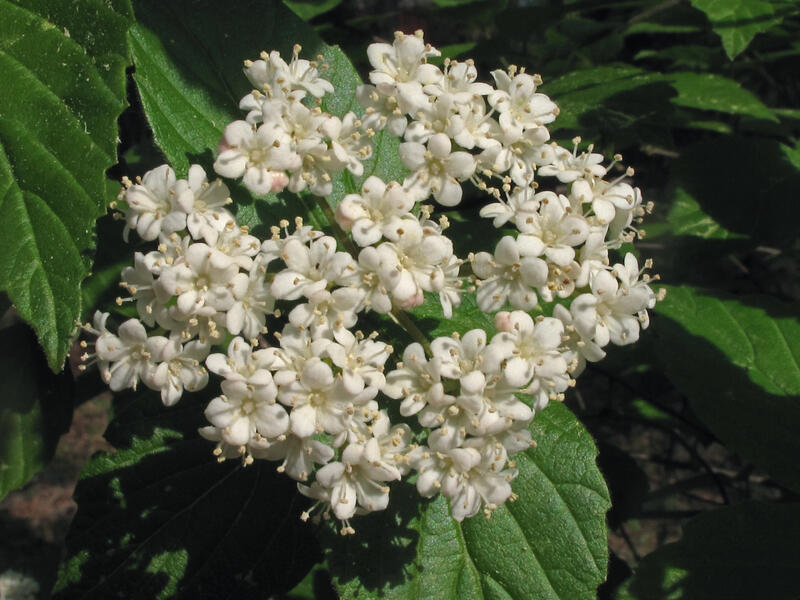
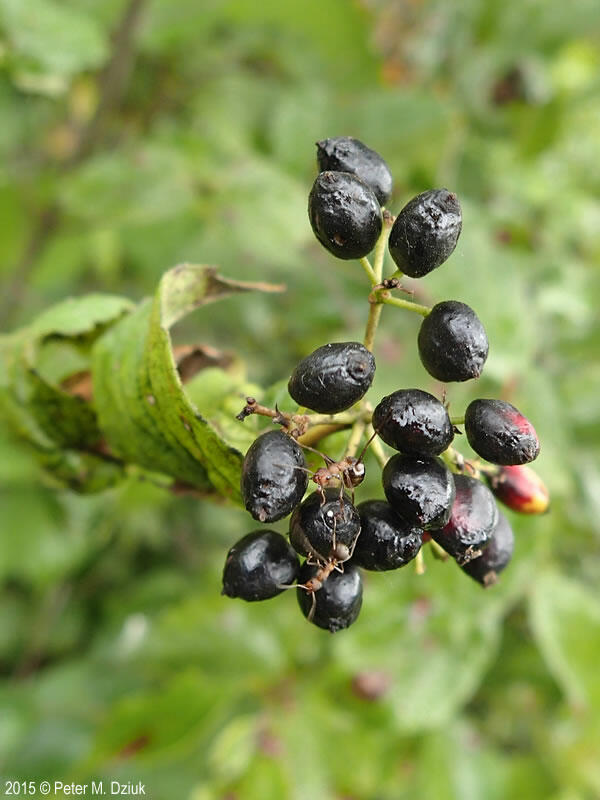
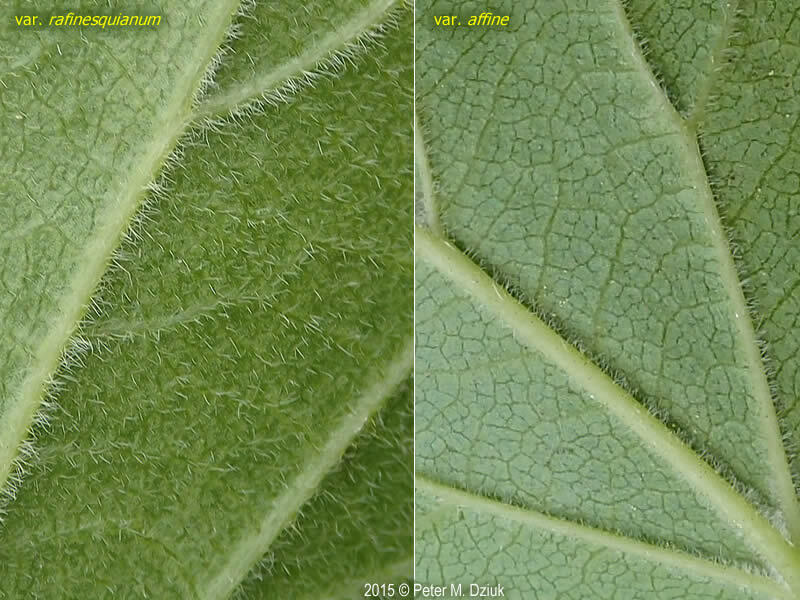
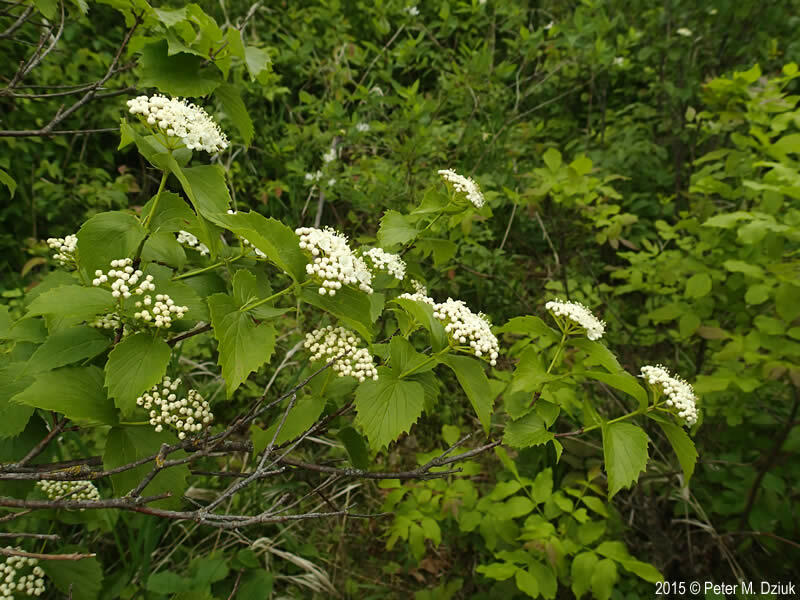
Deciduous shrub up to 10 feet (3 meters) tall at maturity, with one or more straight stems, brownish-gray stems. Winter buds are covered by two or more overlapping scales. Leaves are 1.5-3 inches long and 1-2 inches wide (4-8 cm long and 3-5 cm wide), opposite, oval, with 5-10 low teeth on each side, straight and parallel lateral veins that each end at a tooth, and short stalks (less than 0.25 inch [0.6 cm] long); there are two small, narrow stipules at the base of each leaf stalk. The lower leaf surfaces are hairy throughout (var. rafinesquianum) OR slightly hairy only on the veins (var. affine). Flower clusters are up to 3 inches (7.5 cm) wide with rounded tops and all branches attached at the same point; there are few or no glands or glandular hairs in the flower cluster. Flowers are small (about 0.25 inch or 6 mm wide), white, 5-lobed, foul-smelling, and bisexual flowers with 5 long stamens. Fruits are oval to round, somewhat flattened, juicy, purplish-black, not hairy, about 0.3 inch (8-10 mm) long, each with one seed about 0.25 inch (6 mm) long.
Southern Arrowwood (Viburnum dentatum) occurs in marshes, swamps, and on streambanks in north Georgia. Its leaf stalks are more than 0.4 inch (10 mm) long, the leaves are more coarsely toothed and have branched hairs on the lower surface; it blooms earlier than Downy Arrow-wood, in late March–April.
Carolina Arrow-wood (Viburnum carolinianum) occurs in moist to dry forests, on rock outcrops, and along streams in north Georgia. It flowers in April. Its leaves are nearly round in outline with 13-18 teeth on each side; the lower leaf surface is densely hairy and felt-like, and its fruits are hairy.
Smooth Arrow-wood (Viburnum recognitum) occurs in marshes, moist forests, and on streambanks in north Georgia. It flowers late March–May. Its leaves are up to 4 inches long and 3 inches wide (10 cm long, 7.6 cm wide); the leaf stalks are hairless, and the lower leaf surface is hairless and pale, whitish-green. Its fruits are dark blue.
Limerock Arrow-wood (Viburnum bracteatum) is also similar but its leaves have 5-9 lateral veins on each side of the midvein. See “Related Rare Species” below.
Limerock Arrow-wood (Viburnum bracteatum) occurs in northwest Georgia on limestone bluffs above the Coosa River and on rocky slopes of the Cumberland Plateau. For more information, see: https://georgiabiodiversity.org/portal/profile?group=plants&es_id=19686
Witch-hobble (Viburnum lantanoides) occurs in northern hardwood forests and boulderfields in northeast Georgia mountains. Its leaves are heart-shaped and up to 8 inches (20 cm) long. For more information, see: https://gobotany.nativeplanttrust.org/species/viburnum/lantanoides/
Downy Arrowwood (Viburnum rafinesquianum var. rafinesquianum) occurs on steep, rocky slopes in the western Georgia Piedmont and northwest Georgia. The lower surfaces of its leaves are hairy on the veins and between the veins. Variety affine has hairs only on the veins on the lower leaf surface.
Steep, rocky, dry, limestone- or amphibolite-based slopes in north Georgia.
Limerock Downy Arrowwood is a perennial shrub that reproduces sexually by seed (not by the spread of rhizomes); it has a very low rate of seed set. Its flowers are strongly and pungently scented and attract bees, flies, and beetles, which feed on both pollen and nectar. A variety of insects feed destructively on its leaves, including Viburnum Leaf Beetle and larvae of the Spring Azure. A wide diversity of birds and mammals eat the fruits.
Limerock Downy Arrowwood is ost conspicuous when it flowers mid-April–May. However, many Viburnum species have similar flower clusters and flowers; identification depends on close examination of vegetative traits, especially of the leaves.
Both varieties: Georgia, west to Oklahoma, north to Manitoba, Quebec, and New Hampshire.
Logging, mining, clearing. Plant poaching. Lack of sexual reproduction. The viburnum leaf beetle (Pyrrhalta viburni) is so far found only in the northeastern U.S., but may become a threat if it moves south. The beetles are capable of defoliating a shrub by mid-summer.
Viburnum rafinesquianum is ranked S1 by the Georgia Department of Natural Resources, indicating that it is critically imperiled in the state. Only five populations (of both varieties) have been documented in Georgia; three of these have been observed since 2001 and three occur on conservation lands.
Avoid logging, quarrying, or other mechanical disturbances on limestone bluffs. Safeguard location information and prosecute plant poachers. Research the lack of reproduction. Monitor for presence of Viburnum Leaf Beetle.
Cook, W. 2015. Downy Arrowwood (Viburnum rafinesquianum). Carolina Nature–Trees, Shrubs, and Woody Vines of North Carolina. Accessed 31 December 2019. http://www.carolinanature.com/trees/vira.html
GADNR. 2019. Element occurrence records for Viburnum rafinesquianum var. affine. Georgia Department of Natural Resources, Wildlife Resources Division. Social Circle, Georgia.
GADNR. 2019. Element occurrence records for Viburnum rafinesquianum var. rafinesquianum. Georgia Department of Natural Resources, Wildlife Resources Division. Social Circle, Georgia.
Hilty, J. 2019. Species account for Rafinesque's Arrow-wood, Viburnum rafinesquianum. Illinois Wildflowers. https://www.illinoiswildflowers.info/trees/plants/raf_arrowwood.html
NatureServe. 2019. Species account for Viburnum rafinesquianum. NatureServe Explorer: an online encyclopedia of life, Version 7.1. NatureServe, Arlington, Virginia. Accessed 28 December 2019. http://explorer.natureserve.org/servlet/NatureServe?searchName= Viburnum+rafinesquianum
Weakley, A.S. 2015. Flora of the southern and mid-Atlantic States. University of North Carolina Herbarium, University of North Carolina, Chapel Hill.
Linda G. Chafin
Linda G. Chafin, 1 May 2020: original account.