


Loading profile. Please wait . . .
Asclepias purpurascens L.
Purple Milkweed




Federal Protection: No US federal protection
State Protection: Rare
Global Rank: G4G5
State Rank: S1
Element Locations Tracked in Biotics: Yes
SWAP 2015 Species of Greatest Conservation Need (SGCN): Yes
SWAP 2025 Species of Greatest Conservation Need (SGCN): Yes
2025 SGCN Priority Tier: High Conservation Concern
Element Occurrences (EOs) in Georgia: 8
Habitat Summary for element in Georgia: Calcareous flatwoods, wet meadows near Rome
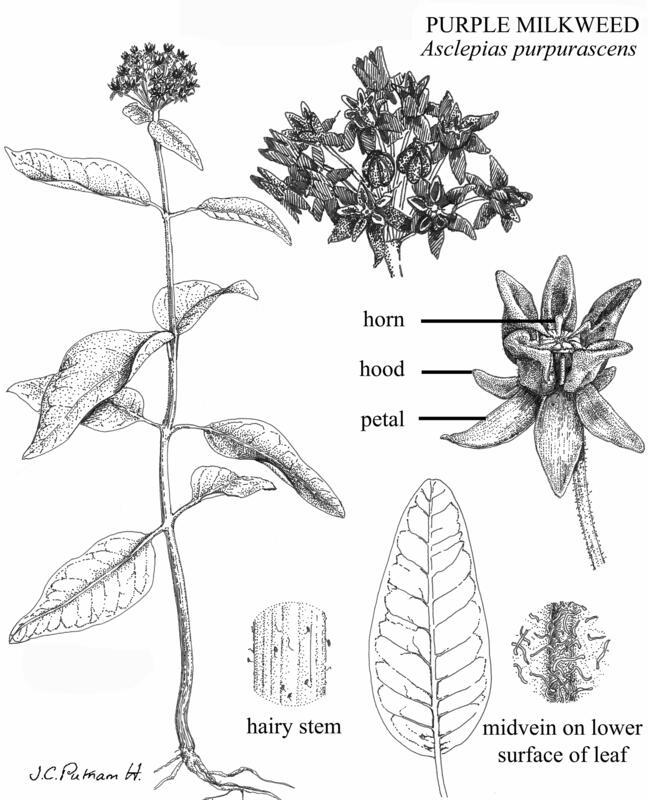
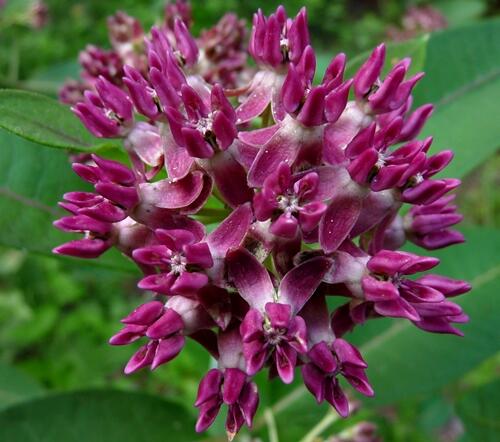
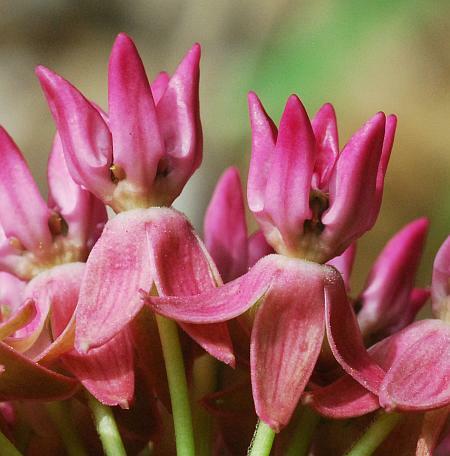
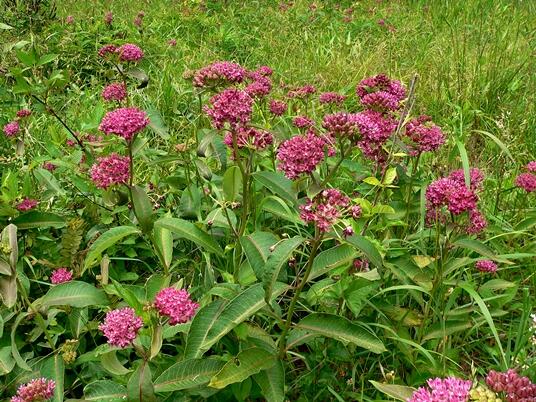
Perennial herb with hairy stems 1.5 - 3.3 feet (50 - 100 cm) tall. Leaves are 4 - 6.3 inches long and 2 - 3.5 inches wide (10 - 16 cm long, 5 - 9 cm wide), opposite, oval to lance-shaped with a pointed tip; the upper leaf surface is dark green and mostly hairless with a red midvein and a conspicuous pattern of pale veins; the lower leaf surface is pale green and hairy. The leaf stalk is 0.2 - 1 inch (0.5 - 2.5 cm) long. Flower clusters are held at the top of the stem. Flowers are 0.3 - 0.4 inch (0.7 - 1 cm) long, rose-purple, with 5 down-curved petals, 5 erect hoods, and 5 sharply pointed horns that are shorter than the hoods and curve sharply inward over the greenish-white column. Fruit is an erect, downy pod 4 - 6 inches (10 - 16 cm) long; fruits are rarely produced. Leaves and stems exude milky latex when cut.
Carolina Milkweed (Asclepias cinerea) and Michaux's Milkweed (A. michauxii) are pink-flowered milkweeds found in the Coastal Plain. Their leaves are very narrow, less than 0.25 inch (6 mm) wide.
Common Milkweed (Asclepias syriaca) also has pink flowers. It is a non-native milkweed that has escaped from cultivation in a few northeast Georgia counties. It is an upland species, 2 - 6 feet tall (0.6 - 1.8 m), with stout, hairy stems and leaves up to 8 inches (20 cm) long.
Asclepias hirtella (Barrens Milkweed) occurs in limestone glades, remnant prairies, and roadsides through these habitats in northwest Georgia. For more information, see: https://www.illinoiswildflowers.info/prairie/plantx/tg_milkweed.htm http://explorer.natureserve.org/servlet/NatureServe?searchName=Asclepias%20hirtella
Asclepias incarnata ssp. incarnata (Western Swamp Milkweed) occurs in swamps over limestone bedrock in northwest Georgia. For more information, see: http://explorer.natureserve.org/servlet/NatureServe?searchName=Asclepias%20incarnata%20ssp.%20incarnata https://www.illinoiswildflowers.info/wetland/plants/sw_milkweed.htm
Asclepias pedicellata (Savanna Milkweed) occurs in Longleaf Pine flatwoods in the Coastal Plain. For more information, see: http://explorer.natureserve.org/servlet/NatureServe?searchName=Asclepias%20pedicellata AND http://hawthornhillwildflowers.blogspot.com/2010/02/savannah-milkweed-asclepias-pedicellata.html
Asclepias rubra (Red Milkweed) occurs in bogs and wet savannas in the Fall Line region and nearby Piedmont counties. For more information, see: https://georgiabiodiversity.org/portal/profile?group=plants&es_id=15997
Prairies, glades, and sunny openings in flatwoods over calcium-rich soils in the Coosa River valley.
Purple Milkweed is a perennial herb that reproduces by seed; it does not spread vegetatively. Like other milkweeds, it is probably self-incompatible and relies entirely on insects to effect cross-pollination. The flowers are rich in nectar that attracts numerous pollinators, including butterflies, bumble bees, true bugs, and flies, as well as hummingbirds. Small, widely separated populations, such as Georgia’s, are vulnerable to low rates of successful cross-pollination and fruit production; fruits are seldom seen in Georgia. Seeds bear a tuft of hairs that aids in wind dispersal. As with most other milkweeds, Purple Milkweed produces a milky white latex which is high in compounds, especially cardiac glycosides, that are toxic to insects and many mammals. Deer are not discouraged by these compounds and have been known to eat plants to the ground. Monarch butterflies use milkweeds as larval (caterpillar) host plants, storing the bitter-tasting compounds in both larval and adult tissues to deter bird predators.
Surveys are best conducted during flowering (late May–June) and fruiting (July–August).
Georgia, north to Maine and Ontario, west to South Dakota and Texas. It is rare throughout most of the eastern United States.
Conversion of habitat to pine plantations and developments. Overbrowsing by deer.
| Threat 1 | Threat 2 | Threat 3 | |
|---|---|---|---|
| General Threat | Natural system modifications | Invasive & other problematic species, genes & diseases | Residential & commercial development |
| Specific Threat | None | None | None |
Asclepias purpurascens is ranked S1 by the GA Department of Natural Resources, indicating that it is critically imperiled in the state. It is listed as Rare by the State of Georgia. Eight populations are known, most on Berry College land or land protected by a conservation easement.
Protect Coosa Valley prairies and flatwoods from clearing, logging, and development. Apply prescribed fire to Coosa Valley prairies, allowing fire to burn into edges of woodlands to create sunny, open patches.
Chafin, L.G. 2007. Field guide to the rare plants of Georgia. State Botanical Garden of Georgia and University of Georgia Press, Athens.
Farnsworth, E.J. and M.J. DiGregorio. 2002. Asclepias purpurascens L. (Purple Milkweed) conservation and research plan. New England Plant Conservation Program, Framingham, Massachusetts. https://tinyurl.com/y7kgge5z
GADNR. 2019. Element occurrence records for Asclepias purpurascens. Georgia Department of Natural Resources, Wildlife Resources Division, Social Circle, Georgia.
Horn, D., T. Cathcart, T.E. Hemmerly, and D. Duhl. 2005. Wildflowers of Tennessee, the Ohio Valley, and the southern Appalachians. Lone Pine Publishing, Auburn, Washington.
NatureServe. 2019. Asclepias purpurascens comprehensive report. NatureServe Explorer. Arlington, Virginia. Accessed 6 January 2020. http://explorer.natureserve.org/servlet/NatureServe?searchName=Asclepias%20purpurascens
Tenaglia, D. 2007. Missouri plants: photographs and descriptions of flowering and non-flowering plants of Missouri. Accessed 6 January 2020. http://www.missouriplants.com/Pinkopp/Asclepias_purpurascens_page.htmlhtttp://www.missouriplants.com
Ware, R.T., Sr. 1995. State record Purple Milkweed from Floyd [County] prairies (Asclepias purpurascens). Georgia Botanical Society Newsletter 67(6).
Weakley, A.S. 2015. Flora of the southern and mid-Atlantic States. University of North Carolina Herbarium, University of North Carolina, Chapel Hill. http://www.herbarium.unc.edu/flora.htm
Linda G. Chafin
L. Chafin, Oct. 2007: original account.
K. Owers, Jan. 2010: updated status and ranks, added pictures.
L. Chafin, Jan. 2020: updated original account.